

The Mother of God made this astounding promise to a humble Carmelite Monk, Saint Simon Stock, in England more than 700 years ago. Most Catholics have learned the story of Saint Simon and the scapular, and were probably enrolled in the Confraternity of the Scapular of Carmel, at the time of their first Holy Communion. But all too soon after those joyful days of youthful innocence, the blessed scapular of Carmel is one day taken off, then lost, and so never worn again by the vast majority of the faithful. What a sad commentary. The Immaculate Heart of Mary has delivered to the Church a precious gift from Heaven, a gift of infinite value because the faithful who accept it will most assuredly be saved. Yet so few will lift a finger to receive what is offered.
Undoubtedly, Satan is pleased with the tremendous lack of gratitude shown toward the Scapular. The Prince of Darkness despises devotion to Mary, for he knows that in the end the humble Virgin shall crush his head. He is especially humiliated by those who practice this simple wordless Marian devotion, for all who piously wear the Scapular join themselves to Mary in a mystical union. Scapular wearers show that they wish to be perpetually united to Our Lady even though they may not be always conscious of, or adverting to their union. The Blessed Mother in turn, is continually protecting, and assisting her special children who are clothed in the scapular of Carmel, that they might pass through the temptations and trials of this life to the never ending happiness of Heaven. This is the essence of Mary’s promise. To those who piously wear the Scapular she will grant either final perseverance in the state of grace or the grace of final contrition. It must be added that she will not grant the gift of final repentance to obstinate sinners who sacrilegiously use the scapular as an excuse for sin. Such unfortunate souls invariably, at one point, rid themselves of the holy garment and die without the consolation of its promise.
But now, more than ever before, those who truly wish to please God should heed to His Mother’s heavenly counsel and wear the holy habit of Carmel. In doing so they will not be disappointed, for as Our Lady reminds us, “He that hearkeneth to me, shall not be confounded…” (Ecclesiasticus 24: 30, Mass of Our Lady of Mount Carmel, July 16).
“I have led you into the land of Carmel….” Jer. 11:7.
The Church sanctions the practice of a number of Scapular devotions besides that of Carmel. The White Scapular of the Trinitarians, for example, and the Black Scapular of the Servite Order, the Blue Scapular of the Immaculate Conception, the Red Scapular of the Passion of the Sacred Hearts of Jesus and Mary, as well as the Green Scapular, all have venerable traditions and are capable of obtaining for the faithful great graces. But none has been so singularly embellished with promises and favors as the Scapular of Mount Carmel. The history of this devotion and of the order that spreads it, is its greatest testimony.
The Carmelite Order is the only one in the Church that can trace its origin back to the Old Testament. Elias who lived some 800 years before the birth of Our Lord, was fittingly chosen by God to be its founder. He was the fiery prophet who never died but was carried away from the earth in a blazing chariot, a symbol of the burning zeal and love of God which would prevail among the Carmelites. He was the glowing figure who, together with Moses, appeared with Our Divine Lord at the Transfiguration, a symbol of the eternal glory which will be awarded to those who die clothed in the habit of Carmel.
The name of the Order is derived from the Mount of Carmel in Palestine where dwelt the disciples of the prophet Elias and after him, Eliseus. These pious souls were really the first in history to devote their lives solely to prayer and contemplation. Their knowledge of the scriptures and particularly of the prophets inspired in them a tremendous longing for the fulfillment of those prophecies concerning the birth of the Messias.
At the base of this holy mountain; in the little village of Nazareth, the Incarnation was accomplished. The Blessed Virgin Mary, there in the shadow of Mount Carmel, uttered her sublime “fiat” thus enabling the second Person of the Blessed Trinity to become Man for our salvation. To the wondrous delight of the hermits, Our Lady with Saint Joseph and the Child Jesus visited Mount Carmel upon returning from their two years of exile in Egypt. As a result of this visit the contemplatives of Carmel professed their unqualified belief in Jesus as the long awaited Messias, the Saviour of the World. Tradition assures us that, because of their childlike faith, the Carmelites were among the first to be baptized by the Apostles after Pentecost. Likewise, their great love for the Mother of God induced them to erect on Mount Carmel the first Church honoring Our Lady. Moreover, as a reward for their devotion to Mary, the Carmelites were the first to be entrusted with the guardianship of the Holy House of Nazareth, following Our Lady’s death and Assumption into Heaven.
Succeeding generations supplied devotees of Mary who sought to preserve the mystical life of the early monks of Carmel. Yet the Carmelites did not become a religious order in the formal sense until the 13th Century when they petitioned the saintly Patriarch of Jerusalem, Albert, to formulate for them a rule about the year 1207. This accomplished, the Order was ready to spread its spirituality from the confines of the East to the rest of the world. The persecutions raised by the Saracens during the Crusades occasioned the initial Carmelite migration westward, as many of the Palestinian Monks accompanied the Crusaders returning to Europe. The first of Elias’ disciples to reach England arrived in the year 1212. They were joined by an extremely holy Englishman named Simon one year later, in 1213.
Saint Simon Stock (1165-1265)
Saint Simon Stock was born of a distinguished family in the County Kent. He exhibited unusual piety from his earliest years. At the age of 12 he retired to the solitude of a forest where, for over twenty years, his abode was the hollow of an oak tree in which he could scarcely stand erect. The saint survived on herbs, roots, and wild apples and drank only water. While thus mortifying his flesh he remained in a continual state of prayer and was frequently visited by Our Lord and Our Lady with whom he conversed as one would with his most intimate friends. During one of these heavenly meetings the Blessed Virgin Mary reveled to Saint Simon that he was to seek the company of those hermits known as the Carmelites who had recently arrived in England. And so, abandoning his secluded forest retreat, Simon Stock found the Carmelites, whose austerity of life and ardent devotion to Our Lady impressed him greatly, and whose ranks he soon joined at Aylesford near Rochester in Kent.
The blessed Simon could do little to hide his extraordinary holiness and within just two years of his entering the order he was appointed Vicar General of all the Western Carmelite Provinces. While the honors and the ordinary responsibilities of such an office alone would have been sufficient cross for the humble recluse, still Saint Simon, in addition to these, inherited a number of serious difficulties. For the next forty years the saint would have to contend with dissensions within the Order and vicious calumnies from without. Both were a source of considerable suffering which Saint Simon endured with exemplarly patience and charity, placing his entire trust in his beloved Queen of Heaven.
The continued attacks of the Mohamedans hastened the Carmelites in Palestine to send the majority of their friars to Europe in 1244. The following year Saint Simon Stock was chosen to be the 6th general of the Order and the government of the Carmelites was transferred to England. The holy man of Kent was eighty years old by this time, alert, but noticeably weakened by his life-long penances. He accepted with total resignation his new appointment and the added sufferings that would accompany it. Surely the aged monk must have often protested to Our Lady that he was ready to endure all things for her sake. His primary concern was not for himself but for Mary’s favored Order which was still being racked by an ever increasing variety of persecutions and internal problems.
In 1251, burdened with the weight of his many troubles, Saint Simon repaired to the Monastery in Cambridge. He poured forth fervent prayer in the privacy of his cell asking Heaven again to bestow its graces upon the spiritually parched Carmelites. Just as Elias had obtained through this prayer the end of three years’ draught in Israel, so too did Saint Simon, in a most singular manner receive an answer to his entreaty. Whilst in ecstasy he beheld the Mother of God surrounded by a multitude of angels. Our Lady held in her hands the full scapular of the Carmelite habit and looking upon Saint Simon with utmost compassion she said, “Receive, my beloved son, this habit of thy Order. This shall be to thee and to all Carmelites a privilege that whosoever dies clothed in this shall never suffer eternal fire.” The holy carmelite was filled with unspeakable joy and consolation. Our Lady concluded by assuring her beleaguered child that his present difficulties would shortly be overcome, and having said this, she vanished from his sight.
Father Peter Swanington, the saint’s confessor, writes of his having accompanied Simon Stock on the very day of the apparition to the house of a man possessed by the devil. Satan’s poor victim had led a scandalous life and had remained obstinate in his sins. He was on the verge of dying in despair, refusing the Sacraments and blaspheming God. Father Swanington relates, “We entered the house and he foamed with rage, ground his teeth and rolled his eyes like a furious animal. Saint Simon seeing that he was about to expire and had already lost the use of his senses, made the sign of the cross and laid upon him the holy Scapular of Carmel, then lifting his eyes to Heaven he prayed to God to give time for repentance, that a soul bought with the price of the blood of Jesus Christ might not become the prey of the demon. All at once the sick man regained his strength, recovered the use of his senses, and making the sign of the cross, cried against the demon, saying with tears, ‘Alas, wretch that I am, how terrible is the fear of my damnation! My sins are more numerous than the sand of the sea! O my God, Thy Mercy is above Thy justice, have pity on me, and you, my Father, help me.’ ”
Having renounced his detestable past he made his confession, and received the last sacraments. In a few hours he died peacefully in the friendship of God. News of the miracle spread quickly and with it the story of Saint Simon’s vision.
There soon came about a complete transformation within the Carmelite Order. Dissensions disappeared, its official Ecclesiastical sanction was reaffirmed by Pope Innocent IV, and even Royal protection was granted to it by King Henry III. Saint Simon beheld aspirants from far and wide seeking admittance to the privileged Order which soon began to prosper gloriously in England and throughout the rest of Europe. Fourteen years after the famous apparition, England’s Elias died at the advanced age of 100 years, on May 16, 1265, at the Monastery of Bordeaux.
The Scapular…a popular devotion
It has long been a practice in the Church to encourage the formation of Confraternities for laymen who wish to be affiliated to religious Orders, that they might participate in their good words and devotions, without pronouncing the vows of a religious. Despite what some skeptics have said, such a confraternity was established by the Carmelites while Saint Simon Stock still lived. The members of this association subsequently received indulgences and other favors from Pope Urban IV, who died one year before Saint Simon, in 1264. It is also held for certain that those who became members of the Confraternity of Our Lady of Mount Carmel were allowed to wear the Carmelite Scapular thus enabling them to share in the immense benefit of Our Lady’s treasured garb. Eventually those in the Confraternity ceased using the full Scapular worn by the religious, which drapes front and back from the shoulders almost to the ground and a version considerably reduced in size, so that it could be more easily assumed by the laymen, was adopted in its place.
It is not surprising to find the confraternity of the Brown Scapular flourishing shortly after its conception. The Scapular is tangible proof of Mary’s concern for each individual soul, a ready instrument given to the faithful to assist them in life’s most essential task, that of gaining eternal life. The Scapular promise and the numerous miracles performed with the Scapular by Saint Simon induced great personages, such as King Edward I of England and Saint Louis, King of France, to wear the Scapular of Carmel. The saintly pontiff, Blessed Gregory X died wearing the Scapular in 1276 and when his body was exumed in 1830 there over his sacred remains lay his small scapular, incorrupt.
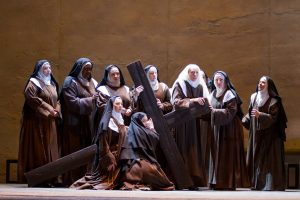
Carmelite Martyrs of Compiègne, with their scapulars on (from a play)
The Sabbatine Privilege
As if Our Lady had not done enough in promising salvation to faithful Scapular wearers, she extended her motherly protection even to Purgatory as well. No one can fully comprehend the excessive torments suffered by the holy souls during their purification for Heaven. All of the saints, however, who have ever treated of the subject agree, that they would rather suffer the cruelest tortures men have ever endured on earth than to suffer the flames of Purgatory for a single day. But the Queen of Heaven reigns also over Purgatory. In 1322 she appeared to Pope John XXII and revealed to the Vicar of Christ that she would descend into Purgatory to deliver from their agony those who had faithfully donned the Scapular of Carmel. Our Lady also made known to the Pope that her visitation to these devoted clients of her scapular would be made on the Saturday after their death, if three conditions were fulfilled.
First: The Brown Scapular of Carmel must be worn with constancy, Second: One must observe chastity according to one’s state in life, and Third: the Divine Office must be recited daily. Since this last requirement is difficult for laymen to fulfill, the Church has allowed the observance of the ordinary fasts of the Liturgical Year along with abstaining from meat on Wednesdays and Saturdays to be used in place of the Divine Office. But more recently the daily Rosary has become generally accepted as a substitution for both the Office and the fasting, with the permission of one’s Confessor.
A Safeguard…Physical and Spiritual
Our Lady’s Scapular is indeed a most powerful sacramental and its degree of efficacy depends on our faith in her intercession. Theologians distinguish between the ordinary state and the active state of investiture in the Scapular. The former is simply a passive wearing of the Scapular but the latter is an active realization of the Scapular’s power. As volumes of personal testimony in the Carmelite archives clearly show, Mary frequently offers miraculous protection to those who place their full confidence in her Scapular. Since the first Scapular miracle performed by Saint Simon Stock in 1251, innumerable wonders have been wrought with the Scapular for both the physical and spiritual good of the faithful throughout the world.
On the battlefield in France, for example, the bullet which would have killed a soldier is deflected by his scapular and leaves not even a bruise on his skin.
In Holland a Carmelite Monk throws his scapular upon surging flood waters which threaten to destroy an entire village and immediately the torrent recedes.
During a terrible draught in Spain, the holy habit of Carmel is carried in procession and the heavens previously closed up begin to shower plentiful rains.
Elsewhere, pestilence is subdued, battles won, fires extinguished, the blind regain their sight, and the crippled are cured all through the Scapular and the invocation of Our Lady of Mount Carmel.
A Scapular miracle often retold occurred on a passenger ship enroute from London to South Australia in 1845. “The King of the Ocean” had embarked in favorable weather and had proceeded on its southern course with no difficulties until it reached a notoriously turbulent part of the Indian Ocean. There, with little warning, a tornado descended upon the waters and severely damaged the ship’s sails and rigging. Tremendous waves enveloped the vessel, evoking cries of despair and pleas for mercy from those on board. One of the passengers, a Protestant Minister named James Fisher, with his wife, his two children and other passengers, climbed to the deck from the quarters below and began to pray for mercy and assistance. The raging storm, nevertheless, continued to batter the helpless barque. Then a crew member, an Irish sailor named John McAuliffe, calmly removed his scapular from his neck and making the sign of the cross with it, cast it into the sea. When but a short time had elapsed the furious tempest was calmed. Finally, a small wave splashed onto the boat and deposited the Scapular almost at the feet of the astonished sailor. Even more astonished was the Protestant Minister who was the only one who noticed the entire incident. Immediately he questioned the sailor about his little pieces of brown cloth and after a short explanation, the Reverend Mr. Fisher resolved to take the powerful Virgin of Carmel for his patroness and to accept the only Faith that acknowledges her miraculous protection, the Holy Catholic Faith. When they had safely arrived at Sydney, Australia, Mr. Fisher and his family were received into the Church and thereupon became fervent Catholics.
* * *
Saint Bonaventure, the holy Franciscan and Doctor of the Church, reminds us that “Men do not fear a hostile and powerful army as much as the powers of Hell fear the name and protection of Mary.” If, as we have seen, Mary’s heavenly garment is an extraordinary physical safeguard, what must be the spiritual protection afforded by the holy scapular? A story involving Saint John Marie Vianney stands as an exemplar of the marvelous effects the Scapular has on aiding us in our invisible warfare with hell.
It is related that a young woman who was preparing to enter religious life made her general confession to the holy Cure of Ars. As with so many of the Cure’s penitents, this girl was surprised to find that the saint clearly knew certain hidden details about her past life. A portion of their conversation is as revealing to us as it was to her.
“You remember, my child, a certain ball which you attended a short time ago?”
“Yes, Father.”
“You met a young man there, a stranger, elegant in appearance and of distinguished bearing, who at once became the hero of the fete? And you wished he would invite you to dance? You were vexed and jealous when he preferred others to you?”
“You are certainly right, Father.”
“Do you recollect that when he left the assembly you thought you saw, as he walked, two small bluish flames beneath his feet but you persuaded yourself that it was an optical illusion?”
“I remember it perfectly.”
“Well, my child, that youth was a demon. Those with whom he danced were in a state of serious sin! And do you know why he failed to ask you? It was owing to the Scapular which you did well not to lay aside and which your devotion to Mary impelled you to wear as your safeguard.”
Not enough can be said concerning the advantages of this spiritual armour which so perfectly shields us from the wiles of the wicked one. The fact to remember is how intimately identified we become with the Immaculate Mother of God when we place ourselves under her blessed mantle. We become, as it were, Mary’s personal possessions and her interest in our spiritual welfare is all that is needed to send the demons fleeing in confusion.
Enrollment
The promises of salvation and deliverance from Purgatory apply to those who die wearing either the large Scapular of the Carmelite habit, the small Scapular, or the Scapular Medal. Anyone wishing to join the Confraternity must be properly enrolled by a priest who has the faculties to do so. Most priests receive this power with the general faculties they acquire from their diocese. Those who are enrolled remain Confraternity members for life and if anyone should fail to wear the Scapular, even for an extended period, there is no need for a re-enrollment in the Confraternity. Also, new Scapulars need not be blessed if the wearer has already been enrolled. In cases of emergency, during war for instance, soldiers and sailors are officially received into the Confraternity by simply wearing the Scapular and reciting some prayers to Our Lady, such as three Hail Marys.
There are a few guidelines pertaining to the small scapular itself which should be observed in addition to the enrollment requirements.
- The Scapular must be made of woven wool.
- Its color may be any shade between brown and black, but preferably brown.
- It must be two rectangular shaped pieces of the cloth connected by cord, string, or chain.
- It must be worn over the shoulder to rest on the front and back of the body.
- It may be decorated with pictures or designs but this is not necessary.
The Scapular Medal
Early this century missionaries petitioned Rome to allow a Medal to be used instead of the cloth Scapular. Those who made this request were stationed in tropical regions and had considerable trouble preserving their Scapulars from decaying in the excessive humidity. After careful consideration, Pope Saint Pius X, in 1910, granted permission for the use of a Scapular Medal. It was to have an image of the Sacred Heart on one side and an image of Our Lady on the other and would possess the same promises and indulgences as the Brown Scapular. The Medal’s usage, however, was to be restricted. Saint Pius added explicitly to his consent that for ordinary circumstances, “I desire most vehemently that the cloth Scapulars be worn as heretofore.”
A Final Thought
So as to emphasize the importance of the Scapular of Carmel, Our Lady, on one occasion, chose to wear the Carmelite habit when she appeared to the three little children at Fatima, Portugal. This particular apparition which occurred on October 13, 1917 was her sixth and final appearance to the Fatima shepherds. It was accompanied by what has been termed the “greatest modern miracle.” For on that memorable day the 70,000 spectators who were gathered at Fatima witnessed the sun whirling in the sky like an enormous ball of fire.
Our Lady’s message at Fatima was that the world must pray, do penance, and be consecrated to her Immaculate Heart. Only when Russia is specifically consecrated to Our Lady’s Immaculate Heart by name, in accordance with Our Lady’s words to Sister Lucy, will that nation be converted and her insidious errors, including atheism, be countered. Mary’s favorite prayer is the Rosary…the penances which please her most are the little daily sufferings anyone can offer…and what better way is there to be perpetually consecrated to her Immaculate Heart than by wearing the Brown Scapular?



