

As was the last Ad Rem, this number is an edited excerpt from the talk I am soon to give at Saint Benedict Center’s annual conference.
In Chapter ten of the Commonitory, Saint Vincent considers what we should do when what he calls “a teacher established in the Church” errs against the Faith in some opinion he teaches. I would like to read to you the entirety of that brief chapter, but, for my purposes, I would like to establish a foundation that will update the concepts he spells out in it with a more developed theological lexicon. This will entail a few moments’ tangent, but we will come back to our point.
The distinction between magisterium extraordinarium and magisterium ordinarium (ordinary and extraordinary Magisterium) was first made in the Nineteenth Century. While there has long been an ambiguity in the term “ordinary magisterium,” its great champion in that century, one whose teaching very much informed the interventions of Pope Pius IX and, later, the Council of Vatican I, was the German Jesuit theologian, Father Joseph Kleutgen. Here is how Dr. John P. Joy, a contemporary American theologian, explains Kleutgen’s view of the magisterium ordinarium:
[I]t is primarily based on the distinction between the explicitly documented teaching of the Church (whether pope or bishops, whether gathered in council or dispersed throughout the world) and the implicit or undocumented teaching of the Church — that is, the teaching of the Church not found in the documents of the hierarchical magisterium, but rather in Scripture, in the liturgy, in the fathers and doctors of the Church, in the consensus of the faithful, etc.
According to Kletugen, the Church exercises a twofold magisterium: ordinary and extraordinay. The extraordinary magisterium is the judging office… of the Church. It is exercised in the act of defining or declaring the doctrine of the Church. He makes no essential distinction in this regard between judgments, definitions, declarations, determinations, or decisions of the Church. These various terms are for him merely so many ways of expressing the definitive or irrevocable nature of the Church’s judgments. The distinguishing feature of the extraordinary as compared to the ordinary magisterium lies in the explicitness of these judgments: they are visibly and tangibly enshrined in the public documents of the Church. (On the Ordinary & Extraordinary Magisterium, from Joseph Kleutgen to the Second Vatican Council, pp. 79-80)
Later, Dr. Joy further summarizes Kleutgen’s concept of the ordinary magisterium (I’m going to skip over the German terms that Joy cites from Father Kleutgen):
The ordinary magisterium is identified with the living tradition of the Church, the constant and perpetual process of handing down the faith received from the apostles. This teaching office [German] of the Church is described as the ‘ordinary and perpetual’ [German], the ‘constant and ordinary’ [German], and the ‘usual’ magisterium of the Church. The distinguishing feature of the ordinary magisterium by contrast with the extraordinary magisterium, lies in its intangibility — its teaching is something upon which one cannot directly put one’s finger. The teaching of the ordinary magisterium is that teaching of the Church that is not formulated in the documents of the Church. The teaching of this father or of that father, of this bishop or that bishop, of this or that doctor, may indeed be tangible and explicit; but only through the unanimity of their teaching are able to recognize the common teaching of the Church. (Ibid., p. 81)
Now, it is true that the term “ordinary magisterium” itself developed over time, and the warnings of some of the Fathers at Vatican I proved prophetic, that the term was too ambiguous and therefore lent itself to confusion. Nonetheless, the Council used it. As it later evolved in the first half of the Twentieth Century, the term came to include written magisterial interventions that did not rise to the level of extraordiary judgments of the Pope or the Bishops. Vatican II, interestingly and I might say wisely — without any irony — avoided the term and instead opted for “authentic magisterium,” which, when clearly understood as “merely authentic” and not extraordinary, is not per se infallible. I don’t have the leisure here to develop all these distinctions, but in Father Kleutgen’s original distinction, the ordinary magisterium was considered infallible. And why? Because it was the expression of what was always taught by the Ecclesia docens (the teaching Church) and believed by the Ecclesia discens (the learning Church). This “intangible” doctrine transmitted through the daily teaching of the hierarchy and the living of the faith is what we find when we look — and I quote Dr. Joy again — “to Scripture first of all, and then to the fathers and doctors of the Church and other eminent ecclesiastical writers, to the monuments of antiquity, to the customs, laws, and liturgies of the Church…” (p. 82). This older concept of ordinary magisterium is conceptually indistinguishable from the Vincentian Canon. It is Tradition!
It was this concept that Vatican I called “the ordinary and universal” magisterium.
With this understanding of the infallible ordinary magisterium under our belts, permit me to read the entirety of Chapter Ten of the Commonitory so that we can understand that sometimes the “merely authentic” — i.e., non-infallible — magisterium of this or that pope, this or that Roman dicastery, episcopal conference, or even this or that council can be assessed (very carefully, mind you!) in light of a higher, more deeply rooted, and more constant principle.
Why Eminent Men are permitted by God to become
Authors of Novelties in the Church.
But some one will ask, How is it then, that certain excellent persons, and of position in the Church, are often permitted by God to preach novel doctrines to Catholics? A proper question, certainly, and one which ought to be very carefully and fully dealt with, but answered at the same time, not in reliance upon one’s own ability, but by the authority of the divine Law, and by appeal to the Church’s determination.
Let us listen, then, to Holy Moses, and let him teach us why learned men, and such as because of their knowledge are even called Prophets by the apostle, are sometimes permitted to put forth novel doctrines, which the Old Testament is wont, by way of allegory, to call “strange gods,” forasmuch as heretics pay the same sort of reverence to their notions that the Gentiles do to their gods.
Blessed Moses, then, writes thus in Deuteronomy: “If there arise among you a prophet or a dreamer of dreams,” that is, one holding office as a Doctor in the Church, who is believed by his disciples or auditors to teach by revelation: well — what follows? “and gives you a sign or a wonder, and the sign or the wonder come to pass whereof he spoke,” — he is pointing to some eminent doctor, whose learning is such that his followers believe him not only to know things human, but, moreover, to foreknow things superhuman, such as, their disciples commonly boast, were Valentinus, Donatus, Photinus, Apollinaris, and the rest of that sort! What next? “And shall say to you, Let us go after other gods, whom you know not, and serve them.” What are those other gods but strange errors which you know not, that is, new and such as were never heard of before? “And let us serve them”; that is, “Let us believe them, follow them.” What last? “You shall not hearken to the words of that prophet or dreamer of dreams.” And why, I pray you, does not God forbid to be taught what God forbids to be heard? “For the Lord, your God, tries you, to know whether you love Him with all your heart and with all your soul.” The reason is clearer than day why Divine Providence sometimes permits certain doctors of the Churches to preach new doctrines — “That the Lord your God may try you”; he says. And assuredly it is a great trial when one whom you believe to be a prophet, a disciple of prophets, a doctor and defender of the truth, whom you have folded to your breast with the utmost veneration and love, when such a one of a sudden secretly and furtively brings in noxious errors, which you can neither quickly detect, being held by the prestige of former authority, nor lightly think it right to condemn, being prevented by affection for your old master.
Now, St. Vincent does not himself apply this thinking to popes or councils, but he did apply it to Origen, Tertullian, and even Saint Cyprian of Carthage, the great African bishop-martyr, who erred on the contentious issue of the “rebaptism” of heretics, and clashed with Pope St. Stephen in the matter. About this, the Lerinian writes, “On the other hand, what some saint, learned man, bishop, confessor, or martyr has individually thought outside of, or even contrary to, the general opinion, must be considered his personal, particular, and quite private opinion, entirely removed from the common, public, and general opinion.” (p. 105) He points out that there were heretics and schismatics who took such opinions with them straight out of the Church. But not all who went against the grain of what would later be called the infallible ordinary magisterium were subjectively or really schismatics or heretics. There are saints who fit this description. And so, without attempting to judge the interior forum of the clergy, I very much believe that we can apply Saint Vincent’s thinking to the novelties assailing us for several decades now from popes and bishops. It is my personal belief — confirmed in at least one approved private revelation — that a future ecumenical council will do just that in assessing and authoritatively correcting the dystopian regime of novelty the Church has been suffering under for decades.
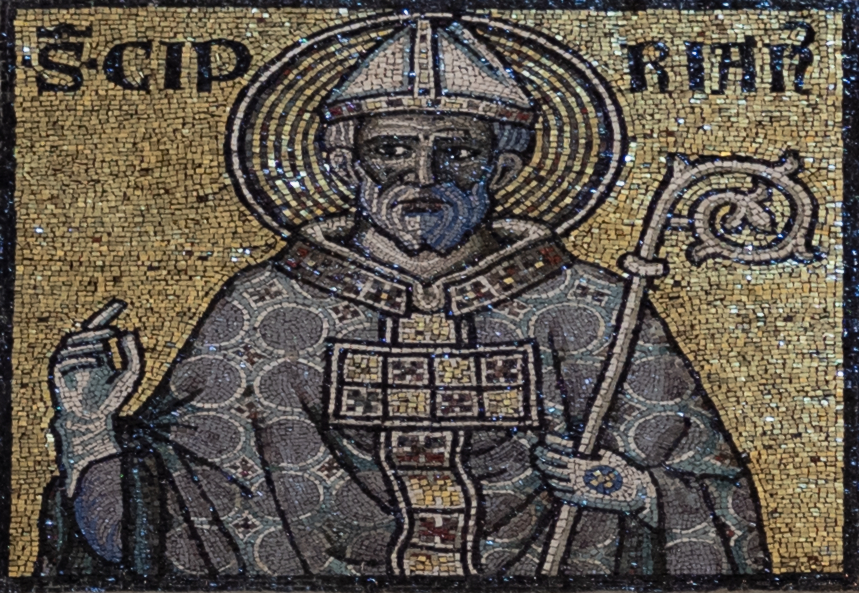
Mosaic of Cyprian the Bishop in the Florence Baptistery. Photo credits (cropped from original): SuzzaneMcg, CC BY 4.0, via Wikimedia Commons.



