UPDATE: Our handouts (see below) made their debut on Saturday afternoon, when a group of about 55 or so from our chapel stood in front of a theater to pray and protest “The Da Vinci Code.” The police showed up … Continue reading
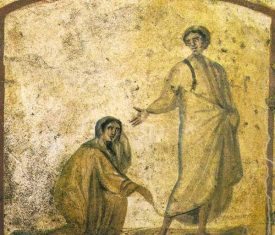
The loving woman who wipes Our Lord’s face in the sixth Station of the Cross is extra-biblical, or so most people think. But the saint, whose feast is on July 12, is thought by some to be the Haemorrhissa (woman … Continue reading
The gyrating daughter of Herodias met her death in a gruesome, winter-time danse macabre. Salome, it should be recalled, was the damsel whose shameful dancing was rewarded by Herod Antipas with the head of St. John the Baptist (Mt. 14:6-8; … Continue reading
Anyone traveling there from out of state, looking at a map, or reading a news item about Louisiana, may be surprised to see the word “parish” used as a political demarcation. After the 1803 Louisiana Purchase — arguably the best … Continue reading
Theodore Herzl (1860-1904), one of the pioneers of Zionism, had the distinction of winning Western Jews and European leaders to the cause of a Jewish state in Palestine. Toward the end of his career, he met with, among others, the … Continue reading
We English-speaking American Catholics often overlook (or are ignorant of) the accomplishments of our non-English-speaking Catholic forerunners on this continent. One such forerunner, who should be a household name to American Catholics, is St. Philip of Jesus. In 1597 — … Continue reading
The success of the First Crusade (1095-1101) brought with it the creation of the Latin Kingdom of Jerusalem, with Lord Godfrey of Bouillon as its first monarch. After Godfrey’s death, the barons invited his brother, Baldwin of Edessa, to rule, … Continue reading
The word jeremiad, meaning “a prolonged lamentation or complaint,” also, “a cautionary or angry harangue” (Merriam-Webster’s online dictionary), has its origin in the name of the Prophet Jeremias (Jeremiah). The word comes to us from the French jérémiade, which, in … Continue reading
Everyone’s heard the expression, “When in Rome, do as the Romans do.” Few, however, know that the adage owes its origin to two doctors of the Church: St. Ambrose and Saint Augustine. In the thirty-sixth of his catalogued Epistles, St. … Continue reading
The word scruple is defined by Webster’s as “an ethical consideration or principle that inhibits action.” The word came into English via the Middle English word scriple, from the Latin scrupulus , a unit of weight. Scrupulus was, in turn, … Continue reading
Leave it to a poor man to figure out how to handle money properly. The man with the august title, “Father of Accounting,” was a Franciscan Friar named Luca Pacioli (1445-1517). Born of poor parents in Sansepulcro, Tuscany, he entered … Continue reading
What do these two have to do with each other: one, a battle fought in 1456 against Moslem invaders and the other, the mystery of Our Lord’s manifesting His glory to three of His Apostles on Mount Tabor? On July … Continue reading
The Talmud, which is well known to contain many blasphemies against Our Lord and Our Lady, is an odd mixture of authentic Israelite tradition and the damnable “tradition of men . . . making void the word of God” which … Continue reading
Last year was the 700th anniversary of St. Ives, patron saint of lawyers. On May 19, 1303, Ivo Helory entered Heaven. Now known as St. Ivo, St. Yves, or St. Ives, he was a French Franciscan lawyer who often defended … Continue reading
One of the major relics of the Passion of Our Lord is the Holy Lance of Saint Longinus. While many of the faithful are familiar with the story of Saint Helen and the finding of the True Cross, that of … Continue reading
Site development: Bonaventure