
The Vatican website has posted the Address of Pope Leo XIV to Participants in the Meeting of Studies on Cardinal Rafael Merry Del Val. I recommend you read it because it is very edifying.
There are critics of the post-Vatican II regimes in the Holy See who are opposed to the very concept of papal or Vatican diplomacy, but diplomacy is not an intrinsic evil. Nor is it at all new in the life of the Apostolic See. Cardinal Merry Del Val, a worldly wise, cosmopolitan man who came from a diplomatic family, shows us that such skills are not incompatible with sanctity. (For a glimpse of that sanctity, read Professor Roberto de Mattei’s excellent piece at Voice of the Family, Cardinal Rafael Merry del Val: a perfect example of a servant of the Church.)
His Eminence gets honorable mention a few places on this site, especially in our excellent bio of Pope Saint Pius X. As Wikipedia tells us, “Rafael Merry del Val y Zulueta, OL (10 October 1865 – 26 February 1930) was a Spanish Catholic bishop, Vatican official, and cardinal.” He was Pope Saint Pius X’s Secretery of State, and would go on to become the Secretary of the Congregation of the Holy Office under Popes Benedict XV and Pius XI. (Secretary was the highest office in that dicastery then, as the Holy Father himself was its Prefect.)
Born Rafael María José Pedro Francisco Borja Domingo Gerardo de la Santísima Trinidad Merry del Val y Zulueta, he is, believe it or not, of mixed Irish, Spanish, English, Dutch, and Scottish ancestry, which somehow makes his carreer in Vatican diplomacy seem particularly apt.
Pope Leo remarked that Cardinal Merry Del Val’s “name has become associated with a prayer that many of us know, the Litany of Humility.” It was associated so cloesly, that the prayer is often attributed to him, but it appears that he merely helped to popularize a pre-existing prayer, which he may also have embellished. The Holy Father comments on several of the petitions of that Litany in his speech. Again, the speech is edifying.
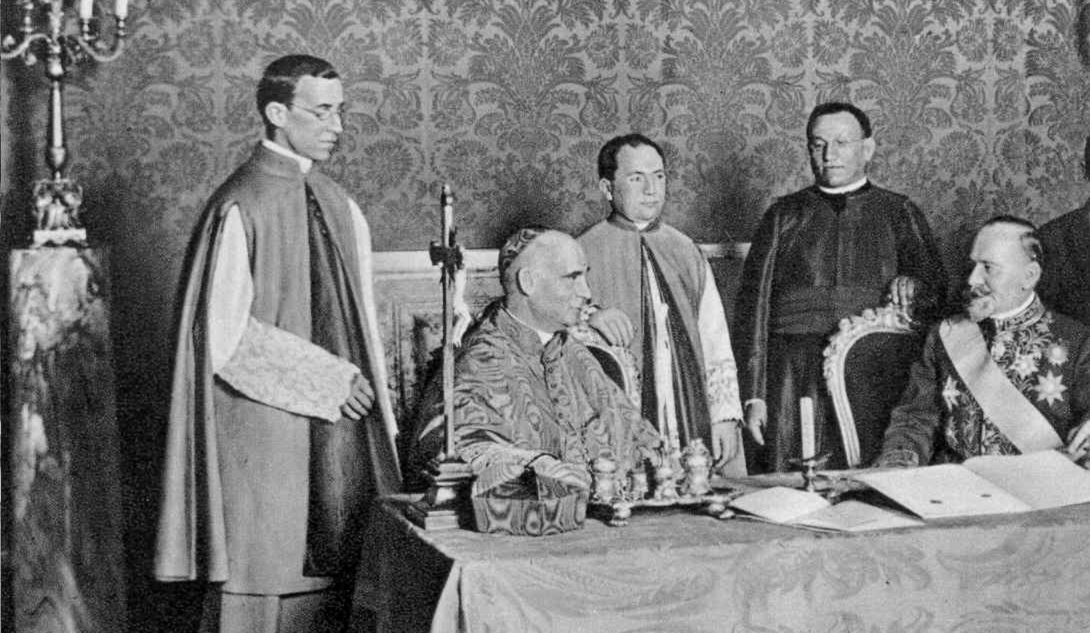
Cardinal Merry del Val and Milenko Vesnić signing the Concordat between the Holy See and Serbia on June 24, 1914 (only a few days before the outbreak of the July Crisis). Left to right: Eugenio Pacelli (the future Pope Pius XII, at this time Secretary of the Congregation of Extraordinary Ecclesiastical Affairs and true designer of the agreement), Rafael Merry del Val (Vatican Secretary of State), Nicola Canali (his private secretary), Mons. Dionigi Cardon (1865-1928, Provost of Taggia, Liguria, Vatican’s negotiator in Belgrade), Milenko Radomar Vesnić (Special Minister of Serbia). Missing on the right (cut off): Lujo Bakotić (Serbian diplomatic agent). The wall portrait shows Pope Pius X who died a few month later. The image, courtesy of Wikimedia Commons, is in the Public Domain.
Here are the opening paragraphs of the Holy Father’s address:
On the commemoration of the 160th anniversary of his birth, we give thanks to the Lord for the servant of God Rafael Mery del Val, who was born in London in 1865, in an environment in which openness to the world was part of everyday life: the son of a Spanish diplomat and an English mother, he had a cosmopolitan childhood that accustomed him from an early age to different languages and cultures. He grew up in an atmosphere of universality, which he would later recognize as the vocation of the Church, and this formation prepared him to be a docile instrument in the diplomatic service of the Holy See at a time marked by great challenges.
At a very young age, he was called to the service of Leo XIII to deal with delicate matters. Shortly thereafter, he was sent as apostolic delegate to Canada, where he worked for the unity of the Church and for Catholic education. He was a student at the current Pontifical Ecclesiastical Academy, an institution he would later preside over and which today, as it celebrates 325 years of history, recalls its long tradition of forming hearts in the faithful and generous service of the Apostolic See. There he came to understand — and to transmit by his example — that the diplomacy of the Church flourishes when it is lived within priestly fidelity, that of a heart that offers its talents to Christ and to the mission entrusted to the Successor of Peter (cf. 1 Cor 4:1-2).
He was just thirty-five years old when he was appointed titular archbishop of Nicaea, and a few years later, in 1903, at just thirty-eight, Saint Pius X made him cardinal and appointed him as his Secretary of State. His youth, however, was not an obstacle, as the history of the Church teaches that true maturity does not depend on age, but on identification with the measure of Christ’s fullness (cf. Eph 4:13). What followed was a path of fidelity, discretion and dedication that made him one of the most significant figures in papal diplomacy in the twentieth century.



