

After working in a classroom for over twenty years, I think I’m finally getting the hang of a few things. One issue that used to come up frequently and which was very difficult for me to deal with was lying — I wanted my students to stop it. I struggled for a number of years, before discovering this bit of wisdom which has really proven to be a game changer: It is much easier and more effective to teach the habit of telling the truth than to try to stop the lying. Approaching things from this angle has made a tremendous difference, and I am very grateful to report that I no longer have the same trouble with my students lying. Of course it comes up, but it doesn’t become an issue any more. When students come into my class in first grade, they usually learn how to meet my expectations for honesty by the time they reach second grade. Below are some specific strategies which may be helpful to others. And, although I have gained these insights while working with six and seven year olds, I believe many of these principals apply across a much broader age range.
We Cannot Give What We Do Not Possess
Effectiveness in teaching children to speak the truth will depend largely on the teacher’s personal habit of speaking the truth. We might think that our own small (or big) faults against honesty are unknown to the little ones that we teach, but somehow they are able to smell a liar. You can tell children that the truth is important to you, and you can even think that this is really so, but, if deep down you don’t actually appreciate the truth enough to pursue it yourself, they’ll know. Intuition and keen perceptivity to nonverbal communication make youngsters superior to grown ups in picking up on the real message, beyond whatever we adults think we are communicating. We will only be able to teach others honesty to the extent that we ourselves are honest. It’s that simple.
Getting the Facts Straight
As much as it seems perfectly reasonable to desire to get accurate information from children, it isn’t necessarily possible. Sometimes when children are afraid, angry, when they really want something, or are otherwise emotionally involved, it can be quite difficult for them to give a straightforward account of the story, especially if it is going to be self-incriminating. Adults can make the mistake of insisting on getting to the bottom of things; examining witnesses, threatening, punishing, and even bluffing about already knowing who the guilty party is, because they think it’s part of their duty to solve the mystery. Not only do such strategies not usually work, but the dogged determination to catch the liar seems to overemphasize the gravity of the matter. While there are certainly urgent situations which need to be handled accordingly, it is not every situation. For myself, it has been a helpful outlook shift to acknowledge that I simply cannot always discover the truth. This is not to say I shouldn’t try, but it is to say that trying is all I can do. I can’t force it. Understanding this has led me to be more just with my students and less scary, which has gone a long way in building a rapport of trust and honesty.
Accusing
I used to accuse children when I was sure (or almost sure) they were lying. Again, this was not an effective way to encourage honesty. When someone is caught in a lie, it is a moment of extreme vulnerability. Nobody appreciates being humiliated or blamed, and while a child may need to be confronted about dishonesty, there are ways to do this besides directly accusing him. When a child sees — when he knows — that you genuinely love him and want to help him, a gentle manner and a few questions are much more effective than an accusation.
Fear — Not an Ally
The more I have stressed the loathsomeness of lying and the punishment awaiting those who commit such a crime, the more my students have been motivated to not get caught in a lie. Although fear of negative consequences and of displeasing others is a sign of a healthy conscience, too much fear is harmful to children as they are developing. Also, we grown ups can inadvertently intimidate and scare these dear little people into a fight or flight mode when we get too worked up or angry. This does not help them or us in the work of teaching honesty. My experience has shown that a calm and gentle manner will always be more effective in encouraging openness and trust than a heated temper.
Asking Direct Questions
It is difficult for children (for all of us) to admit our mistakes and faults. They are a source of shame and embarrassment, and we fear they will cause others to be disappointed in us. It is our task as adults to make it easier, not more difficult, for children to admit their blunders. When little Susie is asked “Did you leave this here?” “Did you tell him the answer?” or “Did you take her money?” it is almost like setting her up for a lie. If we ask boys and girls to own the humiliation of some misconduct and its attendant consequences in a single word, it is just as easy for them to choose the opposite word. Generally speaking, we will get a lot further if we avoid putting little ones on the spot. For example, when I find paper towels in the toilet, instead of asking each of the boys, “Did you do this?” I might take them all into the bathroom and explain to them, “Gentlemen, I know this sort of thing can happen. It’s just an accident and nobody is in trouble. But if this happens again, please come tell me so I can take care of it. You don’t want to reach in there to fish them out, and flushing paper towels can clog the plumbing so the toilet won’t work.” It seems like a subtle strategy, but it is definitely encouraging honesty and discouraging lies.
Equating Falsehoods with Lies
Sometimes children do not know how to express themselves, and they end up uttering falsehoods, which they do not intend to be lies. A classic example of this may come up when a child insists he isn’t cheating, even though his answers clearly indicate otherwise. At a certain age a child understands that to look at someone else’s page deliberately and copy his answers is cheating. However, when his eyes accidentally fall upon a classmate’s answer and then he consequently decides to change his own answer, this does not register in his mind as cheating. If a student denies that he was cheating, his problem could be a lack of comprehension more than a lack of honesty. Experience in working with children has taught me to pause before jumping to conclusions. Is there room for a possible misunderstanding? Could the child have been trying to do something constructive and inadvertently broken the rules? If so, his denial of misconduct would be false, but not dishonest.
Tall Tales
Children don’t necessarily understand the difference between fact and fiction, or at least it is not something that every child comprehends at the same age or to the same degree. A sanguine child of seven years may have a vivid imagination which makes his ideas seem similar to reality. In his eagerness to be a part of the conversation he may contribute an anecdote that he wishes were true without fully seeing that it isn’t actually true. At a certain point I started taking time to explain these things to my students. “Sometimes we like to imagine or pretend we saw a bear, when we didn’t really see one. If I ask, ‘Has anyone ever seen a bear?’ and you never have, but you would like to see one someday, then just tell me that. Say, ‘Well, I’ve never seen one in real life, but I’ve seen one on TV, and I think it would be neat to see a live one.'” It isn’t as though this explanation automatically puts an end to all tall tales, but it seems to help make children aware of the difference between fact and fiction. As obvious as that distinction may be to us adults, a child learning to think, reason, and speak sometimes needs to have it pointed out. Another way to handle tall tales is by gently turning the conversation to a different subject. Children do pick up on subtleties.
Being on the Same Team
One thing that has been tremendously helpful to me has been learning to see the situation from the child’s point of view. If little Susie complains that Johnny kicked her, I try to assume a reasonable motive on Johnny’s part. I ask him to explain what happened, and listen patiently and sympathetically. Sometimes I am surprised to find out that little Susie was provoking and antagonizing Johnny. The point here is not to make excuses for Johnny or to let him off, but rather to show him that I love him and understand where he is coming from. When he sees that I am not just trying to catch and punish all troublesome brats, he learns to trust me. 99% of the time he takes his punishment manfully because he knows it was given in justice and not rashly or angrily. It may take time, but Johnny will want to be friends with and tell the truth to an adult who knows that he is a good boy who needs help. This can be hard to see when a child has an extensive collection of bad habits, but it’s pretty important.
Assist Children to Articulate the Truth
Because it is hard for children to admit shameful deeds, it can be helpful for an adult to give them the words to say. If it looks like a child has broken his pencil because he lost his temper, we might suggest this to him: “When we get angry sometimes, our hands get tight and sometimes they break something. Do you think that is what happened with your pencil?” He might deny it. Perhaps there is some other explanation. But sometimes he will nod his head because you have successfully expressed what he didn’t quite know how to say. Could this sort of thing turn into feeding a child convincing excuses? Maybe it could, but I have not had that problem. I have found that it helps in teaching them how to own up.
Praise Honesty
People, (even small ones,) want to be trusted. Sometimes I have had to admit to a child that I’m not sure if he is telling me the truth. They hate that. Stories can be a great way to give examples of real or fictitious children who tell the truth in difficult situations and who thereby win the confidence and trust of others. Praising children who admit their mistakes shows them that you genuinely appreciate their honesty. “Thank you for telling me,” or “Thank you for being honest with me,” are short but effective ways to encourage little ones to speak the truth.
Pray for Your Children
I save this for the end because if you take away nothing else, this is the most important tip. It seems easier for us to remember to pray for temporal things like money and material goods because we see and feel their absence more acutely. How many of us think to ask for such everlasting goods as honesty, justice, peace, love? The Holy Ghost, the Spirit of Truth, must be so delighted when we ask for precisely those things which He’s been wanting to give us all along. Could there be any more straightforward or powerful means for helping your children to learn honesty, then by asking God to grant them an increase in that virtue? I can’t think of any. Make this petition a regular one, and gradually, gently, the Sanctifier will apply the healing balm of truth to the wounds caused by lying, in our own hearts as well as our children’s.
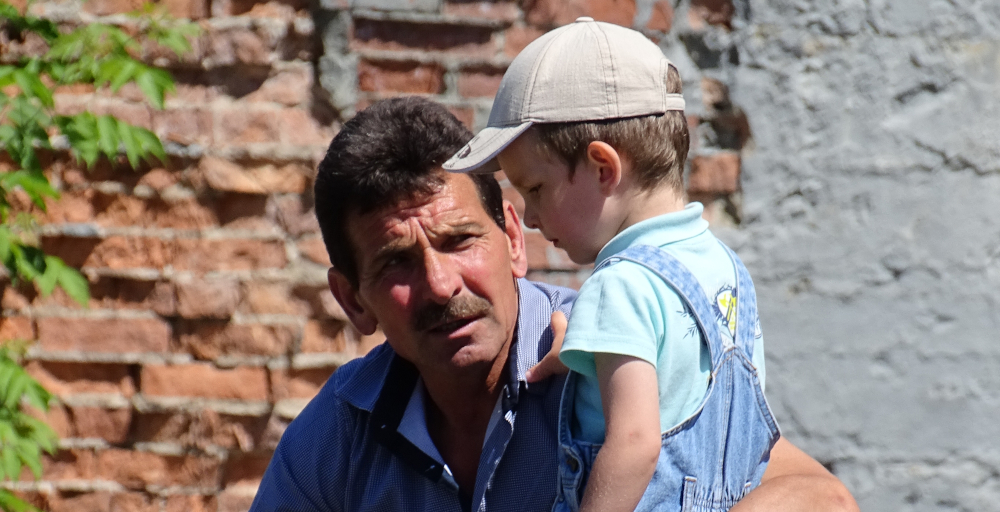
Father and Son on Tank Turret – Brest Fortress – Brest – Belarus. Photo by Adam Jones from Kelowna, BC, Canada, CC BY-SA 2.0, via Wikimedia Commons.



