

The last Ad Rem I published, Are You a ‘Roman Catholic’ or Just a ‘Catholic’?, received some constructive criticism that helped me to see that I had misread a passage of the book I was commenting on, The Iron Sceptre of the Son of Man. The resulting error in my piece was an error of fact and not one of doctrine or theology. Still, I want to rectify matters.
Under the row of asterisks, below, I have reproduced the re-written (and expanded) section where the problem appeared. Explaining the nature of my mistake would be tedious; suffice it to say that I confused the discussion of the Fathers of Vatican I on Dei Filius, with their additions to the Creed of Pope Paul IV. For the curious, the problem passage can still be seen in the uneditable email archive of the Ad Rem. (The section in question begins with the same opening words of the new version.)
That mea culpa being made, I am happy to note that the additional study my mistake and its subsequent correction occasioned was very rewarding. What I discovered, contrary to the point my constructive critic himself was trying to make, is that it is a clearly settled matter in the Magisterium that the note Roman applies not only to the particular Church of the City of Rome — of which the Pope is always the Bishop — but also to the whole Church.
It was Pope Pius XII, in two encyclicals seven years apart, who settled the matter. He did so specifically with reference to a passage in the Vatican I Dogmatic Constitution Dei Filius that Dr. Fimister discussed in some detail in his book.
Now, for my corrected and expanded discussion of Romanitas as a note of the Church in Vatican I and Pius XII:
* * * * * * * * * * * *
Lastly, and to bring us closer to the main line of Dr. Fimister’s book, before Vatican I’s Dei Filius was approved in April of 1870, there was a concern expressed by the English Bishops about the wording of the following section (particularly, what I have emphasized):
The Holy, Catholic, Apostolic and Roman Church believes and acknowledges that there is one true and living God, creator and lord of heaven and earth, almighty, eternal, immeasurable, incomprehensible, infinite in will, understanding, and every perfection.
The issue that the English Bishops had with the original wording was that reference was made to the “Roman Catholic church.” To accommodate this concern, the word Roman was deliberately moved from before the word Catholic to where it is now forever fixed, thus avoiding a problem to which Albion’s episcopacy were particularly sensitive (see below, for the “least acceptable” use of the term, Roman Catholic). In the archived discussions of the Council Fathers, it is made clear that the note Roman here is used to describe not simply the Church of the City of Rome as head of all the local churches, but to the Catholic Church as a whole; that is to say, the note Roman is proper to Christ’s whole Mystical Body.
This, by the way, is exactly how Pope Pius XII used the term “Roman Catholic” in two definitive encyclicals of his pontificate: Mystici Corporis and Humani Generis. The 1943 encyclical, Mystici Corporis, both quoting and footnoting Vatican I’s Dei Verbum, says this:
13. If we would define and describe this true Church of Jesus Christ — which is the One, Holy, Catholic, Apostolic Roman Church 12 — we shall find nothing more noble, more sublime, or more divine than the expression “the Mystical Body of Jesus Christ” – an expression which springs from and is, as it were, the fair flowering of the repeated teaching of the Sacred Scriptures and the holy Fathers.
What I have emboldened in this passage are the four “notes” of the Church as given by Vatican I’s Dei Filius. The Holy Father preceded them with the note, One, thus listing five notes of the Church: One, Holy, Catholic, Apostolic, and Roman. Footnote 12 is a direct reference to that document, so Pope Pius XII is here confirming the sense in which the Fathers of that Council used the term Roman, namely, that they applied it to the One Church of Christ.
In his 1950 encyclical, Humani Generis, Pope Pius XII refers back to Mystici Corporis, affirming that its doctrine is binding on the faithful, and using the term “Roman Catholic” as a name for the Universal Church:
27. Some say they are not bound by the doctrine, explained in Our Encyclical Letter of a few years ago, and based on the sources of revelation, which teaches that the Mystical Body of Christ and the Roman Catholic Church are one and the same thing [quae quidem docet corpus Christi mysticum et Ecclesiam Catholicam Romanam unum idemque esse]. Some reduce to a meaningless formula the necessity of belonging to the true Church in order to gain eternal salvation. …
It could not be more clear; for a pope as sensitive as was Pope Pius XII to the churches of the East that enjoy communion with the Holy See, there was no question of confusing his using the word Roman here to refer to the Roman Rite or to the Holy See itself, as if the particular Church of the City of Rome were somehow the full extent of the Mystical Body of Christ. No, he is applying the note Roman to the whole Mysitical Body, i.e., to the Universal Church.
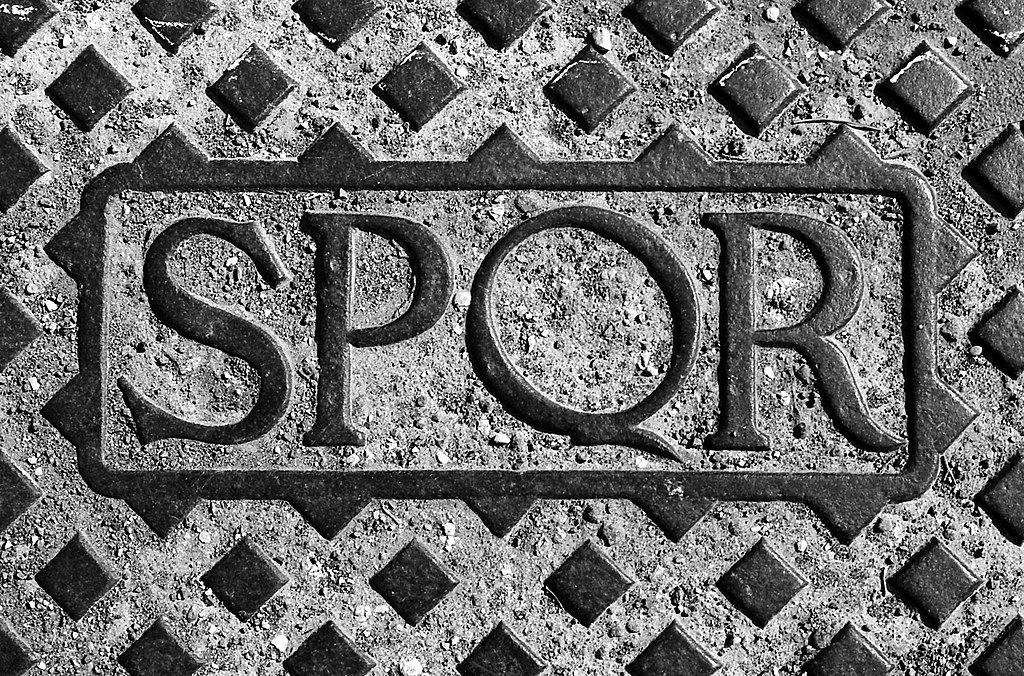
Manhole cover (Detail) in Rome with the letters SPQR (Latin: Senatus PopulusQue Romanus). © Heinrich Stürzl / Wikimedia Commons / CC BY-SA 4.0



