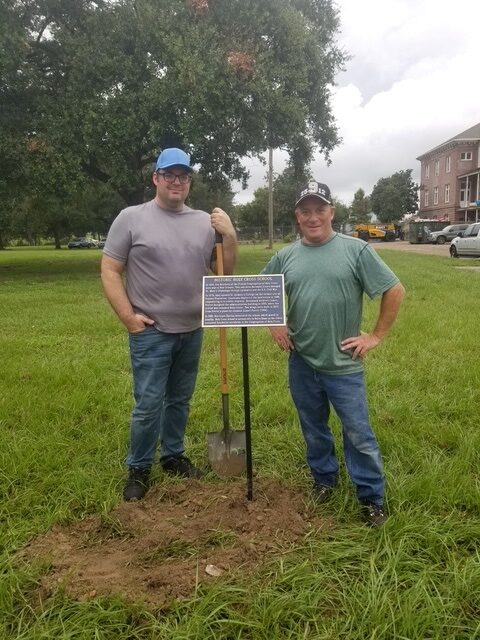
This is an interesting bit of New Orleans Catholic lore. An historic plaque was placed on the grounds of the old Holy Cross campus at 4950 Dauphine Street in the Crescent City, an area known as the “lower ninth ward.” (Based upon a message I received from an old band director at the school, I am led to believe that the plaque is recently placed there.) There is a personal connection for me as this is the school from which I graduated (1988), as did my father before me (1954), two uncles, both my older brothers, and some other relatives.
Holy Cross was established and, until the last twenty years or so, run by the Congregation of Holy Cross, a religious institute founded in the nineteenth century by the saintly Canon Basil Antoine Marie Moreau, who is now a Blessed of the Church. (Saint André Bessette, C.S.C. and Father Patrick Peyton, C.S.C., were, respectively, a brother and a priest of the congregation). When I was at this boys-only Catholic school, there were more lay teachers than religious, but there were still Holy Cross Brothers in the classroom, and the Brothers’ residence was right on our campus, being renamed “Blessed Brother André Hall” after Frère André’s beatification in 1982.
Hurricane Katrina destroyed the old campus, the lower ninth ward being particularly devastated when the levee was breached. The school administrators had already been considering relocating as the demographic shifts in the city were becoming more and more unfriendly to the institution’s flourishing. Its distance from the neighborhoods where a considerable portion of the student body came from was something of a local legend. Some of us drove past other Catholic schools in order to get there. The school turned this inconvenience into a funny PR campaign in my day, coming out with a bumper sticker that read, “Holy Cross: It’s worth the ride.”
Naturally, this irked some non-Holy Cross people. And back in those days, the Catholic school football league was highly competitive (as were basketball, wrestling, etc.), and there were some deep seated rivalries between the city’s far-flung Catholic schools, some of which were diocesan, but many of which were technically private schools run by religious congregations, as was Holy Cross. (Our big nemesis was Jesuit, to which many of my cousins went, thus assuring vigorous conversations at family gatherings.)
Thanks to Katrina, though, “the ride” was made shorter for many, as the school was relocated to the Gentilly section of the city. A replica of the historic “administration building” was built 150% the size of the original — the architectural work being done by Holy Cross grads — and the much larger campus that surrounds it is big enough and its facilities grand enough to be the envy of many a small Catholic liberal arts college. The New Orleans symphony used to use the gym for rehearsal, or so I was told when I toured the new campus about ten years ago when I happened to be in the area to give a talk.
The Katrina-ravaged original campus sits in ruins looking abandoned and desolate, like a brick ghost on the Mississippi.
Here is the text of the plaque, and below that is a photo of it:
HISTORIC HOLY CROSS SCHOOL
In 1849, five Brothers of the French Congregation of Holy Cross were sent to New Orleans. They and three Marianite Sisters managed St. Mary’s Orphanage through epidemics and the U.S. Civil War.
In 1879, they opened St. Isidore’s College on the former site of the Reynes Plantation. Louisiana chartered the institution in 1890, empowering it to confer degrees. Renowned architect James Freret designed the administration building in 1895, the school was renamed Holy Cross. Two wings were built in 1913 from Freret’s plans by alumnus Lionel Favrot (1914).
In 2005, Hurricane Katrina devastated the school, which moved to Gentilly. Holy Cross School is second only to Notre Dame as the oldest sustained foundation worldwide in the Congregation of Holy Cross.