
In my most recent Ad Rem, On the Boy Jesus and the Doctors of the Law, I did something I rarely do. I quoted from the Talmud. Someone on social media took exception to my doing so, and I explained that I was not citing that work as an unimpeachable source of religious truth, as should be obvious in the context of my citations. Apparently, because I did not include a blistering critique of the Talmud, the gentleman thought my sourcing of it was “ambiguous,” which I do not believe it was.
Rather than fume and boil because someone criticized my work, I would rather shed light on the matter, which is my purpose in writing this brief apologia for using the Talmud as a source.
The first point that needs to be made is that approved and excellent Catholic sources cite this work. For instance, when I was writing the article in question, I consulted the Life of Christ written by the very anti-Modernist Catholic Scripture scholar, Abbot Giuseppe Ricciotti. The learned Abbot cited the Talmud in his work to explain the Rabbinical traditions germane to certain episodes in Our Lord’s life. But Abbot Ricciotti is by no means unique among orthodox Catholic commentators. The Jesuit scripture scholar, Cornelius a Lapide, cited the Talmud in his highly acclaimed Great Commentary (cf. this PDF of his commentary on St. Matthew, in which the terms “Talmud” and “Talmudists” may be searched), as did the great Franciscan “Apostolic Doctor,” St. Lawrence of Brindisi, who knew both Hebrew and Aramaic (see here and here).
It would be a fulfilling research project to find and document other such Catholic commentators who cite the Talmud, but time does not permit me to undertake that project now.
The reason approved Catholic sources cite the Talmud is simple: While it contains much that is blasphemous and offensive to sound morals, the Talmud also has some very useful information. But don’t take my word for it; here is the testimony of the famous ex-Rabbi, Monseur David Paul Drach, an expert in the Talmud (note the section I have put in bold):
Talmud (more correctly Thalmud) . . . is a Hebrew word used by the Rabbins to signify ‘doctrine’ or ‘teaching.’ It designates more particularly the great body of doctrine of the Jews, to which the greatest doctors in Israel have successively contributed at different epochs. It is the complete civil and religious code of the synagogue . . . The judicious reader of the Talmud is often saddened by the presence of many of those strange aberrations into which the human mind falls when bereft of the true faith, and very frequently the baseness of rabbinical cynicism makes him blush for shame. The Christian also is horrified by the insane and atrocious calumnies which the impious hatred of the Pharisees hurls at everything he holds sacred. Nevertheless, the Christian theologian discovers useful data and precious traditions for the explanation of many difficult texts of the New Testament as well as for the purpose of convincing our religious opponents of the antiquity no less than of the holiness of Catholic teaching . . . [The quote is excerpted from The Kingship of Christ and the Conversion of the Jewish Nation by Father Denis Fahey. This passage may be found online here, along with other material relevant to our subject.)
Given this mixture of the good and bad, the useful and the horrible, the Talmud has a certain two-fold value. The former can be used by the Christian exegete to defend orthodoxy and the continuity of religion; the latter can, by contrast, be used both to show the terrible doctrinal and moral consequences of rejecting the Savior, and to illustrate how precisely right it was of Our Lord to condemn the false traditions of the Pharisees, which eventually developed into the written Talmud.
According to those who revere it as a religious text, the Talmud is supposed to be the written codification of an alleged oral law given to Moses on Mount Sinai, being passed down from Moses to Joshua to the seventy elders, then to the prophets, and finally to the Great Sanhedrin, who kept the law as an oral tradition. Of course, there was an authentic Jewish oral tradition, and this fact provides excellent apologetical arguments against the heresy of Sola Scriptura (for one specific argument regarding Jewish oral tradition, see here). But the Talmud is a hodgepodge of those genuine Old-Testament oral traditions, and that false tradition Jesus Himself roundly condemned for “making void the word of God” in Mark 7:13 (cf., Matt. 15:3-9).
At the time of our Lord, the Talmud was only an oral tradition, but from the second to the sixth centuries, it was written down, in order to preserve it faithfully.
Again, here is Catholic convert and Talmudic Scholar, David Paul Drach:
The Talmud is divided into the Mischna, … which forms the text, and the Ghemara, which is the commentary and development of the text. The Ghemara is twofold, comprising both the Commentary of Jerusalem and the Commentary of Babylon… In the Ghemara, there are at least a hundred passages which are insulting for the memory of Our Adorable Saviour, the more than angelic purity of His holy Mother, the Immaculate Queen of heaven, as well as the moral character of Christians, whom the Talmud represents as practicing the most abominable vices. There are also passages which declare that the precepts of justice, equity and charity towards one’s neighbor do not bind where Christians are concerned: nay more, they even go so far as to condemn as guilty of crime anyone who observes these precepts in his relations with his Christian neighbors. The Talmud expressly forbids a Jew to save a non-Jew from death or restore to him his lost possessions, etc., or to take pity on him. The Rabbins declare also: ‘Since the life of an idolator is at the discretion of the Jew, a fortiori his goods.’
When Drach mentions “passages which are insulting for the memory of Our Adorable Saviour, [and]… His holy Mother,” he very chastely refers to things so shocking that we cannot repeat them.
I hope this serves to clarify both where I stand on the Talmud and why it is good and useful for orthodox Catholic exegetes to cite this work.
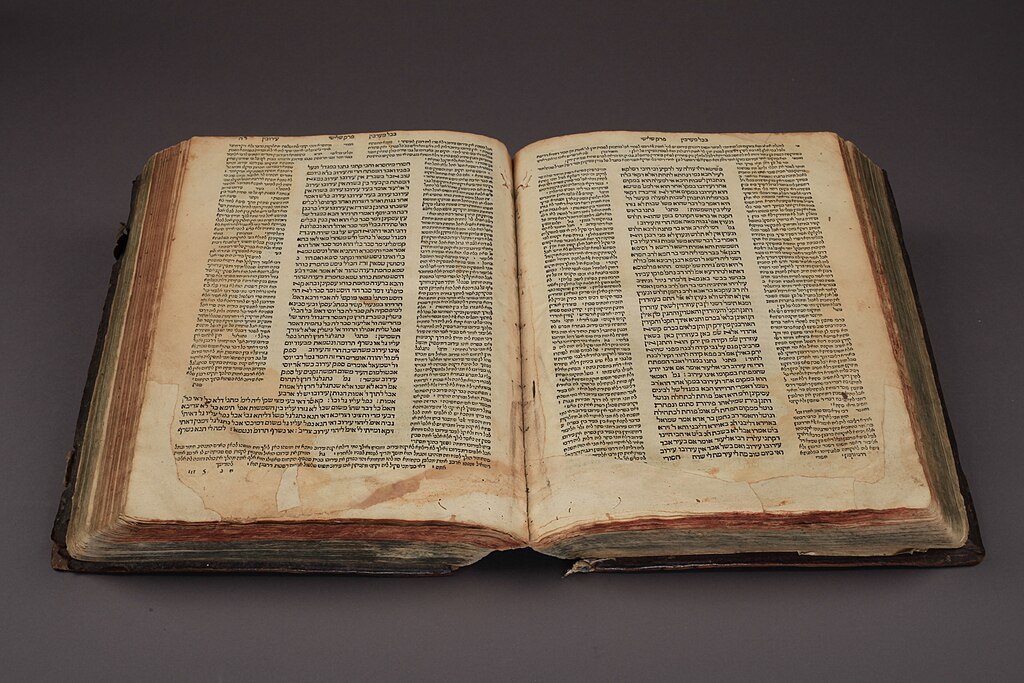
The Talmud on display in the Jewish Museum of Switzerland in Basel, which brings together parts from the first two Talmud prints by Daniel Bomberg and Ambrosius Froben. Image source: LGLou, CC BY-SA 4.0, via Wikimedia Commons.



