

When St. Louis Marie de Montfort set out to fire the world with enthusiasm for Total Consecration to Jesus through Mary, he was careful to establish that this devotion was in keeping with Tradition. Holy Slavery, argues this great Marian apostle, “is a secure way because [it] is not new” (TD #159). He cites a Fr. Boudon whose scholarship, dating the practice of Total Consecration as more than 700 years old, bore witness to the different Popes who had approved of it, the theologians who had examined it, the persecutions it had undergone and overcome, and the thousands of persons who had embraced it, without any Pope ever having condemned it. “Indeed,” St. Louis Marie concludes, “we cannot see how it could be condemned without overturning the foundations of Christianity” (cf. TD #159-163).
It was obvious to St. Louis Marie that, as he was but promoting a holy means of renewing one’s baptismal promises, there was absolutely nothing in his essential teaching that stood in contradiction to faith or morals or even approved pious customs. But he also knew that what was obvious to him would not be obvious to all. This particular form of Marian devotion, while not unheard of, was also not widely heard of at the turn of the eighteenth century. And when Catholics have not heard of a thing, it is — ipso facto — suspect. This is as it should be.
The Novelty of the Little Way
Oddly enough, St. Therese of Lisieux was unconcerned that she had not received “her doctrine” of Spiritual Childhood through anyone else’s explicit teaching. When asked where she had learned the Little Way, she replied, “Jesus alone. No book, no theologians taught it to me, and yet I feel in the depths of my heart that I possess the truth” (CSDST, 18).
Remarkable words! To think that the “greatest saint of modern times” could not — or did not — point to a single Father or Doctor of the Church, not one other saint or theologian, living or deceased, as having held and practiced her particular method of spirituality is simply astonishing. But that she was in no wise daunted by this seeming lack of support from Tradition is even more so. “It is all in the Gospels,” she said with a confidence that might well strike us as over-confidence.
Just how new Therese’s teaching was remains a debated point. Some authors, such as the Carmelite Fr. Eugene McCaffrey (d. 2021), proclaim her as a saint who, “forging her own way to God, mapped out a path for others to follow and impressed her own creative genius on a fresh and original expression of the Christian message” (DLW, 18). Others, such as Msgr. P.E. Hallet (d. 1948), patently deny the presence of any novelty at all: “There is nothing new about the Little Way; it is the way of the saints, it is the way of Our Lady, it is the way of the Gospels. Its characteristics are humility, trust, constant self-sacrifice, simplicity, and love. What saint has ever gained his crown in any other way?” (RST, 9). Last of all, there are those who remain perplexed on this point, as is evidenced by the words of Rev. François Jamart, OCD, author of The Complete Spiritual Doctrine of St. Therese of Lisieux, who wrote, “Therese has been given to us by God to teach us a new way of holiness” (CSDST, 234), but then thirty-seven pages later came out with: “Therese did not…teach a new means for attaining perfection” (ibid., 271).
So much for outside opinions. Let us hear the little saint speak for herself. “It is impossible for me to grow bigger,” she famously wrote, “so I must put up with myself as I am, with all my countless faults. But I will look for some means of going to Heaven: a little way which is very short and very straight, a little way that is quite new” (SS, 140). She understood her way to be so new, in fact, that she “told her novices that if she found she was wrong about her ‘Little Way,’ she would make sure they ceased to follow it” (SS, 214). Just the opposite occured. “On January 16, 1910, she appeared to the prioress of the Carmelite convent in Gallipoli in Italy and told her, ‘My way is sure, and I was not misguided in following it’” (ibid.).
Her Little Way was so new that it might very well have cost her her canonization. According to St. Therese’s sister Celine (Sr. Genevieve):
When the promoter of the faith asked me at the canonical process: “Why do you desire the beatification of Sister Thérèse of the Child Jesus?” I answered that it was solely that her Little Way might become known to the world. I spoke of it as a “Little Way” because the saint had consistently used this expression when referring to that particular road along which she was traveling to union with God. It was, what we might call, the symbol of her school of spirituality.
The promoter of the faith warned me, however: “Once you begin to speak of a special Way, the Cause is infallibly doomed; innumerable cases on record bear abundant witness to that.”
“That is indeed too bad,” I replied, “but a fear of hindering the beatification of Sister Thérèse could never deter me from stressing the only important point that interests me — that her Little Way might be raised with her, so to speak, to the honors of the altar.”
So I held out; nor did the cause suffer as a result. In fact, everything relating to the process began to move so rapidly that it was only a few years later that the decree on the heroicity of the virtues of Sister Therese was promulgated by the Sovereign Pontiff, Benedict XV. On that day, August 14, 1921, when His Holiness in his discourse officially raised the Way of Spiritual Childhood to its exalted rank in the life of the Church, my joy reached heights never again attained, not even on those other memorable days when my little sister Thérèse was first beatified and then canonized by Holy Mother Church. (LC, 212)
With the clearness of vision afforded by hindsight, we know, of course, that St. Therese did “possess the truth”. The Church has long since examined her writings, scrutinized her life, consulted her intimate companions, marveled at her delivered-as-promised shower of roses, and pronounced “her doctrine” to have been indeed Heaven-sent, an organic development of Catholic thought, perfectly in sync with Sacred Tradition despite its apparent novelty. But that she knew it herself with such assurance is a fact that begs for closer consideration.
Novelty: Its Connotation and Denotation
“Novelty” is not a happy word for many Catholics. Struggling to keep their bearings in the aftermath of Vatican II, they naturally associate it with the smorgasbord of post-conciliar innovations dished up in the 1960’s: “…a new rite of Mass, a new liturgical calendar, new sacramental rituals, a new ecumenism, a new rapprochement with non-Christian religions, a new ‘dialogue with the world,’ a new rule of life in seminaries, priestly orders, and convents; a ‘new evangelization,’ and even a ‘new theology’” (GF, 29). That which was presented as sweet, turned out to be most bitter. As then-Cardinal Ratzinger admitted in 1984: “The results of the Council seem cruelly too have contradicted the expectations everybody had, beginning with John XXIII and Paul VI…. [W]e have been confronted instead with a continuing process of decay that has gone on largely on the basis of appeals to the Council, and thus has discredited the Council in the eyes of many people” (GF, 33).
It has an awful connotation, yes; however, novelty by definition is a neutral term, not a negative one. It means something new, and we know very well that not everything new is execrable, not even with regards the True Faith. Far from it.
Our Lord Himself worked “new” miracles, such as had never even been heard of before (cf. Jn. 9:32); He gave us a New Commandment and established a New Covenant superseding that which had been in place for 1,500 years prior to His coming. His fulfillment of the Law and the prophets resulted in the institution of a new priesthood, a new rite of worship, and a new mandate to go and teach all nations not the sacrosanct traditions of the patriarchs and the prophets, but the life-giving challenge of the Son of God to Whom had they all pointed. That the Jews had been custodians of the True Religion, none can doubt. But they had it only in a preparatory form. For when He came Who was to come, behold, He made all things new.
The point here is not that, having Christ as our Divine Examplar, we are free to follow His example and institute — or justify — changes that drastically alter the external practice of the God’s Religion. As Christians, rather “it is our duty, not to lead religion whither we would, but rather to follow religion whither it leads; and that it is the part of Christian modesty and gravity not to hand down our own beliefs or observances to those who come after us, but to preserve and keep what we have received from those who went before us” (CSVL #16). The point is that error is to be identified as such not on account of its newness, but on account of its being contrary to the Deposit of Faith. Explaining St. Paul’s admonition to St. Timothy to guard this deposit and shun profane novelties of words, St. Vincent of Lerins says,
Profane novelties of words [are] doctrines, subjects, opinions, such as are contrary to antiquity and the faith of the olden time. [I]f they be received, it follows necessarily that the faith of the blessed fathers is violated either in whole, or at all events in great part; it follows necessarily that all the faithful of all ages, all the saints, the chaste, the continent, the virgins, all the clergy, Deacons and Priests, so many thousands of Confessors, so vast an army of martyrs, such multitudes of cities and of peoples, so many islands, provinces, kings, tribes, kingdoms, nations, in a word, almost the whole earth, incorporated in Christ the Head, through the Catholic faith, have been ignorant for so long a tract of time, have been mistaken, have blasphemed, have not known what to believe, what to confess. (CSVL #61)
Holding Fast to Truth
By its nature the True Religion consists of God revealing and man receiving, God speaking and man listening, God decreeing and man conforming. We are saved by grace through faith, “and,” says St. Irenaeus of Lyons, “faith is given by Truth, since faith rests upon reality: for we shall believe what really is, as it is; and, believing what really is, as it is forever, keep a firm hold on our assent to it. Since, then, it is faith that maintains our salvation, one must take great care of this sustenance, to have a true perception of reality” (PAP, 49). We are in possession of Truth when our minds conform to reality, the reality that is itself a conformity to God’s mind. Which is to say, Truth can no more be invented by the human intellect than can reality itself.
Thus, knowing by divine faith that all those things which are needful for our salvation were, in fact, given to the Apostles to be bequeathed to all Christians as our spiritual patrimony in Christ, we are right to look with wariness on any teaching, any formula, any opinion or practice which appears to spring up in the present without a clear precedent in the past; this being, of course, a perfect definition for novelty in a theological context: a thesis which is lacking in support from the Fathers or Doctors of the Church, or from her most eminent theologians — not that it might not be true, rather merely suspect on account of a rightful bias in favor of Catholic Tradition.
We ought to suspect any such thesis, but we need not automatically condemn it, for, though all heresy is novel, it does not follow that all novelty is heretical. So the question becomes: how are we to distinguish between the novelty that is innocent (such as St. Louis Marie’s writing of his own Act of Consecration and introducing the “new” practice of a thirty-three day preparation period) and the novelty that is noxious? How are we to know when we are faced with a dangerous innovation or a pious elucidation, such as those given by the saints and holy theologians when they share with us the fruits of their contemplation of the divine mysteries? To answer these questions, we must have a good grasp of the nature and limitations of the development of dogma, something which very much comes into play in our present investigation of Theresian spirituality.
Truth: A Thing Real and Alive
It might be argued that defined Church teachings cannot develop in any way, since development necessitates change, and we know that Truth cannot change. But let us define our terms.
Ontological truth — the conformity of reality to the mind of God — can in nowise change because it can never cease to be relational to that which is supremely, unalterably, and immutably real. Truth, then, is real because God Himself is real; Truth cannot cease to be true any more than God can cease to be God. Neverthless, Truth, and its correlary, Tradition — by which is meant Truth as revealed and passed down in teaching and embodied in practice through the centuries — “is not merely an assemblage of doctrines, but a living thing” (TLM). But that which is alive manifests its living-ness by growth, assimilation, and reproduction. So, too, the body of Divine Truth must grow, it must assimilate, and it must be fruitful. This it most certainly does, as we shall see presently.
Another illuminating, albeit mysterious, perspective on this matter is that “Christian truth is something more than an abstraction that can be expressed in the form of theorems and theses. Before all else, that Truth is Jesus Christ, and Jesus Christ teaches it not only by His words, but simply by being Himself” (TWC, 41). Truth is a Person. Truth is He Who said, I am the Truth; therefore, to seek Truth, is to seek Christ; to guard and promulgate Truth is to guard and promulgate Christ; and this, we know, is precisely the work of His Church.
The mystery deepens still further when we recall that the Church is herself His own Body, the mystical extension of Himself through time and space. What shall we conclude, then, but that not only shall there be, as St. Augustine says, one Christ loving Himself — but, by our uniting ourselves to the Truth that is our God and Savior, there shall be one Christ manifesting Himself, explaining Himself, developing Himself, and reproducing Himself in souls. Truly, we can no more deny that truth is alive than we can deny that Our Lord is alive.
And, if alive, then bound to grow.
The “Growth” of Truth
Msgr. Robert Hugh Benson defines growth to be, “the unfolding of interior capacities through the assimilation of external substances” (BCQ, 272). We see right away that development implies growth and vice-versa. A living thing that is growing cannot grow into something that it is not, something contrary to its nature. An acorn will never sprout into a cactus. So, too, with Church doctrine. Never can it “develop” in such a way as to deny or contradict what was previously known by divine and catholic faith to have been true. If this appears to happen — say, in the now-popular affirmation that God has positively willed in the world a diversity of religions — then what we have is not a case of organic, natural growth of the body, but of a malignant growth in or on the body, such as is caused by contagion or cancer. It is the growth of a disease, novel in its unnaturalness and inimical to the wellbeing of the organism whose vitality it ravages without pity.
For the Belgian Jesuit, Fr. Emile Mersch, whose insights will appear throughout this piece, it is as true for the Church herself as it is for individuals that —
Christian dogma has its life and its power of growth within; it makes use of human causes, but it is not their toy. It lives because it is divine truth, because it is Christ, ever communicating Himself more fully as light and knowledge. It lives because, being transcendent truth expressed in human concepts, it is ever more beautiful than anything we can say of it, so that as our knowledge grows, we realize that it must still be studied more profoundly. (TWC, 212)
That God’s hand is to be seen in the genuine development of doctrine is a thing both beautiful and consoling. The Vatican I document Constitutio de Fide Catholica assures us: “When reason, enlightened by faith, seeks earnestly, piously, and calmly, by God’s gift it attains some understanding of mysteries, and indeed a most fruitful understanding: partly from analogy with truths it knows naturally, partly from the relations of the mysteries with one another and with man’s last end” (TMB, 3).
God guides Tradition with a patient and long-suffering hand. With one act, though after a long preparation, He had given us the whole truth by giving us His Son. But when there is question of bringing men to grasp fully the splendor of His message, He could not proceed so rapidly, unless He were to dispense with our cooperation or to do us violence, so to speak. This in His goodness He refuses to do. Before men can appreciate all the light that came to them when they received Him Who is Light; before they can express to one another the full significance of the words they heard when they received the Word, time — much time — is necessary, even though we have God’s assistance. (TWC, 306)
A Theological Summary
Wishing to give the reader as clear a picture as possible of the ideas presented thus far, we appeal to the technical wording of the theologian Dr. Ludwig Ott. His brilliant summary in the opening pages of The Fundamentals of Catholic Dogma (see pages 6–8) is worth excerpting at length:
– The Immutability of Dogmas. The ground for the immutability of dogmas lies in the Divine origin of the Truths which they express. Divine Truth is as immutable as God Himself: The truth of the Lord remaineth forever (Ps. 116:2). Heaven and earth shall pass away: but My word shall not pass (Mk. 13:31).
– Heretical Notion of the Development of Dogmas. The Liberal Protestant concept of dogma, as well as Modernism, assumes a substantial development of dogmas so that the content of dogma changes radically in the course of time. Modernism poses the challenge: “Progress in the sciences demands that the conceptions of the Christian teaching of God Creation, Revelation, the Person of the Incarnate Word, Redemption, be remoulded” (cf. Denz. 2064). […] The Vatican Council condemned Anton Gunther’s (d. 1863) application of the idea of development in this sense to dogmas as heretical: “If anybody says that by reason of the progress of science a meaning must be given to dogmas of the Church other than that which the Church understood and understands them to have let him be anathema” (Denz. 1818).
– Development of Dogmas in the Catholic Sense. From the material side of dogma, that is, in the communication of the Truths of Revelation to humanity, a substantial growth took place in human history until Revelation reached its apogee and conclusion in Christ (cf. Heb. 1:1) St. Gregory the Great says: “With the progress of the times the knowledge of the spiritual fathers increased; for in the science of God, Moses was more instructed than Abraham, the Prophets more than Moses, the Apostles more than the Prophets.” As to the formal side of dogma, that is, in the knowledge and in the ecclesiastical proposal of Revealed Truth, and consequently also in the public faith of the Church, there is progress (accidental development of dogmas) which occurs in the following fashion:
1) Truths which formerly were only implicitly believed are expressly proposed for belief. There was an increase in the number of articles believed explicitly since to those who lived in later times some were known explicitly which were not known explicitly by those who lived before them.
2) Material dogmas are raised to the status of formal dogmas.
3) To facilitate general understanding, and to avoid misunderstandings and distortions, the ancient truths which were always believed, e.g., the Hypostatic Union, Transubstantiation, etc., are formulated in new, sharply defined concepts.
4) Questions formerly disputed are explained and decided, and heretical propositions are condemned. The exposition of the dogmas in the given sense is prepared by theological science and promulgated by the Teaching Authority of the Church under the direction of the Holy Ghost (Jn. 14:16). These new expositions of dogmatic truth are motivated, on the one hand, by the natural striving of man for deeper understanding of Revealed Truth, and on the other hand, by external influences, such as the attacks arising from heresy and unbelief, theological controversies, advances in philosophical knowledge and historical research, development of the liturgy, and the general assertion of Faith expressed therein.Even the Fathers stress the necessity of deeper research into the truths of Revelation, of clearing up obscurities, and of developing the teachings of Revelation. See the classical testimony of St. Vincent of Lerins (d. before 450). “But perhaps someone says: Will there then be no progress in the religion of Christ? Certainly there should be, even great and rich progress…only, it must in truth be a progress in Faith and not an alteration of Faith. For progress it is necessary that something should increase of itself; for alteration, however, that something should change from one thing to the other” (Commonitorium, Ch. 23).
In reference to the argument posed above: we affirm that Truth can never change into untruth. However, we deny that it cannot legitimately develop in accordance with its nature, for without this growth, it would cease be a living thing. Thus, St. Vincent argues,
The growth of religion in the soul must be analogous to the growth of the body, which, though in process of years it is developed and attains its full size, yet remains still the same. There is a wide difference between the flower of youth and the maturity of age; yet they who were once young are still the same now that they have become old, insomuch that though the stature and outward form of the individual are changed, yet his nature is one and the same, his person is one and the same. An infant’s limbs are small, a young man’s large, yet the infant and the young man are the same. Men when full grown have the same number of joints that they had when children; and if there be any to which maturer age has given birth these were already present in embryo, so that nothing new is produced in them when old which was not already latent in them when children. This, then, is undoubtedly the true and legitimate rule of progress, this the established and most beautiful order of growth, that mature age ever develops in the man those parts and forms which the wisdom of the Creator had already framed beforehand in the infant. Whereas, if the human form were changed into some shape belonging to another kind, or at any rate, if the number of its limbs were increased or diminished, the result would be that the whole body would become either a wreck or a monster, or, at the least, would be impaired and enfeebled.
In like manner, it behooves Christian doctrine to follow the same laws of progress, so as to be consolidated by years, enlarged by time, refined by age, and yet, withal, to continue uncorrupt and unadulterate, complete and perfect in all the measurement of its parts, and, so to speak, in all its proper members and senses, admitting no change, no waste of its distinctive property, no variation in its limits. (CSVL #55,56)
The Devotional and Doctrinal “Assimilation” of Truth
Truth not only can but must develop; however, this development must be the natural, well-ordered growth of the one Christ knowing Himself. Now, just as a living organism progresses towards maturation by means of the food it assimilates, so God’s Truth can be said to grow by the assimilation of the myriad manifestations of “newness” that the Church has weighed, measured, and found beneficial. When she approves new practices of piety, we might call this “devotional assimilation”; whereas, her approval of new terms or formulae to express more clearly ancient teachings, we may call “doctrinal assimilation.”
When she approved the pillar of St. Simon Stylites; when she consecrated the Pantheon to the Queen of Martyrs; when she canonized St. Francis of Assisi and devoted a liturgical feast to his Stigmata, and exonerated the Maid of Lorraine and her “voices,” the Church established the precedent for future ages that this method, this charism, this individual is worthy, if not of imitation, at least of veneration. Such approvals took time, and the saints often suffered much in the interim. St. Teresa of Avila was accused of being novel when she founded San Jose, her first convent of the Carmelite Reform, declaring that it would be 100% dependent on the alms of others for its sustenance (cf. STA, 229-236). St. Margaret Mary Alacoque, too, was censured by her superiors for the novelty of having set up an image of the Sacred Heart — the first of its kind — in the novitiate and encouraging the novices to carry out their devotions before it (cf. ASM, 108). Truly, each new infant the Church baptizes, every new saint she enrolls in her catalog of the blessed, each new religious community that she enfolds in her bosom, is the Church’s way of solemnly recognizing God’s gift to her; she accepts them as does a bride accepting food or medicine or outward adornment from the hands of her devoted spouse, growing thereby in health and strength and beauty, and in wisdom and grace before God and men.
So, too, the Church’s acceptance (even after much debate) of the orthodoxy of new words like consubstantial and Transubstantiation, is her acknowledgment that, “Truth,” as Josef Pieper says, “cannot be exhausted by any (human) knowledge; it remains therefore always open to new formulation” (SST, 103). Fr. Mersch does not hesitate to use the word “novel,” when speaking of how St. Paul employed the concepts of Head and members to describe the mysterious relationship of Christ with His Mystical Body. His statement was by way of observation, not accusation. He points out that the analogy of the human body hardly appears in St. Paul’s greater epistles, but only later in the epistles of captivity, thereby showing that the Apostle’s thinking itself developed over time. Fr. Mersch also talks about St. Irenaeus’ “theory” of recapitulation; of St. Hilary of Poitiers’ efforts to reclaim the word gnosticism for the side of Catholic orthodoxy; of St. Thomas’ “theory” of the integral relations between the individual grace, the principal grace, and the grace of Headship in Christ, noting the interesting fact that not all theologians agree with St. Thomas (cf. TWC, 474–475). He recounts how the French School laid particular emphasis on the idea of annihilation. We could add also St. Maximilian Kolbe’s depiction of Our Lady as the created Immaculate Conception and the Holy Ghost as the Uncreated Immaculate Conception. The list goes on.
No one would accuse these great thinkers of novelty in its dangerous sense. Fr. Mersch would say that, although guided and protected by the Holy Ghost, these men were simply not spared having to do the mental grunt work that is part and parcel of searching for the proper expressions with which to encapsulate the all-but-inexpressible truths with which they were dealing (cf. TWC, 36-37). And he who would condemn as a tissue of idle speculations the thousand-year-long endeavor of the Church to construct a theology on the basis of the truths that have been defined —
has completely failed to understand the magnificent tragedy. Faith parted the curtain, and the human mind caught a fleeting glimpse of the grandeur of something it could not hope to express. Forever after it was enthralled and resolutely set itself to the quest of words and ideas that might represent in the least deficient way possible the mystery given to it, and the purpose for which the revelation was granted. What does it matter if the journey is endless in the harsh desert of abstractions? The pilgrimage was undertaken with a love that refuses to be rebuffed; the mind obstinately consumes and exhausts its powers in the effort to re-examine and correct its concepts, to plod on yet farther to the very limits of its resources, in order to express the inexpressible. This is neither rationalism nor Byzantinism. It is precisely the contrary. Fire has fallen from Heaven into man’s intellect, and the intellect allows itself to be enkindled, and will burn itself out rather than relax its grasp. (TMB, 329)
Speculative Theology
Theological speculation is to doctrinal assimilation what cultivating and harvesting are to eating — preliminary activities, as arduous as they are essential. In order to eat in the natural order, crops must be planted; so, in the supernatural order, Christ planted His celestial doctrines in the fertile hearts of His Apostles. Crops must be tended; so, supernaturally, individual souls accept through faith and gratefully cherish the truths they have received. Crops must gathered in by those called to such labor; hence, specific to this notion of doctrinal assimilation is the method of theological inquiry known as theological speculation.
In English, speculation has the connotation of brainstorming, proposing, hypothesizing. Not so in Latin. From the Latin specto, “I look at,” theological speculation is nothing more than looking carefully at known truths and reasoning from them by means of sound principles, in order to discover and draw out that which has been there implicitly all along, or discuss with greater precision what has been acknowledged all along. According to Dr. Ott, “Speculative dogmatic theology, which is identical with the so-called Scholastic theology, strives as far as possible for an insight into the truths of faith by the application of human reason to the content of revelation” (FCD, 3–4). Its existence flows from the nature of the science of theology as a whole, which “demands that the knowledge won through faith be deepened, expanded, and strengthened, so that the articles of faith be understood and defended by their reasons, and be, together with their conclusions, arranged systematically” (MT). In a word, theological speculation is fides quaerens intellectum: faith seeking understanding; or, as St. Augustine would have it, thought put to its very best use: “To believe is nothing else than to think with assent. Not all who think believe, since many think so as not to believe. But everyone who believes thinks and thinks by believing and believes by thinking…. If faith is not charged with thought, it is nothing” (TMB, 10).
Finally, the fruits of the readings and meditations of saints and scholars, if judged to be healthful for the faithful, are to be served up. This last step belongs to the Church; to her discretion alone has been entrusted the mission of distinguishing the wheat from the chaff.
Distinguishing the Holy from the Harmful
Is there no way, then, for a child of the Church, to distinguish for himself between the innocent (and really only apparent) novelty of, say, the mendicant orders — appearing in a world to which “monk” and “cloistered” were all but synonymous — and “the madness of novelty” inveighed against by St. Vincent of Lerins (cf. CSVL #13)? Yes, St. Vincent answers; he must look to Tradition:
He must collate and consult and interrogate the opinions of the ancients, of those, namely, who, though living in various times and places, yet continuing in the communion and faith of the one Catholic Church, stand forth acknowledged and approved authorities: and whatsoever he shall ascertain to have been held, written, taught, not by one or two of these only, but by all, equally, with one consent, openly, frequently, persistently, that he must understand that he himself also is to believe without any doubt or hesitation. (CSVL #7-8)
As for opinions and speculations wherein there appears nothing contrary to Catholic doctrine, we simply leave the final judgment to Holy Mother Church: “[J]ust as it possesses within itself its own principle of growth, so Christian dogma contains within itself the criterion that passes judgment upon the legitimacy of its development. The two, indeed are one and the same: they are Christ, Christ dwelling in His brethren; that is to say, in the Church. Hence it is the Church alone that can adequately effect and definitely authenticate doctrinal progress” (TWC, 212). Should the Church in her wisdom recognize some “novelty” as being in conformity with Sacred Tradition, she does nothing more than admit that she possessed that truth all along (cf. TLM).
The “Reproduction” of Truth
Growth and assimilation being clearly discernible signs of the living Truth that is Christ, it follows that reproduction must needs be present, as well. In fact, this sign is the most obvious of all, attesting, however, less to the development of doctrine as to its fecundity. To reproduce is to be the efficient cause of new life. A mature oak tree produces an acorn which, of itself, possesses the potentiality to develop into an entirely unique tree. Is Truth, then, productive of life? Yes.
Our Lord’s mandate in St. Matthew’s Chapter 28 was but the supernatural substance foreshadowed by His primeval command to Adam and Eve: Be fruitful and multiply. “Go forth into the whole world,” Christ commissioned His members, “and give them the Truth. Whoever believeth and is baptised — whoever accepts this Truth and conforms his life to It — shall be saved.” Thus, by grace we have been saved through faith, for by faith we have received Eternal Life. Faith in the Truth produces life in that same Truth, since this is eternal life: that we may know Him, the only True God, and Jesus Christ, Whom He has sent (cf. Jn. 17:3). Is this not why Christ came? That we may have life and may have it more abundantly (cf. Jn. 10:10)?
Oh, glorious, heavenly reproduction! To be not mere followers of Christ, but Christ Himself! To not only grow in the Truth, but to have Truth Himself grow in us!
Through the instrumentality of man, God produces greater effects than man is aware of. When truth, particularly divine truth, is once received in the human heart, it lives and develops by its own powers, with the energy it has from God; and God watches over His truth far more jealously than does the man who has received it. (TWC, 91)
The Church’s Maternal Solicitude
With this sublime end in view, the Church has always encouraged among her children the humble and pious investigation of Truth. She is confident that, if genuinely inspired by the Holy Ghost, such inquiry will be guided by Him to a fruitful termination. Fr. Emile Mersch observes,
The procedure in the order of knowledge resembles that which we observe in the order of volition. The human will can elicit supernatural acts, for example, of theological virtues, but a divine aid must have incited, sustained, and fecundated it. God begins and God finishes; but to begin and finish thus, God requires and arouses a free cooperation. When the work has been accomplished, it is assuredly His work, and in a certain sense it is His alone; yet it is also and quite literally our work. God makes our knowledge fruitful in the same way and divinizes it by grace. Aided by this grace, the mind seeks, reasons, and reflects; and God grants that its efforts are crowned by a better understanding of the revealed doctrine. This understanding is a divine gift; but it is also, in strict truth, the fruit of human endeavor. (TMB, 16–17)
Nevertheless, the Church must be as vigilant as she is indulgent when it comes to overseeing her children’s quest for insight and appreciation, for children do not always perceive danger when they are faced with it. Free as she has left them to mine for treasures in the realm of thought — through which she has carefully marked out safe paths by her definitions, her traditions, her illuminating commentary on the Sacred Scriptures, and her reliance on that incomparable handmaid, Lady Philosophy — still, holy Mother Church has erected a rock wall all around this vast area, and on it she has engraved in gold the immortal maxim of St. Vincent of Lerins, Quod semper, quod ubique, quod ab omnibus creditum es — “All possible care must be taken,” runs the vernacular, “that we hold that Faith which has been believed everywhere, always, and by all” (CSVL #6). Beyond this sacrosanct border, they must never pass at peril of their spiritual lives. How could she have done otherwise? She knows that flanking one side of her kingdom lies the mirkwood of Unending and Irrelevant Musings; while on the other side are the Cliffs of Novelty, at whose base, the River of Heresy empties into the Ocean of Despair. What precautions must she not take to protect her dear ones from so awful a fate.
Happy children that we are! Free to explore but not to be lost! Oh truly blessed captivity that permits us to ponder what might be but not to play with what is.
The Saints: Credible but Not Infallible
This is not, however, to claim for each Catholic of good will, who searches into the depths of God’s wisdom, the inability to err. The saints provide us ample proof that man remains man, whose best efforts often fall short; nor would any saint wish to be taken as infallible in those matters he merely proposes as possible. St. Gregory of Nyssa, for instance, in his supplement to St. Basil’s Hexaemeron speculated that the existence of the male and female sexes was a result of God’s foreknowledge of the Fall (cf. OMM, ch. XXII); St. Cyprian went astray on the issue of the baptism of heretics (cf. HDT); and St. Augustine, only a few years before his death, wrote an entire book re-evaluating his writings of past years, including there several retractions of previously held positions. Perhaps the most famous example, of course, of the fallibility of even spiritual geniuses, is St. Thomas Aquinas’ denial of the Immaculate Conception. He, along with such giants as St. Bernard of Clairvaux and St. Bonaventure, were simply mistaken in their position on this now-defined dogma, (although, to be fair, they never actually considered it as it later came to be defined).
Considered the champion of said dogma, Bl. John Duns Scotus is an excellent example of the distance a devout theologian may go in his intellectual excursions while still remaining orthodox. The Church has not condemned a single proposition of his; a significant fact considering how many there are which have been rejected by the generality of theologians since Scotus’ time, including: “formalism with the distinctio formalis; the spiritual matter of angels and of the soul; the view that the metaphysical essence of God consists in radical infinity; that the relationes trinitariae are not a perfection simpliciter simplex” (ScS), and several other highly technical points. These the Church neither officially endorses nor formally condemns, contenting herself to declare that nothing in them contradicts the known truth. “You may believe them if you wish,” she says to us with her characteristic wisdom and benevolence, “but you must not condemn the contrary positions, which I allow, even as I allow yours.” Such was also her answer when the de Auxiliis controversy was brought before her in the person of Clement VIII: In necessariis, unitas; in dubiis, libertas; in omnibus, caritas: “In what is necessary, unity; in what is uncertain, liberty; in all things, charity.”
Theologians of Today
There is no denying the marked disadvantage of those who learned their theology in the Kantian, modernistic atmosphere that has permeated the Church for the last two centuries. We need only look at such figures as Karl Rahner and Teilhard de Chardin to ascertain the fruits of theological speculation run amok. “Teilhard’s ambiguous use of classical Christian terms cannot conceal the basic meaning and direction of his thought,” wrote Dietrich von Hildebrand, whose scathing assessment continues:
In his works, he glides from one notion to another, creating a cult of equivocation deeply linked with his monistic ideal. He systematically blurs all the decisive differences between things: The difference between hope and optimism; the difference between Christian love of neighbor (which is essentially directed to an individual person) and an infatuation with humanity (in which the individual is but a single unit of the species man). And Teilhard ignores the difference between eternity and the earthly future of humanity, both of which he fuses in the totalization of the Christ-Omega. To be sure, there is something touching in Teilhard’s desperate attempt to combine a traditional, emotional attraction to the Church with a theology radically opposed to the Church’s doctrine. But this apparent dedication to Christian terms makes him even more dangerous than Voltaire, Renan, or Nietzsche. […] We find it impossible, therefore, to agree with Henri de Lubac that Teilhard’s theology fiction is a “possible” addition to Christian revelation. Rather, the evidence compels our argeement with Philippe de la Trinité that it is “a deformation of Christianity, which is transformed into an evolutionism of the naturalistic, monistic, and pantheistic brand.” (CFTC)
Men such as Teilhard and his fellow travelers have given theology a bad name, falling, as they do, under the indictment of Pope Leo XIII, who said:
[S]ince man is drawn by imitation, we have seen these novelties lay hold of the minds of some Catholic philosophers, who, undervaluing the inheritance of ancient wisdom, have chosen rather to invent new things than to extend and perfect the old by new truths, and that certainly with unwise counsel, and not without loss to science; for such a manifold kind of doctrine has only a shifting foundation, resting as it does on the authority and will of individual teachers. (RCP)
Still, there is a sense in which the traditionally minded theologians of today have an advantage over their predecessors: namely, they possess the work of those same predecessors upon which to draw. St. Thomas Aquinas did not have an Angelic Doctor upon which to rely in his studies. Lovers of Truth like Fr. Reginald Garrigou-Lagrange, OP, and Fr. Emile Mersch, SJ, however, did. Standing, as it were, on the shoulders of such a giant, their vantage point was optimal. Relying on him, they rendered themselves worthy of credibility, for, in the words of Innocent VI:
[St. Thomas’] doctrine above all other doctrine, with the one exception of the Holy Scriptures, has such a propriety of words, such a method of explanation, such a truth of opinions, that no one who holds it will ever be found to have strayed from the path of truth; whereas anyone who has attacked it has always been suspected as to the truth. (RCP)
The Peril of Novelty
Neither Bl. Duns Scotus nor Fr. Garrigou-Lagrange nor Fr. Mersch let the threat of novelty deter them in their quest for understanding, but this is not to say they were not fully aware of what a danger it could be. Church history is rife with the tragedies resultant from novel positions on Christ and His teachings being taken up, promulgated, and acted upon; with the calamities occasioned by individuals wresting the Scriptures to their own destruction. St. Paul was emphatic on this point: As we said before, so now I say again: If any one preach to you a gospel, besides that which you have received, let him be anathema (Gal. 1:9). Hear how St. Vincent of Lerins describes the effects of the novelty of Arianism:
[W]hen the Arian poison had infected not an insignificant portion of the Church but almost the whole world, so…was abundantly shown how great a calamity the introduction of a novel doctrine causes. For then truly not only interests of small account, but others of the very gravest importance, were subverted. For not only affinities, relationships, friendships, families, but moreover, cities, peoples, provinces, nations, at last the whole Roman Empire, were shaken to their foundation and ruined. For when this same profane Arian novelty, like a Bellona or a Fury, had first taken captive the Emperor, and had then subjected all the principal persons of the palace to new laws, from that time it never ceased to involve everything in confusion, disturbing all things, public and private, sacred and profane, paying no regard to what was good and true, but, as though holding a position of authority, smiting whomsoever it pleased. Then wives were violated, widows ravished, virgins profaned, monasteries demolished, clergymen ejected, the inferior clergy scourged, priests driven into exile, jails, prisons, mines, filled with saints, of whom the greater part, forbidden to enter into cities, thrust forth from their homes to wander in deserts and caves, among rocks and the haunts of wild beasts, exposed to nakedness, hunger, thirst, were worn out and consumed. Of all of which was there any other cause than that, while human superstitions are being brought in to supplant heavenly doctrine, while well established antiquity is being subverted by wicked novelty, while the institutions of former ages are being set at naught, while the decrees of our fathers are being rescinded, while the determinations of our ancestors are being torn in pieces, the lust of profane and novel curiosity refuses to restrict itself within the most chaste limits of hallowed and uncorrupt antiquity? (CSVL #10-11)
No, the danger of novelty is not to be underestimated.
Every Catholic is to be a miniature repository of Truth — taking with reverence what he has received and transmitting it intact. When theological speculations pass beyond the border of What Has Always Been Believed — which is to say, when theses are held which contradict the known Truth — then “novelty” is no longer a thing new-and-innocent, but new-and-deadly, the child of a subtle pride which thinks that we know or understand truth better than the saintly, enlightened thinkers who came before us; or, worse, that Christ’s words awaited our private interpretation in order to be understood in their fullest, most complete sense. Entertaining novel ideas or positions (in any field!) can also be a waste of time and energy, of no benefit to anyone. Worse than this, though, pertinacious adherence to novel thinking, especially against the counsel or commands of one’s spiritual guides, can lead God’s abandoning us to our own ideas, the forfeiting of our claim to the grace that would enable us to see and rectify our mistakes humbly. In addition, we will be held accountable for the demise of other souls we have led astray.
Such is the peril run by those who would venture to speculate in the field of theology.
Is it not far safer, then, to refrain from playing with ideas when the distortion of them can be so detrimental to the our own and others’ spiritual lives? Should we not do better to confine ourselves to the knowledge of defined truth, perhaps branching out to embrace the accepted theological opinions of such trustworthy guides as Fr. Garrigou-Lagrange?
Safer, yes. As it would have been safer for St. Joan of Arc to stay home on her farm and St. Catherine of Siena to keep her nose out of Papal politics. The fact is, when God has a work to be done, even if it is only a work in the realm of thought, He appoints for its accomplishment whom He wills, not whom the world would judge as most qualified. Simply put, the fear of novelty should act as a guardrail not a roadblock to our faith’s seeking of understanding and our love’s fulfilling of the will of the Beloved.
The Littlest Theologian
What does any of this have to do with the lily-white rose of Lisieux? Quite a bit, actually. Proclaimed a Doctor of the Church on October 19, 1997, St. Therese was the youngest saint to have received this honor, one which marked her as outstanding not just for holiness but for learning. Yet she had had no formal training in theology. As a matter of fact, she took comfort in her lack of erudition. One day, when she was standing in front of a library, she exclaimed, “Oh! I would have been sorry to have read all those books!” Sister Genevieve asked, “Why? This would have been quite an acquisition. I would understand your regretting to read them, but not to have already read them.” St. Therese’s response was: “If I had read them, I would have broken my head, and I would have wasted precious time that I could have employed very simply in loving God” (cf. LC, 261). Hardly the words of a die-hard scholar.
Her study, her only interest and passion, was love. It was all she cared about, all that moved and inspired her. Therefore, it would be just as ridiculous to think of her as the “inventor” of the Little Way, ingeniously crafting it from her own wit and resources, as it would be to accuse her of stealing it from some obscure spiritual book and passing it off as her own. No. Therese’s spirituality — indeed, theology — was a thing shown to her interiorly. And she knew it. “Although I never see Him or hear Him,” she said, “Our Lord is all the time secretly teaching me. He does not do this through books, for I never understand what I read” (JFT, Oct. 8). Bold words. But no more bold than the child who is asked by an adult, “Who gave you that beautiful piece of gold?” and replies, “No one. I found it myself.” “Ah!” the grown-up might then well exclaim, “So God gave it to you!”
Are we surprised that God should place such a treasure in the hands of one so small? Do we not know that love does such things? “If God be Truth, and God be Love, is it not absolutely inevitable,” asks Msgr. Robert Hugh Benson, “that the love of God should bring the truth of God down to the level of the very simplest?” (BCQ, 390). Furthermore, “God,” says St. John of the Cross, “communicates Himself most to that soul that has progressed farthest in love” (DI, 1041).
Rather than trouble us, the Little Flower’s lack of credentials should give us great confidence to follow in her footsteps, since The Imitation says, “Far more noble is that learning which flows from above, from the divine influence, than that which with labor is acquired by the industry of man” (JFT, Oct. 3). Is it any wonder, then, that the Church has embraced the “novel” doctrine of her littlest theologian wholeheartedly?
[T]he Church of Christ, the careful and watchful guardian of the doctrines deposited in her charge, never changes anything in them, never diminishes, never adds, does not cut off what is necessary, does not add what is superfluous, does not lose her own, does not appropriate what is another’s, but while dealing faithfully and judiciously with ancient doctrine, keeps this one object carefully in view — if there be anything which antiquity has left shapeless and rudimentary, to fashion and polish it, if anything already reduced to shape and developed, to consolidate and strengthen it, if any already ratified and defined, to keep and guard it. (CSVL #59)
Holy Mother Church has gladly born witness to the reality that, child though Therese was, God used her to bring to light certain aspects of His One Truth that He had kept hidden for so many centuries; it was left to her to cut and polish such Gospel gemstones as, unless you become as little children, you shall not enter into the Kingdom of Heaven. Oh, beautiful and true development of doctrine! Let posterity welcome, therefore, and understand through her exposition, what antiquity venerated without understanding; for, though she spoke after a new fashion, what she spoke was not new (cf. CSVL #53).
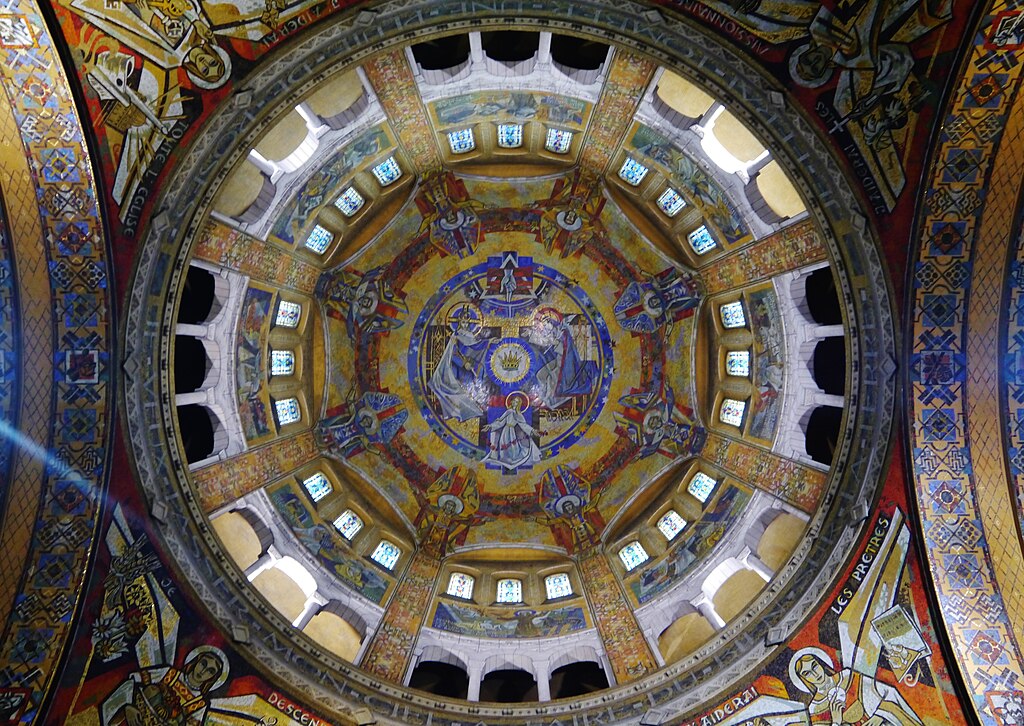
Dome of the Basilica of St. Therese, Lisieux, Dpartment of Calvados, Region of Normandy (former Lower Normandy), France. Photo by Zairon, CC BY-SA 4.0, via Wikimedia Commons.
Sources Referenced
ASH – “A Saint in Heaven” by Fr. Thomas Crean, OP; Mass of Ages Magazine
ASM – The Autobiography of St. Margaret Mary
BCQ – The Book of Catholic Quotations selected and edited by John Chapin
BJDS – “Bl. John Duns Scotus,” Catholic Encyclopedia, 1914
CFTC – “Critique of Fr. Teilhard de Chardin” by Dr. Dietrich von Hildebrand
CSDST – The Complete Spiritual Doctrine of St. Therese of Lisieux Rev. François Jamart, OCD
CSVL – Commonitorium of St. Vincent of Lerins
DI – Divine Intimacy by Fr. Gabriel of St. Mary Magdalen, OCD
DLW – St. Therese: Doctor of the Little Way edited by Br. Francis Mary, FFI
FCD – The Fundamentals of Catholic Dogma by Dr. Ludwig Ott
GF – The Great Facade: Vatican II and the Regime of Novelty in the Catholic Church by Christopher A. Ferrara and Thomas E. Woods, Jr.
HDT – “The History of Dogmatic Theology,” Catholic Encyclopedia, 1914
JDS – John Duns Scotus: Mary’s Architect by Allan B. Wolter, OFM, and Blane O’Neill, OFM
JFT – Just for Today: Selections from St. Therese of Lisieux and the Imitation of Christ compiled by a Benedictine Nun of Stanbrook Abbey
LC – St. Therese of Lisieux: Her Last Conversations translated by Fr. John Clarke, OCD
MT – “Moral Theology,” Catholic Encyclopedia, 1914
OMM – “On the Making of Man” by St. Gregory of Nyssa
PAP – Proof of the Apostolic Preaching by St. Irenaeus of Lyons; Ancient Christian Writers, Vol. 16
RCP – “On the Restoring of Christian Philosophy According to the Mind of St. Thomas Aquinas, the Angelic Doctor” (Encyclical Letter of Leo XIII, 1879)
RST – A Retreat with St. Therese by Pere Liagre
ScS – “Scotists and Scotism” Catholic Encyclopedia, 1914
SS – The Story of a Soul by St. Therese of Lisieux
SST – The Silence of St. Thomas by Josef Pieper
STA – St. Teresa of Avila by William Thomas Walsh
TD – True Devotion to Mary by St. Louis Marie de Montfort
TLM – “Tradition and the Living Magisterium,” Catholic Encyclopedia, 1914
TMB– Theology of the Mystical Body by Fr. Emile Mersch, SJ
TWC – The Whole Christ by Fr. Emile Mersch, SJ



