
Salvation to all that will is nigh;
That All, which always is all everywhere,
Which cannot sin, and yet all sins must bear,
Which cannot die, yet cannot choose but die,
Lo, faithful virgin, yields Himself to lie
In prison, in thy womb; and though He there
Can take no sin, nor thou give, yet He will wear,
Taken from thence, flesh, which death’s force may try.
Ere by the spheres time was created, thou
Wast in His mind, who is thy Son and Brother;
Whom thou conceivst, conceived; yea thou art now
Thy Maker’s maker, and thy Father’s mother;
Thou hast light in dark, and shutst in little room,
Immensity cloistered in thy dear womb.
—John Donne, “Annunciation.”
THE BEGINNING of all that is good and true in our lives — our very capacity to be saved — begins with the Incarnation of Our Lord Jesus Christ. The feast of the Annunciation on March 25 marks the apparition of St. Gabriel the Archangel to Our Lady. When she was told that she was to conceive of the Holy Ghost, Mary answered with the greatest “yes” in our sad history. It was the beginning of the Salvation of all who were to be Saved — and we are participating in that story ourselves, whenever we receive the Sacraments or perform a work of mercy.
Not surprisingly, the Annunciation is the earliest feast we know of, with evidence dating it back to at least the 400s. Ultimately, Christmas would derive its dating from it — nine months from the Annunciation being the date of the latter feast, despite all the many efforts to disprove December 25 as the birthday of Our Lord. It is a feast that always occurs in Lent and stands out by its Marian rather than Lenten propers — the white vestments re-emerge for the day after weeks of purple.
So important was this beginning of our own ascents to Heaven, that in the Middle Ages, according to Fr. Francis Weiser, “It was an ancient custom of the papal Curia (executive office) to start the year on March 25 in all their communications and documents, thus calling it the ‘Year of the Incarnation.’ This practice was also adopted by most civil governments for the legal dating of documents. In fact, the Feast of the Annunciation, called ‘Lady Day,’ marked the beginning of the legal year in England even after the Reformation, up to 1752. was made New Year’s Day.” Lady Day was one of the days when rents were due, and work contracts were concluded. It remained a Holy Day of Obligation until 1918.
This beginning of our Salvation was acknowledged by two of our greatest Catholic writers. Based upon calculation from internal evidence in The Divine Comedy, a number of scholars have claimed that Dante entered “that wood in life’s mid-way, where the true path was lost” on Annunciation Day, 1300. Others, for rather arcane reasons, claim it would have been Good Friday. Either actually makes sense, because either way the Incarnation and the Passion were both essential to our Salvation, and in truth the beginning of wisdom. Either way, Dante’s pilgrimage to wisdom begins on a day that made ascent to Heaven eventually possible. In the Purgatorio, he describes the Annunciation thusly:
The angel who came to earth with the decree
of the long-lamented peace,
who opened heaven of its long prohibition,
appeared before us so true
here carved in a sweet gesture,
that he did not seem an image that is silent.
One would have sworn that he said ‘Ave!’;
because there was imagined she
who turned the key to open the high love;
and he had on his act imprinted this speech
‘Ecce ancilla Dei’, precisely
as a figure is sealed in wax.
It is obvious that Dante too saw this great mystery as the beginning of it all, by opening “Heaven of its long prohibition.” In any case, the Italian Government endorsed the Annunciation as the date on which Dante’s mysterious trip began, by declaring March 25 National Dante Day in 2020. How is it to be celebrated? Well, for a start, by reading Dante, either in Italian or translation. If you find yourself in Ravenna on that day, you might visit his tomb. Or else, at 6 p.m. on March 25, you can join millions of his fans around the world by gathering on your porch or balcony and declaiming the opening and closing lines of the Inferno.
But March 25 is also observed in honour of another literary figure. It is also Tolkien Reading Day. Why? Well, according to the website of the Tolkien Society, which body began the observance in 2003, “It has been organised by the Tolkien Society since 2003 to encourage fans to celebrate and promote the life and works of J.R.R. Tolkien by reading favourite passages. We particularly encourage schools, museums and libraries to host their own Tolkien Reading Day events.” Why this date? Well, the same source claims “The 25th of March is the date of the downfall of the Lord of the Rings (Sauron) and the fall of Barad-dûr. It’s as simple as that!” While that is true, there is a bit more to it than that.
Tolkien declared in his Nomenclature, that “…March 25 (accomplishment of the quest) [was] intentionally chosen by me.” Indeed it was. His stories of Middle Earth were set in this world, albeit long before recorded history — yet very much after the Fall — as The Silmarillion shows. Being a devout Catholic, he regarded Lord of the Rings as a Catholic work — and as such, it is filed with personas and things that are prefigures of the Revelation he so deeply believed in: Galadriel and Elbereth were clearly Marian figures, and Lembas, the “Waybread of the Elves” was a sort of foreshadowing of the Eucharist: “The lembas had a virtue without which they would long ago have lain down to die. It did not satisfy desire, and at times Sam’s mind was filled with the memories of food, and the longing for simple bread and meats. And yet, this way bread of the Elves had potency that increased as travelers relied upon it alone and did not mingle it with other foods. It fed the will, and it gave strength to endure, and to master sinew and limb beyond the measure of mortal kind.”
In similar wise, Tolkien obviously chose the date of the future Incarnation for the overthrow of the arch-demon Sauron as yet another foreshadowing of the Order of Grace that woud one day come to Middle Earth — by which time it would have passed away. As he wrote in On Fairy Stories: “The Birth of Christ is the Eucatastrophe of Man’s history. The Resurrection is the Eucatastrophe of the story of the Incarnation. This story begins and ends in joy… There is no tale ever told that men would rather find was true, and none which so many skeptical men have accepted as true on its own merits…” In The Gospel, for Tolkien, man’s deepest yearnings which are seen throughout his stories and legends, find their fulfilment in sweet reality.
When the Dark Tower falls, an Eagle flies to the City of Minas Tirith, the Tower of Guard, to alert them to the great news:
Sing now, ye people of the Tower of Anor,
for the realm of Sauron is ended for ever,
and the Dark Tower has been thrown down.Sing and rejoice, ye people of the Tower of Guard,
for your watch hath not been in vain,
and the Black Gate is broken,
and your King hath passed through,
and he is victorious.Sing and be glad, all ye children of the West,
for your King shall come again,
and he shall dwell among you all the days of your life.And the Tree that was withered shall be renewed,
and he shall plant it in the high places,
and the City shall be blessed.Sing all ye people!
Here too, we see a prefiguring of the Gospel. For the long watch of the people of Gondor that was finally rewarded was not rewarded as they thought it would be. In a way, this is analogous to the long watch of the Jews, from the time of the Covenant with Abraham to the Incarnation itself, with which the promises given him, David, and Adam were fulfilled. As a result of all that would flow from the Incarnation, the Throne of David would be restored, although not in the way the Jews had thought it would be. So it stands above us all forever, occupied by its rightful holder, Christ the King, the Heir of David and Second Person of the Holy Trinity.
Annunciation Day is a Marian festival, to be sure, given its close connexion with Our Lady. But it is also a feast of Our Lord. Given that it celebrates the Word Made Flesh, the entrance of God into time, how about adding to your celebration reading a bit of both Dante and Tolkien, two very different authors who nevertheless shared a similar vision of the Faith being deeply embedded in the World around us. Even though it is no longer a Holy Day of Obligation, it will also give you another wonderful opportunity to follow Tolkien and Dante in their love of receiving the Blessed Sacrament.
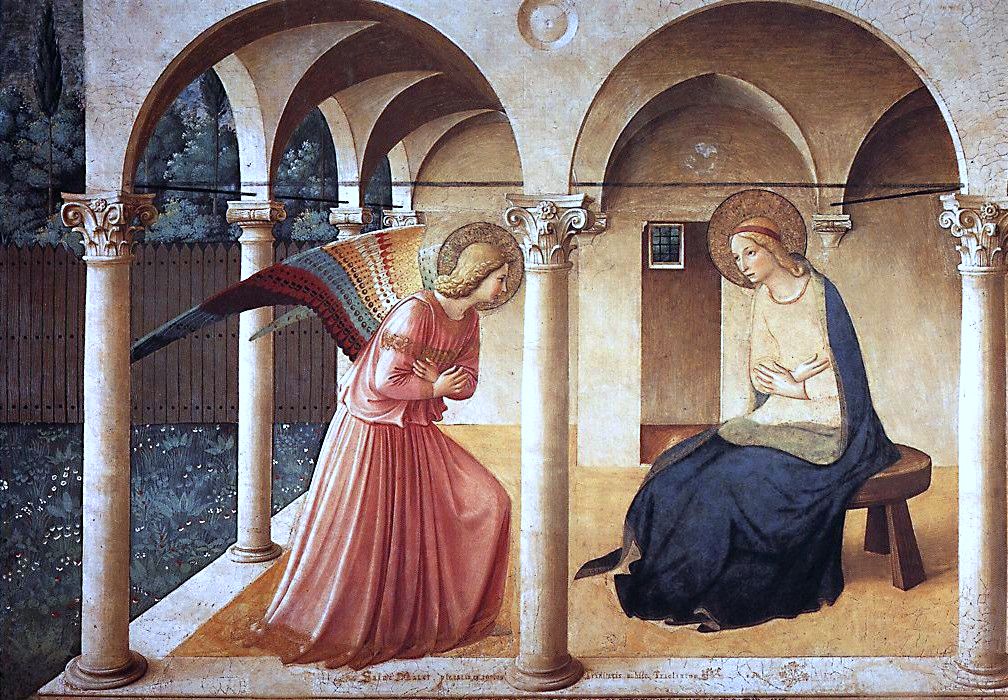
The Annunciation, by Blessed Frangelico. Image credit: Fra Angelico, CC BY 2.0, via Wikimedia Commons.