

The Polish self-image as a “Christ among nations” or the martyr of Europe can be traced back to its history of Christendom and suffering under invasions. During the periods of foreign occupation, the Catholic Church served as a bastion of Poland’s national identity and language, and the major promoter of Polish culture. The invasion by Protestant Sweden in 1656 known as the Deluge helped to strengthen the Polish national tie to Catholicism. The Swedes targeted the national identity and religion of the Poles by destroying its religious symbols. The monastery of Jasna Góra held out against the Swedes and took on the role of a national sanctuary.
—Wikipedia, “Christ of Europe.”
POLAND is certainly one of the most remarkable nations in Europe. The cited article explains its own title thusly: “Christ of Europe refers to the Polish popular self-image as a ‘martyr nation.’ The doctrine was adopted by Polish Romantics, who referred to their homeland as the Christ of Europe or as the Christ of Nations crucified in the course of the foreign partitions of Poland (1772–1795). Their own unsuccessful struggle for independence from outside powers served as an expression of faith in God’s plans for Poland’s ultimate Rising.”
But the country that was partitioned in 1772 was not merely Poland — it was the Polish-Lithuanian Commonwealth, itself more complex than even that name implies. In addition to Poles and Lithuanians, the Commonwleath also was inhabited by the Belarusians and Ukrainians. These East Slavic peoples, joint heirs with the Russians of Kievan Rus, were distinguished from each other by the outside countries that dominatd them after the falloff their parent state: in the case of the Ukrainians, it was the Poles; for the Belarusians, the Lithuanians; and for the Russians, the Mongols. These divisions remain to-day.
In any case, the Commonwealth was created by the Union of Lublin, which on July 1, 1569 integrally united the Kingdom of Poland and the Grand Duchy of Lithuania. These had already been in a personal union since the Krewo Agreement of 1385 and the wedding of Queen Jadwiga of Poland to Grand Duke Jogaila of Lithuania, who was crowned as Władysław II Jagiełło, who was crowned King of Poland by right of marriage. Their descendant, Sigismund II Augustus, put through the merger to maintain the united realm in the face of his childlessness. On his death in 1572, the Jagiellonian dynasty ended in the male line. Thanks to Anna Jagellonica, granddaughter of Casimir IV and wife of Holy Roman Emperor Ferdinand I, the Habsburgs were the senior heirs in the female line to the House of Jagiello. But the Polish-Lithuanian nobility preferred an elective monarchy, which featured members of domestic noble families or external dynasties being elected to the throne for life.
This period of elected Monarchy, while it did produce a few strong characters like Jan III Sobieski, noted for his heroic breaking of the Turkish siege of Vienna, featured elections with heavy lobbying by the nobility and foreign interests. Most of the Monarchs were weak; in 1697, however, the Elector of Saxony, Augustus II (called “the Strong”) was elected King. At his death in 1733, his son, Augustus III expected to succeed his father. Another party among the Polish nobility had other ideas, and wished to elect Stanisław Leszczyński; ironically, both candidates were great devotees of the Sacred Heart. The result, however, of the disputed election was the war of Polish Succession, which engaged most of the European powers. When it was over on 1738, August III had secured his father’s throne, and Stanislaw was given the Duchy of Lorraine. His daughter Maria married Louis XV, and it was provided that Lorraine would go to France after his death. Francis, Duke of Lorraine, married to Imperial heiress Maria Theresia, was given Tuscany in return, and would become Holy Roman Emperor when his father-in-law died.
When Augustus III died in 1764, the Polish and Lithuanian nobility gathered to elect a new King. The Commonwealth’s three neighbours — Russia, Prussia, and the Habsburgs’ Austrian lands — were all committed to a weak Poland as a buffer with Russia. At the same time, all three remembered the war three decades before, and were anxious to prevent a further outbreak. This time, a native Pole was needed as King, whom the powers felt would be malleable. Stanisław Antoni Poniatowski, as a young man, had been sent as a young diplomat to the Court of St. Petersburg in 1755. He soon became one of Russian Empress Catherine the Great’s lovers. Thinking that he was emotionally dependent upon her and so upon Russia, she lobbied successfully for his election. When he was elected King as Stanislaus II Augustus, the Empress congratulated herself upon the installation of a puppet upon the Polish-Lithuanian throne.
The Empress was very much mistaken; the new King loved his countries more than he ever had his sponsor. In the immediate, however, her minions ran roughshod over the new Monarch’s administration, Russian troops arresting and exiling several of their opponents (namely bishop of Kyiv Józef Andrzej Załuski, bishop of Cracow Kajetan Sołtyk, and Field Crown Hetman Wacław Rzewuski and his son Seweryn). In response, a group of Polish nobility formed the Confederation of Bar. This began a civil war of sorts in 1768.
Initially, the King attempted to mediate between the Russians and the Confederates; this attempt failed. The Confederates turned for aid in maintaining Polish independence to France and the Habsburgs, with the Confederation establishing a headquarters in Austrian territory. But in 1771, their leadership launched a plot to kidnap King Stanislaus; this backfired mightily, in that Empress Maria Theresia turned against them when she received the news. The Civil War continued as the Confederate leadership fled to the Ottoman Empire; the Ottomans were already at war with Russia, who had occupied the Danubian principalities. The Russians began making noises that they would incorporate the whole of the Commonwealth into their domains, which would have brought them directly to the Carpathians and the Hungarian frontier, while they already were on the Transylvanian frontier — perhaps giving Prussia a land bridge from Pomerania to East Prussia. This presented Maria Theresia and her advisers with a seemingly insoluble problem. It seemed their only alternative was to go to war on the side of the Ottomans to prevent themselves from being completely surrounded.
France, friendly at the time with all the powers involved, suggested a compromise. Russia would withdraw from the Danubian Principalities, and Prussia would return to Austria part of the Silesian lands she had stolen in the War of Austrian Succession. Frederick the Great, unwilling to cede anything he had conquered, proposed a counteroffer. In return for Austrian acceptance of Russia nicking only a relatively small part of eastern Lithuania, Prussia would take what became West Prussia, and Austria would receive Galicia, which would give her a considerable buffer beyond the Carpathians.
Maria Theresia suffered a considerable crisis of conscience over this manoeuvre, but in the end, she accepted the strategic realities. The three powers agreed to the partition on September 22, 1772; immediately they demanded that King Stanislaus and the Polish-Lithuanian Sejm (i.e., the Commonwealth’s powerful bicameral legislature) agree to the partition. Given that the Commonwealth would lose about 81,000 square miles (30% of its territory), with a population of over four to five million people, about a third of its population of fourteen million, the King sought ways of delaying the convocation of the Sejm. When the so-called Partition Sejm finally assembled, it was under the guns of the occupying powers in Warsaw, with less than half of the eligible delegates in attendance. The Sejm elected a committee of thirty to deal with the various issues presented by the powers. On September 18, 1773, the committee signed the treaty of cession, renouncing all Commonwealth claims to the lost territories.
This was and remains to this day a huge trauma for the Poles, Lithuanians, Belarusians, and Ukrainians — and contributed mightily to the enmities between those peoples and with the Russians that remain to-day. The remaining Confederates in the Ottoman territories became the prototype of the exiled Polish soldiers fighting on for the Motherland which also continued until the present.
But there were some unexpected benefits in surprising quarters. In 1773, Pope Clement XIII suppressed the Jesuits; but Frederick and Catherine refused to allow this measure to be enacted in their realms, and so the order’s work continued unabated in the territories they had taken. The Ruthenian and Ukrainian Catholics of Galicia, who had been tolerated by the Poles since the 1586 Union of Brest, now received the same sort of patronage from the Imperial House that the Eastern Catholics of Transylvania, Hungary, and Croatia-Slavonia had been receiving for decades; this would be extended during the 19th century to their parishes in the nascent United States.
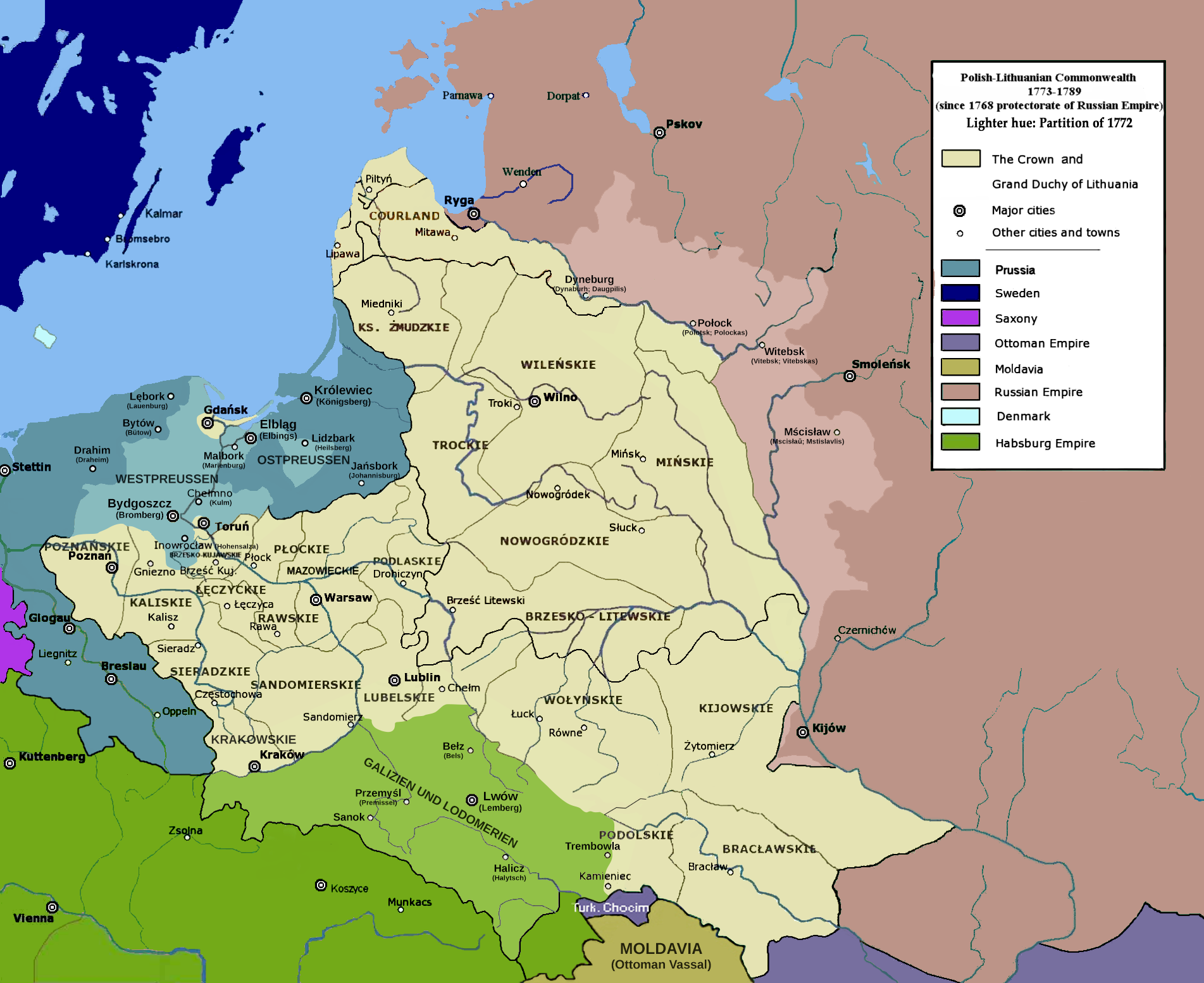
Map courtesy of Mathiasrex, Maciej Szczepańczyk, vased on layers of User:Halibutt, CC BY 3.0, via Wikimedia Commons — of which a detail is used as the “featured image” for this article.



