

Think, in this batter’d Caravanserai
Whose Portals are alternate Night and Day,
How Sultan after Sultan with his Pomp
Abode his destined Hour, and went his way.—Omar Khayyam, “The Rubaiyat,” trans. Edward Fitzgerald
THE RECENT demonstrations against the Iranian government at home and abroad, calling for the return of Shah Reza II have led a great many to wonder about this particular Monarchy, which was overthrown by the current regime in 1979. My own memory goes back not only to that time, but eight years earlier, when Reza’s father, Shah Mohammed Reza Pahlavi, oversaw the glittering 2,500-year celebration of the Persian Empire. Of course, on that occasion a great many critics happily pointed out that the Pahlavi dynasty had only sat on the storied Peacock Throne since 1925. In that paradox of ancient crown and recent dynasty lies the drama the Persian Monarchy.
The first great Empire we are aware of in history is the Assyrian, whose leadership made themselves renowned for their cruelty and occasional lapses into genocide. Its annoyed subjects rose up, and in 612 BC the Medes and Babylonians took the capital of Nineveh. The latter took over the Mesopotamian heartland, ruling from their capital of Babylon; the Medes returned to their home in the East.
Their rule would not last long. Herodotus tells us that their last King, Astyages, dreamt that his daughter, Mandane, would give birth to a son who would destroy his empire. Afraid of this dream, Astyages married her to the ineffectual Cambyses I of Anshan. But their son, Cyrus I did indeed depose his maternal grandfather, and led his father’s Persian people in the conquest of Medean Empire in 550 BC. This was the date that would be selected to commemorate 2500 years later. They then went on to conquer Lydia, Babylonia (as noticed in the Old Testament), and Egypt. Cyrus’ grandson, Xerxes I (485-465), tried unsuccessfully to conquer the Greek city states, in the famous Graeco-Persian Wars.
The Persian Empire over which Xerxes and his Achaemenid dynasty ruled was in a real sense the first modern Empire — or at least, the first to discover the key to long-term survival: indirect rule of newly conquered areas by their own native leaders. This was a method that has been used ever since by successful colonisers.
The State Religion of the Persian Empire was Zoroastrianism. It was a dualist faith, holding that Ahura Mazda, the god of light, and Ahriman, the god of darkness, were equal rivals for control of the cosmos; it was the role of the devout follower of the prophet Zoroaster to support the valiant combat of the former through prayer and good works. Their worship centred on veneration of sacred fires seen as ultimate symbols of the god of light. This religion was the centre of pre-Islamic Persian civilisation, which was as highly developed as any.
In 335 BC, Alexander began his conquest of the Persian Empire, a task which took about five years. During course of that time, Alexander saw and learned to value the Persian manner of governance. Indeed, when one adds both Macedonia and Greece, as well as his conquests eastwards in India, his personal realm was even larger than that of the Achaemenids. Finished conquering, he made his capital at Babylon, and carried on a great deal of Persian and Babylonian administration and culture, while enriching it with Greek elements; from this time forward, historians speak of “Hellenistic” rather than “Hellenic” civilisation, to refer to Alexander’s expansion of its scope.
Alexander, because of his retention of the methods of governance as he found them, is sometimes called “the last Achaemenid.” At his death in 323 BC, his generals began a series of civil wars; these ended with Antigonus ruling Macedonia and Greece, Ptolemy presiding over Egypt, and most of the rest — including the Persian heartland — under Seleucus, who set up his capital at Babylon in 312 BC. This last was the father of a long-lived dynasty, the Seleucids.
While the dynasty would continue to reign over Syria until 63 BC, it lost its hold over Persia long before. Employing Persian methods, they had installed as governors over the Persian homeland the Frataraka dynasty, descendants of a younger line of the Achaemenids. Over the course of the 2nd century BC, these began to gain more and more independence from the Seleucids. But they were overshadowed by yet another Iranian people, the Parthians, who ejected the Seleucids from Persia and later Mesopotamia. They maintained a local dynasty as “King of Persia” under their own empire, which would last from 247 BC to 224 AD. During this time, the Parthians acted as the major antagonists in the East of the Roman Empire. But their overthrow would not come at the hands of their Roman foes, but those of the King of Persia.
Seizing control of the Empire in 224, and taking the title of Ardashir I, the head of the revived Persian Empire — who could claim remote descent from the Achaemenids — inaugurated his line as the Sassanid dynasty. He and his descendants ruled according to the old Persian ways — including patronage of Zoroastrianism. They would also take up the Parthians’ role as Roman antagonists. But one thing they had to face in common with their longtime foes was the rise of a new religion: Christianity.
Initially, thanks to their persecution by the Romans, the Persian Emperors treated the Christians who were expanding into the Empire, very favourably, as a reaction to their persecution in the Roman Empire. This policy began to change when Armenia converted to Catholicism en masse in 303 AD, and collapsed completely with Constantine’s commencement of favouring the Church. Starting in 339 under Shapur II, a wave of persecution claimed 16,000. But for all that he and his successors tried to kill the nascent Church, it continued to spread.
Giving up the fight, in 409, Yazdegerd II legalised Christianity in his domains; the following year the Church in Persia had its first open synod. Peace was made with Rome for the nonce. But the rise of the Nestorian Heresy had a large effect on the Church in Persia, as many Nestorians fled persecution into Persia. In 484, at the Synod of Beth Lapat, Metropolitan of Nisibis, Barsauma, publicly accepted Nestorius’ mentor, Theodore of Mopsuestia, as a Church Father. “The Church of the East,” as it was henceforth called, was now a separate body from the Catholic Church of Rome and Constantinople. It would expand throughout the Persian Empire, and indeed Asia, reaching China via the Silk Road and India by sea. Its apogee was probably in the 1300s. But the various Mongol invasions ruined it and destroyed many of its dioceses. By the beginning of the 17th century, its remnant, the so-called Assyrian Church, was primarily to be found where it is today — Northern Iraq and Northwestern Iran. Elements returned to union with Rome after that — these became the Chaldean Catholic Church.
In the meantime, the Byzantine Empire inherited Rome’s on again-off again feud with the Sassanids, which reached its height under Emperor Heraclius and the war of 602–628. This included such episodes as the siege of Constantinople, and the loss and retaking of Jerusalem and its precious relic, the True Cross. This catastrophe exhausted both sides, leaving the duo at the mercy of a new and fresh power which arose shortly after in the Near East: Islam.
Invading what is now Iraq in 634, the Muslims defeated the major Persian army in 637; the country collapsed ad was occupied in five years, and Emperor Yazdegerd III was murdered in exile in 651. The Muslims imposed Sharia Law and enforced conversions; although most Zoroastrians converted to Islam over time a few remained until today. Many more fled to India: known as Parsis “Persians,” for long years they have outnumbered their co-religionists in their ancestral homeland.
Despite the heavy Islamisation, the Iranians or Persians did not become Arabised.
Nevertheless, from 643 until 1501, although various native noble houses ruled small areas of what is now Iran/Persia under foreign authority, the country as a whole was under Arab, Mongol, or Turkish overlords. But in 1501, the Safavids conquered the country. Claiming remote descent from the Sassanids, they imposed Shia Islam on the country, and emphasised Iran’s difference from the rest of the World. Ruling until 1722 (with restorations from 1729 to 1736 and 1750 to 1773); at their height they controlled all of what is now Iran, Azerbaijan, Bahrain, Armenia, eastern Georgia, parts of the North Caucasus including Russia, Iraq, Kuwait, and Afghanistan, as well as parts of Turkey, Syria, Pakistan, Turkmenistan, and Uzbekistan. They were in fact the founders of modern Persia.
Their legacy was continued by the Asharid Dyasty, whose founder, Nader Shah took control of the country in 1736. They did not hold on to power long, despite successful wars against the Ottomans and the Moguls. The Zands, a tribal family, deposed the last Asharid in 1751. Under their foreign rule, the country began to break up into local principalities. Civil war raised its ugly head. But starting in 1779, Mohammad Khan Qajar, another tribal chief — but of Iranian ancestry — began the reunification of the country. Originally working with the Zands, in 1789, he made himself Shah. Ruling until 1797, he revived the Safavud heritage in religion and administration, and regained for Persia/Iran the prestige of local power lost under the Zands.
The Qajars ruled through the 19th and early 20th centuries, during which they and their neighbours had to deal with the expansion of both the British and the Russians. For Persia this meant not only the humiliation of losing various small bits of territory, but becoming adept at playing the two powers off against each other. After the two countries became allies shortly after 1900, this became impossible, however. Ahmad Shah Qajar, who would be the last of his line to rule, came to the throne of 1909, inheriting the internal struggles over a constitution. World War I, during which Russian and British troops freely transited over the country’s territory to fight the Ottomans, reduced both the Shah’s prestige and the country’s independence. By 1919, the country was divided by rival warlords, and the Shah had no control outside his capital. Bankrupt after the war, the Shah had to sign over control of the country’s oil to British Companies.
As it happened, in 1879, during the years of the Anglo-Russian rivalry, the then Shah formed the Persian Cossack Brigade. Officered by Russians until 1920, it was the most effective unit in the Qajar army. In 1921, its commander, Reza, overthrew the last Qajar, proclaimed himself Shah as Reza I Pahlavi. He set himself the task of reuniting the country internally and reestablishing its independence from the British. In this he was very successful.
In many ways he was too successful — especially by depending on Czechoslovak and Danish advisors and companies to reduce dependence on Britian and the Soviet Union. Shah Reza declared a scrupulous neutrality in 1939. After the Germans invaded the Soviet Union in 1941, the Allies felt a pressing need to supply the Soviets — and the easiest way to do this was via the Persin Gulf, which Reza refused to do. The result was the Anglo-Soviet invasion of Iran in 1941. Shah Reza I was forced to abdicate and was succeeded by his eldest son, Mohammad Reza Shah.
He of course was the Shah of my childhood: a steadfast American ally and host of the gala anniversary referred to. Deposed in 1979 by the Islamic Revolution, he died in exile, and was succeeded in his claims by his son Reza II. It is to him that a great many Iranians look to for a renewal of the Iranian Crown. Who knows?; the 47-year interregnum seems like a long time to us — but means little given the sweep of Iranian history.
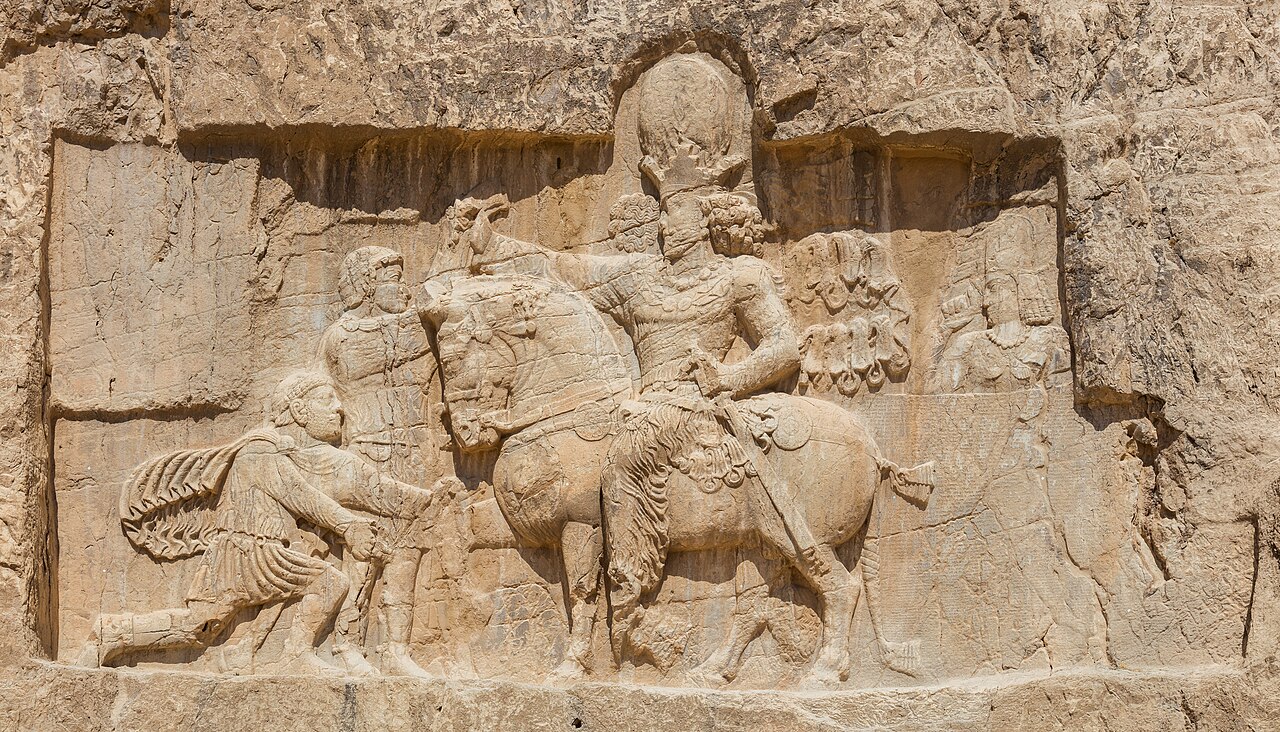
Relief of triumph of Shapur I over Valerian at Naqsh-e Rostam (ca. 241–272 AD), located 3 km north of Persepolis. It is the most impressive of eight Sasanian rock carvings cut into the cliff beneath the tombs of their Achaemenid predecessors. This carving depicts a famous scene in which the Roman Emperor, Valerian, is kneeling before Shapur I and asking for mercy. Shapur defeated Valerian at the Battle of Edessa, in which the entire Roman army was destroyed and Valerian became Shapur’s prisoner. This was the first and only time a Roman emperor was taken prisoner. The Emperor Philip the Arab is depicting standing and Gordian III is dead at the feet of Shapur’s horse. Photo by Diego Delso, CC BY-SA 4.0



