

It came to my attention via X the other day, thanks to a posting by Stephen Kokx, that a declassified US State Department telegram from 1958 reveals possible top-level government interference in papal elections. Here is an embedded JPG image, followed by the X-posting of Mr. Kokx:
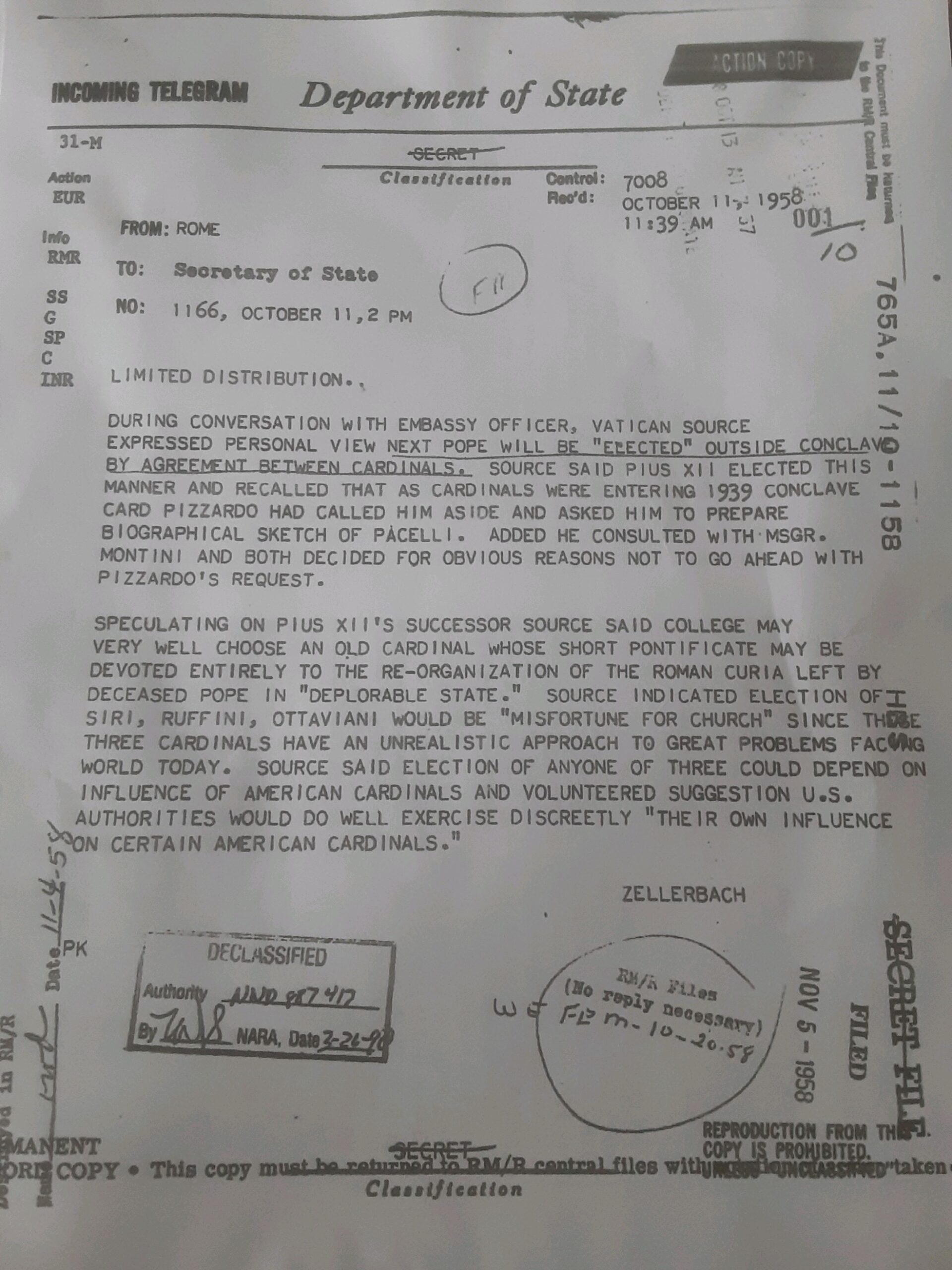
The US State Department had a mole in the Vatican feeding them information about how to interfere with the 1958 conclave so a moderate would be elected. Eventually, Angelo Roncalli emerged victorious. Months later, he announced his intention to hold Vatican II. pic.twitter.com/zOUlWa0QN7
— Stephen Kokx (@StephenKokx) July 30, 2024
That such a thing is possible and even likely would not be the least bit surprising to those familiar with the amazingly well researched work of David Wemhoff, John Courtney Murray, Time/Life, and the American Proposition (I apologize for the link to Amazon; the work is apparently not available from its original publisher). For a taste of the material in Mr. Wemhoff’s book, please read Doctrinal Warfare, the CIA, and the Colonizing of the Catholic Mind on this site. I’ve twice interviewed the author: How the C.I.A.’s Doctrinal Warfare Program Changed the Catholic Church, and Religious Indifferentism and Social Liberalism are Evil Twins.
Back to the telegram. Everything I am about to write in its regard assumes its legitimacy, which I have not seen independently verified. Feel free to put tips in the comments if you know anything.
The document is simple and straight-forward enough, and short. It’s an intel memo from a State Department operative in Rome briefing his superiors on what a “Vatican source” has told him about the politics surrounding the pending papal conclave following the death of Pope Pius XII. That conclave, we know, would go on to elect Cardinal Roncalli, who took the papal name John XXIII. The memo, dated October 11, 1958, was sent a mere two days after Pius’ death on October 9. We get a taste of how the sausage gets made toward the end: After saying what a “misfortune for the Church” would result from the election of either of the (conservative) Cardinals Siri, Ruffini, or Ottaviani, the same Vatican source “volunteered suggestion [that] U.S. Authorities would do well [to] exercise discreetly ‘their own influence on certain American cardinals.’ ”
What the source was recommending here is called “election interference” in modern parlance, and it is something our federal government has done all over the world, along with outright “regime change” when the Deep State operatives decide they do not like the incumbent — whether or not he was democratically elected.
The Father Feeney Connection
What most caught my interest in the telegram came earlier in it than the election interference business. This is the matter-of-fact assertion, by the State-Department operative’s “source” that the “next pope will be ‘elected’ outside the conclave by agreement between cardinals,” followed by this even more stunning claim: “Source said Pius XII elected this manner and recalled that as cardinals were entereing 1939 conclave, Card. Pizzardo had called him aside and asked him to prepare biographical sketch of Pacelli. Added he consulted with Msgr. Montini and both decided for obvious reasons not to go ahead with Pizzardo’s request.”
Today, with the well publicized machinations of the so-called St. Gallen Mafia, it is known that this sort of pre-conclave papal politicking takes place. The idea that such a practice goes back further in recent history may disturb the consciences of those who allege the illegitimacy of Pope Francis’ pontificate based upon the alleged intrigue leading to his election in the conclave of 2013.
The Cardinal Pizzardo accused here of engaging in pre-conclave intrigue is Giuseppe Cardinal Pizzardo (Wikipedia, Catholic-Hierarchy.org), who was the Secretary of the Holy Office that summoned Father Leonard Feeney to Rome on October 25, 1952. There were multiple violations of Father Feeney’s canonical rights involved in the way Cardinal Pizzardo handled the affair, which is one reason we have always maintained that the excommunication issued at the end of this series of events was invalid. Some of these irregularities are outlined here on this site, while the entire correspondence between Father Feeney and His Eminence may be read in Brother Thomas Mary’s fine book, They Fought The Good Fight.
While Wikipedia claims that Cardinal “Pizzardo was considered to be a highly conservative clergyman,” it also tells us that, “Archives opened to the public in 2024 show Pizzardo defended Marcial Maciel [founder of the Legionaries of Christ], a priest known to the Vatican as a drug addict and sexual abuser, from a measure being written by Giovanni Battista Scapinelli.” Further, “He was known as an early patron and mentor of Giovanni Battista Montini, the future Pope Paul VI, who is said to have voted for Pizzardo at the 1963 papal conclave.”
Regarding Cardinal Pizzardo’s protection of the infamous Father Maciel, this Nicole Winfield article, citing the Vatican archives opened in 2024, makes it clear that the same Cardinal who hounded Father Feeney in 1952 would, a mere four years later, protect the most notorious clerical scoundrel in twentieth-century Church history — whose crimes against God and nature are better left unmentioned here.
One last connection presents itself, which I will not read much into, but posit for historical interest: Cardinal Pizzardo was consecrated a bishop by Cardinal Pacelli, with then-Archbishop Francesco Marchetti-Selvaggiani being one of the principal co-consecrators. Cardinal Pacelli, of course, would go on to become Pope Pius XII. It was Cardinal Marchetti-Selvaggiani who would sign the August 8, 1949 Letter of the Holy Office to the Archbishop of Boston concerning Father Feeney.

The signing of the Reichskonkordat on 20 July 1933 in Rome. From left to right: Monsignor Ludwig Kaas, German Vice-Chancellor Franz von Papen, Archbishop Pizzardo, Cardinal Secretary of State Eugenio Pacelli, Alfredo Ottaviani, and Reich Minister Rudolf Buttmann. Bundesarchiv, Bild 183-R24391 / Heinrich Hoffmann / CC-BY-SA 3.0 via Wikimedia Commons.



