126

The Innate Qualities of the Child

Father Reginald Garrigou-Lagrange, O.P. (1877-1964) was one of the greatest theologians of modern times. He was a staunch anti-modernist, who engaged and exposed the twerpy upstarts responsible for the neo-modernist Nouvelle Théologie (”New Theology”). Much more than a controversialist, the Dominican Friar could write of the deepest spiritual truths with a relish and lucidity that make his theology engaging to study.

In a series of three Ad Rem, I purpose to present his thoughts on “spiritual childhood.”

by Brother André Marie March 11th, 2010

‘England should be a Catholic country again’


Brother André Marie

That’s the motion that was debated last week in London, at an event hosted by the Spectator and held at the Royal Geographical Society. And guess what — “the 700-strong sell-out audience voted overwhelmingly in favour of the motion”!

Excerpt from The Catholic Herald:

Cardinal Cormac Murphy-O’Connor, author Piers Paul Read and Dom Anthony Sutch, former headmaster of Downside, spoke for the motion.


No Way to Anime


Brian Kelly

Anime cartoons and their characters are a huge cultic phenomenon, the most popular of all escapist media venues. It is very addictive and very dangerous, to the soul and the mind. I don’t post weird stories, but this blog by Zoe Romanowski from Inside Catholic, along with another, even …


CDF Prefect Affirms: ‘Union with the Catholic Church is the goal of ecumenism’


Brother André Marie

One of the commentators on the relevant CWN article expressed it well: “It’s past time someone said this. Too often ecumenism is taken to mean the weakening of the teachings of the Church and the addition of non-Catholic ritual and beliefs.” A-m-e-n-!

Past time is better than no time — or, “better late than never.” All the scandal that has transpired, and is ongoing, in the name of ecumenism and inter-religious dialogue should cease at these words of Cardinal Levada defining its purpose (or “final cause” to you Aristotelians out there): “Union with the Catholic Church is the goal of ecumenism.”


2010 Saint Benedict Center Conference


The Slaves of the Immaculate Heart of Mary

Our 2010 conference will be held on October 8 and 9 at Saint Benedict Center in Richmond, New Hampshire.

The information currently available is as follows:

Theme: “The Romance of Wisdom”

Cost: $100 for both days (Friday and Saturday). This includes meals. Single days without meals: $40.

Note: This year, Friday and Saturday will both be full days. There will be eight speakers giving presentations in addition to the master of ceremonies, our Prior, Brother Andre Marie.


Why Buddhism Is Open to Suicide


Brian Kelly

Archbishop Alberto Bottari de Castello, apostolic nuncio to Japan, has a very perceptive insight into the subversive effects Buddhist doctrine  has on the soul of a suffering devotee confronting hopelessness.  From Sandro Magister’s latest column: “Why Life is Worth So Little in Prosperous Japan.”

“The Japanese do not have a personal …


Is the False Apparition in Medjugorje Finally to Be Condemned?


The Slaves of the Immaculate Heart of Mary

[March 5, 2010 - Rome Reports (with hat tip to Rorate Caeli)]

Benedict XVI has formed a commission to investigate if Our Lady truly appeared in Medjugorje, a small town in Bosnia.

The commission is part of the Congregation for the Doctrine of the Faith and Cardinal Camillo Ruini will preside over the commission. Ruini is the pope’s former vicar of Rome’s diocese. Ruini goal will be to explain to the pope what’s happening at the sanctuary which has become the third most visited in Europe.

Allegedly, at least 6 people have witnessed the Virgins apparitions there since 1981.


Yet Another Defense of Pius XII


Brother André Marie

When the enemies of the Church, the enemies of Christianity in general, and those who want to “hold” the Catholic hierarchy’s “feet to the fire” constantly jabber about Pius XII’s supposed complicity in the Nazi murder of Jews, it becomes necessary to defend the truth as well as the honor of the Holy Father. He was, after all, not only innocent of the crime of which he stands accused by an angry mob, but was also proactive in the protection of innocent Jews. That’s history. Catholics have a particular duty to defend the Church’s honor, but even secular historians of the era ought to vindicate Pius XII, if only to protect the integrity of their science.


The ‘Woman’ of Genesis


Brian Kelly

In changing the traditional Douay-Rheims rendering of Genesis 3:15 from “I will put enmities between thee and the woman, and thy seed and her seed: she shall crush thy head, and thou shalt lie in wait for her heel” to the Catholic Revised Standard Version translation (based on the King James Bible), “I will put enmities between you and the woman, and between your seed and her seed: he shall bruise your head and you shall bruise his heel,” the scriptural foundation for the dogma of the Immaculate Conception is compromised. So, too, is the traditional doctrine concerning Our Lady’s essential role in salvation history, which has been translated into her more modern title of “Co-redemptrix.”


Iraq’s Dechristianization Continues


Brother André Marie

“The United Nations estimated that 683 Christians fled Mosul between February 20 and February 27. Chaldean Catholic Bishop Emil Shimoun Nona of Mosul estimated that ‘about 400 families’ had left the city’s community of 4,000 Christians.”

This disheartening data comes from an article in Catholic World News. The Iraqi Catholic bishops themselves are bemoaning the situation. But that’s not all they are doing; they are also praying, fasting, and organizing their people to protest peacefully. The facts are not to be denied, and they are not the “spin” of liberal news pundits trying to make a Republican effort look bad.


Manchester Bishop John B. McCormack to Lead Pilgrimage for Brother André’s Canonization


The Slaves of the Immaculate Heart of Mary

Bishop John B. McCormack is inviting New Hampshire Catholics to join him on a pilgrimage to Rome and other Italian holy sites from October 15-25 in celebration of the canonization of Blessed Brother André Bessette.

Pope Benedict XVI recently announced that Blessed Brother André will be formally declared a saint at a ceremony in Saint Peter’s Square on October 17, 2010.

The pilgrimage will be organized by Canterbury Tours of Bedford, NH. It will also include visits to other Italian holy sites in Rome, Assisi, and Siena.


Subscribe to this author's posts RSS Feed

About Sr. Catherine Goddard Clark, M.I.C.M.

Sister Catherine Goddard Clarke was the foundress of the original Saint Benedict Center in Cambridge, Massachusetts. She was a married laywoman. Later (1949), she would become one of the founding members of the Slaves of the Immaculate Heart of Mary. She was also one of the Center's "three teachers," whom we have described elsewhere in the following manner:

In 1940, a prominent Catholic laywoman, Catherine Goddard Clarke, sought permission of the then Archbishop of Boston, William Cardinal O'Connell, to establish an educational oasis of Catholic truth close to the renowned secular universities that dominated the area. The cardinal agreed to the project, admonishing Mrs. Clarke to "teach the Faith without compromise." So it was that Saint Benedict Center quietly came into existence that year at the intersection of Bow and Arrow Streets in Harvard Square, Cambridge, Massachusetts.

The Center's initial purpose was to provide religious instruction for the Catholic students of the universities. In keeping with the instructions of Cardinal O'Connell, its policy was to teach the authentic doctrines of the Church through the study of Holy Scripture and the writings of the Fathers, Doctors, and Saints of the Church. This program of studies achieved immediate success, filling the spiritual vacuum created by an obvious deficiency in the neighboring academic institutions. The Center was attended in large and growing numbers.

In 1942 the well-known and loved Jesuit priest, Father Leonard Feeney, became associated with the work of the Center, counseling students, lecturing, and eventually becoming — by general demand, and by appointment from his superiors in the Society of Jesus and the Archdiocese of Boston — the spiritual director of Saint Benedict Center. An author and poet in his own right, Father Feeney was hailed by his Jesuit Provincial as "the greatest theologian we have in the United States by far," and was also acclaimed publicly as "America's Chesterton." Before long, Father was lecturing on Holy Scripture to a packed Center every Thursday evening, while Mrs. Clarke enjoyed equal success with her Monday evening lectures on Church History.

Later in 1942, while on a research fellowship at Harvard University, Professor Fakhri Maluf of Lebanon visited the Center. Within a short time, Father Feeney asked Doctor Maluf to begin Tuesday evening lectures on philosophy.

These three teachers formed a beautiful union which had a balance and blend that captured and inspired the hearts and minds of those who were studying their Catholic Faith at the Center. They are the founders of what ultimately became the Crusade of Saint Benedict Center.

She wrote numerous books that are available on our online store.


Posts by Sr. Catherine Goddard Clark, M.I.C.M.:

Jun 2

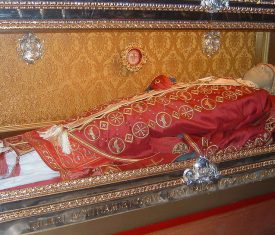
Our Glorious Popes

June 02nd, 2009

Dedication

The lives and times of Holy Roman Pontiffs
who saved the Church during great crises
for Christendom

To our Holy Father
Pope John Paul II
respectfully and lovingly dedicated

May Saint Peter and all our glorious Popes
help him to save the Church and Christendom
in this present crisis!

For over nineteen hundred years, Saint Peter and the Popes who have descended in unbroken succession from him have never ceased to feed, with the life-giving Sacraments and doctrines of the Catholic Church, the sheep whom Jesus Christ, the Good Shepherd, left to their infallible guidance and in their keeping. That this will be so until the end of time, we know, because He Who can neither deceive nor be deceived has given us His promise of it. Read More »

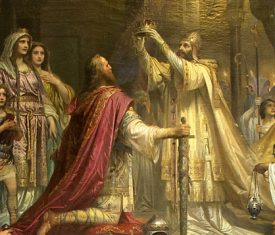
The following will no doubt be taken by some as a Baroque — or worse, Romantic — example of an unenlightened and backward Catholic fascination with legend. So be it. Read More »

Almost six years after the death of Saint Athanasius, in the pontificate of the glorious Pope, Saint Damasus ­- the patron of Saint Jerome in his biblical studies — there came to the imperial throne in the East, the great Emperor Theodosius I. In the first year of his reign, in the winter of 379, Theodosius was instructed in the Catholic Faith and baptized by Ascholius, Bishop of Thessalonica. Read More »

Jul 11

The Life of Saint Gregory the Great

July 11th, 2005

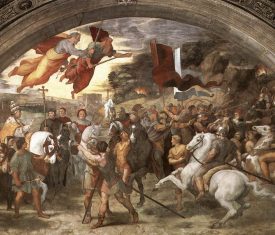
Pope Saint Gregory the Great not only saved the Church, in times so frightful that the men who lived in them were sure that the end of the world was come, but he founded the great civilization which has lasted down to our day and of which we are part, Western Civilization. All alone, in the midst of famine and pestilence, floods and earthquakes, endangered by Greeks and barbarians alike, and abandoned by the Emperor, Pope Gregory, frail and ailing in body but strong and undaunted in spirit, succored and saved his people, his city, his country, and the whole of Christendom. Read More »

Jun 27

Love is the Spirit of Truth

June 27th, 2005

(written in 1948)

Mr. Daniel Sargent has written a classic biography called Thomas More . If anyone should know about Utopia, it would be Sargent. Read More »

Jun 26

Gate of Heaven

June 26th, 2005

To those qui mecum fuerunt in exiliis

There seems to be no end to the number of reasons people can give for not facing the doctrine of the necessity of belonging to the Catholic Church for salvation.

“It is not the Church’s doctrine,” is the first difficulty.

“It is the Church’s doctrine,” we answer.

“None of the priests around here hold it,” they make reply. “Archbishop Cushing of Boston certainly does not, nor Bishop Wright of Worcester.”

“That may be true,” we admit, “but even so you must realize that this does not mean that No Salvation Outside the Church has ceased to be the Church’s doctrine on salvation. We can give you bishops and priests over nineteen hundred years who have held this doctrine, and popes who have infallibly defined it. In fact, we can give you the whole universal Church, with all its popes and cardinals, bishops and priests.

“And whether they believe the doctrine or not, Archbishop Cushing, Bishop Wright, and the priests of the Church all over the world pronounce it every time they receive a convert into the Church, and once a week when they say their Breviary in the Sunday Office.”

“Is that so?” we are asked incredulously. “I find that hard to believe. You may not know that parish study clubs have spent a lot of time on this question since your case came out in the newspapers. The priests lead the discussions. I don’t understand why, if they say there is no salvation outside the Church on Sunday, they teach us there is salvation outside it on Monday.”

“That is something you will have to figure out for yourself,” we have ruefully to say. “Every priest reads in his Office for Sunday the Athanasian Creed. Now, the Athanasian Creed begins this way:

WHOSOEVER wishes to be saved, before all things it is necessary that he hold the Catholic Faith. . . Which Faith except every one do keep whole and undefiled, without doubt he shall perish eternally. Now the Catholic Faith is this. . . .

(There follows a statement of the Creed.) The end of the Creed confirms the beginning:

This is the Catholic Faith, which except a man believe faithfully and firmly, he cannot be saved.

“What do you say to that?” we ask.

“That is pretty plain,” is the answer we usually receive. “But how long has this been said in the Church?”

“From about the year 420,” we reply. “St. Athanasius himself did not write it. It was given his name because it contains the doctrines for which he suffered exile five times, and for which he was excommunicated by every Catholic Bishop in the East.

For 1500 years, Catholic priests have been reciting this Creed, and have been stating at the beginning of it, and at the end of it, that there is no salvation outside the one true Church of Jesus Christ.

“And that is not all. Right in our own day, also, before a convert is received into the Catholic Church, the priest hands to him the `Abjuration of Heresy or Profession of Faith’ which the convert is required to read aloud, kneeling before the priest who is about to receive him. This `Abjuration’ likewise contains the doctrine of No Salvation Outside the Church. It is strong, direct and clear. It leaves no doubt about the Church’s teaching on salvation. This is what it says:

I, ______________ , having before me the holy Gospels, which I touch with my hand, and knowing that no one can be saved without that faith which the Holy, Catholic, Apostolic Roman Church holds, believes, and teaches, against which I grieve that I have greatly erred, inasmuch as I have held and believed doctrines opposed to her teaching.

I now with sorrow and contrition for my past errors, profess that I believe the Holy, Catholic, Apostolic Roman Church to be the only and true Church established on earth by Jesus Christ, to which I submit myself with my whole soul. I believe all the articles of Faith that she proposes to my belief, and I reject and condemn all that she rejects and condemns, and I am ready to observe all that she commands me. And I make the following profession of Faith:

(There follows the profession.)

And, I believe in everything else that has been defined and declared by the sacred Canons and by the General Councils, and particularly by the holy Council of Trent, and delivered, defined, and declared by the General Council of the Vatican, especially concerning the Primacy of the Roman Pontiff, and his infallible teaching authority.

With a sincere heart, therefore, and with unfeigned faith, I detest and abjure every error, heresy, and sect opposed to the said Holy, Catholic, and Apostolic Roman Church. So help me God, and these His holy Gospels, which I touch with my hand.

Our interrogator generally remains silent for a few moments after we have finished reading, and we can understand why. This is the first time he has ever heard these things. His next question, however, is revealing of the weak state of his own Faith, for, invariably, he says:

“My, that’s asking a lot, isn’t it? Do you mean to say people will admit all that about their former religion?”

“But it is the mere statement of the truth. Are you surprised they should speak the truth about heresy? Don’t you believe error should be detested?”

“Yes, I suppose so; but don’t you think it is rubbing it in, especially when they have been good enough to come into the Church?”

“Good enough!” we retort, “it is only right that they should accept the Truth! You are saying that they are good enough to save themselves from hell, good enough to secure themselves heaven – if they live up to the Faith. Furthermore, nothing in the world could pay for the next Gift they receive, after Baptism. Have you ever been with a real convert when he has received his first Holy Communion?”

“No.”

“We have. And if the conversion is a true one, his realization of what has happened to him is a rebuke to the apathy of lifelong Catholics. Lifelong Catholics take for granted the overwhelming Reality of Holy Communion. The convert expects enthusiasm, at least equal to his, from the older Catholic, and instead he gets wondering admiration – not that God should come to man, but that man should be good enough to come to God! This is always disillusioning and confusing to a convert, as well it might be.

“Do you suppose anyone confers a favor upon God by coming into His Church? It is the other way around.”

“Yes, I suppose so.”

“Suppose so!”

It is then we know that the Faith which is left in the American Catholic is weak, lukewarm, without fire or zest, joy or love. And then we can understand why Russia’s hold is fastening every day more devilishly on Europe and the East, and threatens us. We then can understand Korea. In the ages of the Faith when, as now, the Mongol and barbarian threatened Christianity, the Catholics turned from their pleasure-loving and sinful lives back to the Church. They did penance; whole nations prayed. They pilgrimaged, barefoot, to the shrines of Christendom. (They did not journey there on luxury liners.) They renewed their Faith, and made promises to God, which they kept, for the most part. And their prayers were answered. The barbarian hordes were pushed back, time and time again, just as they were about to sweep over Europe from the East, the Southeast, and the South. They were stopped, at the gates of Vienna. They were crushed, at Lepanto – when we had a Saint in the Chair of Peter, Pope Pius V.

There was still enough fire in the faith of Catholics, in those days, to be rekindled. There seems to be left none at all, in our day.

Our Lord told us:

Matt. 10;34: Do not think that I came to send peace upon earth: I came not to send peace, but the sword.

35: For I came to set a man at variance against his father, and the daughter against her mother, and the daughter-in-law against her mother-in-law.

36: And a man’s enemies shall be they of his own household.

37: He that loveth father or mother more than me, is not worthy of me; and he that loveth son or daughter more than me, is not worthy of me.

38: And he that taketh not up his cross, and followeth me, is not worthy of me.

A modern Catholic can understand paying a price for everything but the Faith. We would have had many more supporters in our fight for the pure doctrine of Jesus Christ had not the cost been so high. One Catholic would have had to give up a job, another friends, another peace in the family, another a political appointment, another social prestige. And being weak of faith and thoroughly self-centered themselves, Liberal Catholics find it hard to understand spiritual courage and spiritual honesty in others.

“That is not all that is required of a baptized Protestant about to enter the Church,” we go on. “The instructions in The Priest’s Ritual for a convert’s reception into the Church continue:

While the convert is still kneeling, the Priest says the Miserere or the De Profundis; after which the Priest absolves the convert from his heresy, saying: “By the Apostolic authority, which I exercise here, I absolve thee from the bond of excommunication which thou hast incurred; and I restore thee to the holy Sacraments of the Church, to the communion and unity of the faithful, in the name of the Father, and of the Son, and of the Holy Ghost. Amen.” . . .

I did not know for a long time — and I am sure few “cradle Catholics” are aware — that this beautiful Profession of Faith is required of non-Catholics before they are baptized conditionally. (A person is baptized unconditionally if he has never before received Baptism. Conditional Baptism is given when the convert has been baptized in some other religion, in case the first Baptism might not have been a valid one, for some reason.) All of the converts whose reception into the Church it has been our privilege to witness here at St. Benedict Center have, by Our Lady’s grace, been so conscious of the emptiness, error and confusion of the religions they were leaving that they were eager and grateful to make this Abjuration of Heresy and Profession of Faith.

Not only do our Catholic priests recite the doctrine of No Salvation Outside the Church on the two occasions I have just given, but they read it many times in their Office throughout the year, in the Martyrologies. For instance, the Martyrology for February 20th reads as follows:

. . . At Damascus, (in the year 743), St. Peter Mavimeno. Some Arabs came to see him while he was ill, and to them he said, “Whoever does not embrace the Catholic Christian religion will be damned, as your false prophet Mohammed is”; whereupon they killed him.

The Second Nocturn in the Priest’s Office for November 25th, relates the story of the martyrdom of St. Catherine of Alexandria:

When she saw many diversely tormented and hauled to death by command of Maximin, because they professed the Catholic religion, she went boldly to him, and rebuking him for his savage cruelty, she affirmed with wisest reasons that the faith of Christ is necessary for salvation.

In the Office for September 27th, the feast of the Holy Martyrs, Cosmas and Damian, it is told:

. . . and then, for as much as they freely acknowledged themselves Catholics, and the Catholic faith necessary for salvation, he commanded them to worship the gods, under threats of torments and a most cruel death.

These saints, no one can deny, were martyred because they held there was No Salvation Outside the Catholic Church.

The Office for May 4th tells the story of the Blessed Martyrs, John Cardinal Fisher, Thomas More, and their Companions, who died for the second doctrine for which St. Benedict Center is fighting, namely, that there is no salvation without personal submission to our Holy Father, the Pope. St. John Fisher and St. Thomas More died, the Martyrology tells us, “strenuously fighting for the Catholic Faith and the Primacy of Peter.”

While St. Thomas More was awaiting death in the tower of London, the prosecutor for King Henry VIII came to see him. He reminded St. Thomas More that he was being disobedient to every Catholic Bishop in England by his stubborn stand on the doctrine of the Primacy of the Pope.

“My lord,” Thomas More answered him, “for one bishop of your opinion, I have a hundred saints of mine; for one parliament of yours, and God knows of what kind, I have all the General Councils of the Church for a thousand years.”

It was a Pope of our day — for those who think the Church can change — who canonized Thomas More. Pope Pius XI, in 1935, canonized both St. Thomas More and St. John Fisher. St. John Fisher was the Bishop who refused to follow the other Bishops of England into heresy, and who was therefore martyred, with St. Thomas More, for the doctrine of the Primacy of the Pope and the necessity of submission to him, as Christ’s Vicar.

Then there is James Duckett, the heroic English bookseller, who was beatified with other English Martyrs in 1929. Blessed James Duckett was martyred on the 19th of April, 1602, in London. The Catholic book center which today, in London, bears his name, has published the story of his life and death. Of his death, the story relates:

James Duckett showed great alacrity in his mind, and spoke boldly and cheerfully, to the astonishment of many beholders. He said of how he professed that he died a Catholic, and that so he had lived; . . . telling the people in general that he was most willing to die for that cause, and that it was as impossible for any to be saved outside of the Catholic Church as for any to avoid the deluge that was outside of Noah’s Ark. And so the cart was drawn from him.

We have, in the Holy Gospel according to St. John (15;5,6) the words of Our Lord, Himself, on salvation:

. . . for without me you can do nothing. If anyone abide not in me, he shall be cast forth as a branch, and shall wither, and they shall gather him up, and cast him into the fire, and he burneth.

St. Cyprian, the great Bishop of Carthage, who was born in the year 210 and suffered martyrdom in 258 A.D., wrote:

The bride of Christ cannot be falsified; she is chaste and incorrupt. She knows but one home; she with scrupulous chastity keeps inviolate her one bridechamber. She it is who preserves us for God; she finds places in the Kingdom for the children she has begotten. Whosoever separates himself from the Church is joined to an adulterer and has cut himself off from the promises made to the Church; no one who quits the Church of Christ will attain to the rewards of Christ. He is a stranger, profane, an enemy. He cannot have God for his Father who has not the Church for his mother. If anyone who was outside the Ark of Noah was able to escape (and we know no one was), then whosoever is outside the Church escapes.

St. Cyprian, who was the greatest man in the Western Church from St. Irenaeus to St. Augustine, wrote also, in his book on the Unity of the Church:

If such (heretics or schismatics) should even suffer martyrdom for the name of Christ, they would not expiate their crime. There can be no such thing as a martyr out of the Church. Though they should be thrown into the fire, or be exposed to the fury of wild beasts, such a death will never be esteemed a crown of their faith and constancy, but rather a punishment of their perfidy. Such a man may be put to death, but cannot be crowned. . . If the schismatic should suffer out of the church of Christ, he will never thence become entitled to the recompense which none can claim who are not in it. There is but one God, one Christ, one church, one faith, and one entire body of Christian people. Whatever shall be separated from the fountain of life, can have no life remaining in it, after having lost all communication with its vital principle.

St. Jerome, the great saint and Doctor of the Church, who lived from 342 to 420, wrote to Pope Damasus:

I, following no leader save Christ, am associated in fellowship with your Blessedness, that is, with the See of Peter. On that rock I know the Church was built. Whosoever eats the Lamb outside that house is profane. If anyone shall be outside the Ark of Noah he shall perish when the flood prevails.

St. John Chrysostom, the golden-mouthed Doctor of the Church, 347-407, speaking on the dignity of the priesthood, says:

For it is manifest folly to despise so great a ministry — without which we could obtain neither salvation nor the good things that have been promised. For as no man can enter into the kingdom of heaven, unless he be born again of water and the Holy Ghost; and except he eat the Flesh of the Lord, and drink His Blood, he shall be excluded from everlasting life; and as all these things are ministered only by the consecrated hands of priests, how could anyone without them either escape the fire of hell or obtain the crown that is prepared?

The great Bishop, Confessor and Doctor of the Church, St. Augustine, 354-430, who was loved and venerated in every century, said in a sermon to the people of Caesarea:

No man can find salvation save in the Catholic Church. Outside the Catholic Church he can find everything except salvation. He can have dignities, he can have the Sacraments, can sing “Alleluia,” answer “Amen,” accept the Gospels, have faith in the Name of the Father, the Son and the Holy Ghost, and preach it, too, but never except in the Catholic Church can he find salvation.

St. Augustine’s writings were filled with the doctrine of No Salvation Outside the Church. He said on another occasion:

Because we fight for the honor and unity of the Church, let us not concede to the heretics what we know to be false, but rather let us teach them by arguments that they cannot attain salvation through unity unless they come to that same unity. For the water of the Church is faithful and salutary and holy for those who use it well. But outside of the Church no one can use it well. . . . Therefore we are right in censuring, anathematizing, abhorring and abominating the perversity of heart shown by heretics; . . .

A collection of canons has come down to us from the early Church called, “Ancient Statutes of the Church.” The very first of the 104 canons in this collection reads:

  1. He who is to be ordained bishop must first be examined whether he is prudent, teachable, of gentle manners, etc.; above all, whether he openly acknowledges the chief points of the faith, i.e. that the Father, Son, and Holy Ghost are one God, that Christ has two natures, and yet is only one Person; whether he believes that the Old and New Testaments have only one Author and God; that the devil is not wicked by nature, but of his own free will; whether he believes in the resurrection of this flesh, and in the judgment; whether he does not disapprove marriage, or condemn second marriages, or the eating of flesh; whether he has communion with reconciled penitents, and believes that in baptism all sins, original sin as well as willful sins, are remitted, and that extra Ecclesiam Catholicam nullus salvatur (outside the Catholic Church no one is saved). If he passes the examination he shall be consecrated bishop, with the consent of the clergy and laity. .

St. Fulgentius, 468-533, Bishop of Ruspe, eminent among the Fathers of the Church and principal theologian of the 6th century (not counting Pope St. Gregory the Great) writes:

Hold most firmly, and do not doubt at all, that everyone baptized outside the Catholic Church cannot be made partaker of eternal life, if before the end of this earthly life he does not return to the Catholic Church and become incorporated with it….

Hold most firmly, and do not doubt at all, that not only all the pagans, but also all the Jews, and all the heretics and schismatics who end the present life outside the Catholic Church, will go into the eternal fire, “which was prepared for the devil and his angels.” (Matt. 25;41)

Pope Pelagius II, 578-590, writing to some schismatical bishops, says: “Consider therefore that whoever is not in the peace and unity of the Church cannot have God.”

Pope Innocent III, in 1208, in a “Profession of Faith” prescribed to the Waldensians, says:

With our hearts we believe and with our lips we confess but one Church, not that of the heretics, but the Holy Roman Catholic and Apostolic Church, outside which we believe that no one is saved.

St. Thomas Aquinas (1225-1274) teaches throughout his writings that it is necessary to belong to the one true Church of Jesus Christ in order to be saved. In his treatise Against the Errors of the Greeks, St. Thomas wrote:

To be subject to the Roman Pontiff is necessary for salvation.

St. Bonaventure, a Doctor of the Church who lived in the same century with St. Thomas Aquinas, and who died in the same year (1274), says in his Breviloguium:

Because outside of the unity of faith and love which makes us sons and members of the Church, no one can be saved, hence if the Sacraments are received outside the Church, they are not effective for salvation, although they are true Sacraments. However, they can become useful if one returns to Holy Mother the Church, the only Spouse of Christ, whose sons alone Christ the Spouse deems worthy of eternal inheritance.

Pope Clement VI, in the fourteenth century, writing to the Armenian Patriarch, says:

We ask if you believe, and the Armenians obedient to you, that no man of those traveling outside the faith of the same Church and the obedience to the Pontiff of the Romans can finally be saved; . . . if you have believed and believe that all those who set themselves up against the faith of the Roman Church and died in final impenitence will be damned and descend to the perpetual torments of hell.

Pope Pius IV, in the sixteenth century, speaks of “this true Catholic faith, outside of which no one can be saved.”

Two of the three sixteenth century saints who were made Doctors of the Church were Jesuits. They were St. Peter Canisius (1521-1597), and St. Robert Bellarmine (1542-1621). Both these Doctors professed again and again the doctrine of no salvation outside the one true Church, nor without personal submission to Christ’s Vicar, the Roman Pontiff. And, like every saint, both were devoted children of Christ’s Mother. St. Peter Canisius wrote a Catechism of Catholic doctrine. In his Catechism, he says:

Outside of this communion (as outside of the Ark of Noah) there is absolutely no salvation for mortals: not to Jews or Pagans, who never received the faith of the Church; not to heretics who, having received it, forsook or corrupted it; not to schismatics who left the peace and unity of the Church; finally neither to excommunicates who for any other serious cause deserved to be put away and separated from the body of the Church, like pernicious members. . . . For the rule of Cyprian and Augustine is certain: he will not have God for his Father who would not have the Church for his Mother.

St. Peter Canisius in his Catechism asks: “Who is to be called a Christian?” And he answers:

He who confesses the salutary doctrine of Jesus Christ, true God and true Man, in His Church. Hence, he who is truly a Christian condemns and detests thoroughly all cults and sects which are found outside the doctrine and Church of Christ, everywhere, and among all peoples, as for example, the Jewish, the Mohammedan, and the heretical cults and sects; and he firmly assents to the same doctrine of Christ.

How far away from their two Doctors the Society of Jesus has gone in our day is seen in the dismissal of Father Leonard Feeney by the Jesuits, for holding in exactly the way St. Peter Canisius held it, the Church’s doctrine on salvation. Father Feeney has never ceased to be devoted to these two Jesuit Doctors of the Church and to the Jesuit Saints, most especially St. Ignatius, St. Aloysius, and St. Francis Xavier. It was the Society of Jesus as these men founded and lived it that Father thought he had joined, at seventeen years of age. When he found the modern Jesuits preaching a doctrine on salvation which was the opposite of the one preached by St. Peter Canisius and St. Robert Bellarmine, he sadly allowed himself to be dismissed. He knew in his heart that he was being loyal to St. Ignatius and the early saints of his Order by doing so.

Two of the most beautiful pictures which hang on the walls of St. Benedict Center are of St. Ignatius Loyola and St. Aloysius Gonzaga. They were painted especially for Father Feeney by

two members of the Center. One of the Center houses is named for St. Francis Xavier, the great Jesuit apostle to the Indies.

The Jesuit saint, Robert Bellarmine, who strongly defends the doctrine that Outside the Catholic Church No One can be Saved, defines the Catholic Church as:

The congregation of men bound together by the profession of the same Christian Faith, and by the communion of the same Sacraments, under the rule of the legitimate pastors, and especially of the one Vicar of Christ on earth, the Roman Pontiff.

In the eighteenth century, Pope Benedict XIV, in a profession of faith prescribed to the Orientals, writes of:

. . this faith of the Catholic Church, outside of which no one can be saved.

In the nineteenth century, Pope Gregory XVI, in his famous encyclical against Felicite de Lamennais, writes:

Now we set forth another most fruitful cause of evils, by which we bewail that the Church is at present afflicted, namely, Indifferentism, or that perverse opinion, which has become prevalent by the deceit of the wicked, from all sides: that, by whatever profession of faith, the eternal salvation of the soul can be attained, if one’s morals conform to the norm of a right and honest life. . . .

In the nineteenth century, also, Pope Pius IX published his Syllabus of Modern Errors. Pope Pius IX was writing against the Indifferentists. The Indifferentists of the nineteenth century have become the Liberals of the twentieth century, and their doctrines are the false teachings which St. Benedict Center is fighting today. Pope Pius IX declared – in the Syllabus of Modern Errors:

It is error to believe that: 16. “Men can, in the cult of any religion, find the way of eternal salvation and attain eternal salvation.”

It is error to believe that: 17. “One ought at least to have good hope for the eternal salvation of all those who in no way dwell in the true Church of Christ.”

It is error to believe that: 18. “Protestantism is anything else than a different form of the same Christian religion, in which, equally as in the Catholic Church, it is given to please God.”

A year before the turn of the twentieth century (on January 22,1899), Pope Leo XIII published an encyclical letter, “Testem Benevolentiae,” addressed to His Eminence, Cardinal Gibbons, Archbishop of Baltimore. The entire stand of St. Benedict Center, in the Boston Heresy Controversy, is stated here in this encyclical of Pope Leo XIII. Here, it may be said, is our grievance and our plea, all in one.

Pope Leo XIII writes that some Catholics in America teach that:

. . . in order the more easily to bring over to Catholic doctrine those who dissent from it, the Church ought to adapt herself somewhat to our advanced civilization, and, relaxing her ancient rigor, show some indulgence to modern popular theories and methods. Many think that this is to be understood not only with regard to the rule of life, but also to the doctrines in which the Deposit of Faith is contained. For they contend that it is opportune, in order to work in a more attractive way upon the will of those who are not in accord with us, to pass over certain heads of doctrines, as if of lesser moment, or to so soften them that they may not have the same meaning which the Church has invariably held. Now, Beloved Son, few words are needed to show how reprehensible is the plan that is thus conceived, if we but consider the character and origin of the doctrine which the Church hands down to us. On that point the Vatican Council says: “The doctrine of faith which God has revealed is not proposed like a theory of philosophy which is to be elaborated by the human understanding, but as a divine deposit delivered to the Spouse of Christ to be faithfully guarded and infallibly declared. . . That sense of the sacred dogmas is to be faithfully kept which Holy Mother Church has once declared, and is not to be departed from under the specious pretext of a more profound understanding.” (Const. de Fid. cath. c. iv.) . . . Far be it, then, for any one to diminish or for any reason whatever to pass over anything of this divinely delivered doctrine; whosoever would do so, would rather wish to alienate Catholics from the Church than to bring over to the Church those who dissent from it. Let them return; indeed, nothing is nearer to Our heart; let all those who are wandering far from the sheepfold of Christ return; but let it not be by any other road than that which Christ has pointed out.

The Sacred Congregation of the Propagation of the Faith, under Blessed Pius X, in 1907, in answer to a question as to whether Confucius could have been saved, wrote:

It is not allowed to affirm that Confucius was saved. Christians, when interrogated, must answer that those who die as infidels are damned.

* * *

The above are statements of the doctrines of No Salvation Outside the Church, nor without personal submission to the Pope. There follow the infallible definitions of the Popes on the

Church s doctrine on salvation. These definitions must be believed under pain of excommunication. I have taken them directly from the Enchiridion Symbolorum. The Enchiridion Symbolorum, or The Handbook of the Creed, contains all the major pronouncements of the Popes – either defining alone or at the head of their bishops in Council – and all the ex cathedra definitions. The theologians refer to the Enchiridion usually as “Denzinger.” It was compiled by Henricus Denzinger.

The following, then, are the ex cathedra definitions of the Popes on No Salvation Outside the Catholic Church, nor without submission to the Holy Roman Pontiff:

The Fourth Lateran Council, in 1215, under Pope Innocent III, defining against the Albigenses and other heretics, declared:

There is but one universal Church of the faithful, outside of which no one at all can be saved. (Denz. No. 430)

Pope Boniface VIII, 1294-1303, in his bull, Unam Sanctam, Nov. 18, 1302, expounds the doctrine of the Church and ends with an infallible definition:

Urged by faith, We are obliged to believe and to hold that the Church is one, holy, catholic, and also apostolic. We firmly believe in her, and We confess absolutely that outside of her there is neither salvation nor the remission of sins, as the Spouse in the Canticles (VI, 8) proclaims: “One is my dove, my perfect one. She is the only one of her mother, the chosen of her that bore her,” who represents one mystical body, whose head is Christ, and the head of Christ is God. In her there is one Lord, one faith, one baptism. There was indeed at the time of the deluge only one Ark of Noah, prefiguring the One Church, which Ark, having been finished to a single cubit, had only one pilot and guide, i.e. Noah, outside of which, as we read, all that subsisted on the earth was destroyed. . . .

Furthermore, We declare, say, define and pronounce, that it is wholly necessary for the salvation of every human creature to be subject to the Roman Pontiff. (Denz. Nos. 468, 469)

Pope Eugene IV, in the Council of Florence, decreed in the Bull Cantate Domino, February 4,1441:

The most Holy Roman Church firmly believes, professes and preaches, that none of those existing outside the Catholic Church, not only pagans, but also Jews and heretics and schismatics, can have a share in life eternal; but that they will go into the eternal fire, “which was prepared for the devil and his angels,” unless before death they are joined with Her; and that so important is the unity of this ecclesiastical body that only those remaining within this unity can profit by the sacraments of the Church unto salvation, and they alone can receive an eternal recompense for their fasts, their almsgiving, their other works of Christian piety, and the duties of a Christian soldier. No one, let his almsgiving be as great as it may, no one, even if he pour out his blood for the name of Christ, can be saved, unless he remain within the bosom and the unity of the Catholic Church.

Surely, if language is to mean anything at all, and if we are to retain even the most basic kind of sanity – the sanity which preserves for us the fact that two and two are four, black is black, and white is white, and that a thing cannot be both true and false it the same time – we will know that this infallible definition of Pope Eugene can have but one meaning – that which it so clearly states. To repeat:

None of those existing outside the Catholic Church, not only pagans, but also Jews and heretics and schismatics, can have a share in eternal life. . . . No one, even if he pour out his blood for the name of Christ, can be saved unless he remain within the bosom and the unity of the Catholic Church.

Any one of the hundreds of thousands of Catholics who have gone, like faithful children, to their priests, after the Boston Heresy Case brought the question of salvation into the headlines of newspapers all over the world, will remember that instead of the strong, unmistakable teaching of the Church, speaking through Pope Eugene IV, their priests taught them some one of the following astounding errors and distortions:

(1) Any pagan, Jew, heretic or schismatic can be saved, while remaining outside the Catholic Church, by reason of his own sincerity and his own virtues.

Comment: No comment.

(2) There is a substitute for the reception of the Body, Blood, Soul and Divinity of Our Lord and Saviour, Jesus Christ, in Holy Communion! This substitute is the living of a naturally moral life – without the Sacraments – along with a desire to do God’s will and go to heaven.

Comment: This “desire to do God’s will” is a vague thing, an orthodox inquirer will discover, and it violently rejects Christ’s will that all men should come to a knowledge of the truth – in His Church.

(3) A man, even though he himself angrily resents and denies he is, or ever would become, a Catholic, can be saved because he “implicitly” belongs to the Church.

Comment: No one as yet has been able to explain quite what this means, or how it is brought about. We believe the concept blasphemous and silly.

(4) Many people who are totally ignorant of Christ and His Church can be saved because their ignorance excuses them and confers on them baptism of desire.

Comment: They are ignorant of the Church, we inquire, and yet they desire it? They are ignorant of Baptism and Holy Eucharist, and yet they desire these life-giving Sacraments? As I will bring out in another chapter, this type of reasoning on the part of Catholics is a denial of the Goodness and the Power of God (a) to provide no means, or (b) to be unable to find means, of getting the Gospel to men of such good will – in this day of airplane and radio, when even business men, like the Coca-Cola manufacturers, manage to advertise their products everywhere in the world, and the American motion pictures have invaded the jungles.

(5) Many intelligent Americans in our day can be saved while refusing the Catholic Church because (a) they are invincibly ignorant, or (b) they have not the gift of Faith.

Comment: (a) “Invincible ignorance” in this case seems to have come to mean: hopelessly incapable of understanding. Since even little children can grasp the Faith, invincible ignorance must be a most dense form of stupidity. St. Benedict Center is situated across the street from Harvard University. Liberal Catholics, at haste to protect the majority of Harvard faculty members and students from our denunciation of them as atheistic, agnostic, and heretical, have declared them to be, rather, simply “invincibly ignorant.” We do not think Harvard would be happy about this distinction, but might, on the other hand, prefer our appraisal of them as “invincibly proud.”

(b) The awarding of heaven to those who remain outside the Church because “they have not the gift of Faith,” is made in spite of the fact that the gift of Faith has been bestowed, once and for all, and is waiting to be accepted – in any Catholic Church or rectory. Non-Catholics simply refuse to accept it. And yet modern theologians teach that, nevertheless, these non-Catholics can be saved. For this false teaching, we hold that the theologians themselves will not be saved.

(6) There are many ways of getting to heaven. The Catholic Church is merely the surest way. The Catholic Church may, in fact, be likened to an ocean liner; the other churches to rowboats, or sailboats, or even motorboats. These latter will get there, but they are not as safe conveyances as the ocean liner.

Comment: If that is the case, no church is entirely sure of getting us there. I have known of ocean liners that have gone beautifully to the bottom of the sea. The Catholic Church cannot be said, in any sense, to be the “surest way.” It must be said to be the only way. For that is the stark truth.

If the above simile could hold up at all (which it cannot), imagine wanting to send anyone you love across the ocean in a rowboat; or even in a motorboat (with no gas stations on the way!) And imagine this being God’s plan for ocean crossing, from the shores of time to the shores of eternity!

Papal definition precludes any further interpretation of a dogma. The Church has taught from its beginning that no matter how much a doctrine may be developed or meditated upon, never, never can its meaning in any way be changed. Despite all this, bishops, priests, theologians, and canon lawyers in our day have insisted that distinctions be made with regard to the solemn doctrine “Outside the Church there is No Salvation.” These distinctions are so involved, confused, fantastic and dishonest that the dogma finally has emerged – in the minds of the Faithful – as completely changed. To the straightforward question: Is there or is there not salvation outside the Catholic Church? the answer, after this manipulation of doctrine, would have to be: Yes; there is salvation outside the Catholic Church. We have arrived now at the exact opposite of the ex cathedra pronouncements of the Popes.

Perhaps the following account will best illustrate to what crazy lengths this sinful tampering with doctrine has gone in our day.

In one of St. Benedict Center’s houses, the telephone rang, on an evening in late August, 1950. The members of St. Benedict Center were at dinner. The telephone call was from the United Press, in Boston.

“May we speak with Father Feeney, please?” someone at the other end of the line asked. “Pope Pius XII has just come out with an encyclical in which he states the doctrine you have been fighting for. We would like to get a statement from Father Feeney.”

“Yes, I will give you a statement if I think one is called for,” Father answered. “Can you send someone around to the Center in an hour with the text of the Holy Father’s message?”

“I will get you a text, Father,” the United Press man said, “but I can read to you now exactly what the Pope said about `your’ doctrine.”

“Yes, read it,” Father asked.

“The Pope says: ‘Some reduce to a meaningless formula the necessity of belonging to the True Church in order to gain salvation.’ ”

“Thank you,” Father said, “I will see you at the Center.”

Later on, the New York Times telephoned, and asked for Father Feeney.

“We have the translation of the Pope’s encyclical, Humani Generis,” the Times man said, “and we have checked his pronouncement on no salvation outside the Church with the release you gave us when you were silenced. In that release you said theologians today are making the doctrines of the Church absolutely meaningless. Did you know the Pope says the same thing in this new encyclical? He says, ‘Some reduce to a meaningless formula the necessity of belonging to the True Church in order to gain salvation.’ Will you give us a statement?”

The editions of the New York Times for the next day carried Father Feeney’s statement, and newspapers all over the United States printed the United Press release of Father’s story of his joy and relief – for the salvation of souls – at the Holy Father’s confirmation of the Church’s solemn doctrine.

The Protestant world had no doubt as to the meaning of the Pope’s warning. But the Catholic world did – thanks to the theologians appointed to interpret for Catholics the hidden meaning of the Holy Father’s seemingly obvious message. Catholic comment, when finally it broke forth, lacked the direct and frank simplicity of the secular writing. The Catholic analysis was full of the same weird complexity, confused and twisted evasion that marked the articles written before the Pope’s encyclical, and after the Boston Heresy Case.

The Denver Register, a Catholic newspaper; The Sign, a Catholic magazine; and all the Paulists’ publications were guilty of this same treatment of sacred dogma. It remained, however, for the American Ecclesiastical Review, the most eminent of them all, to turn things so entirely topsy-turvy, to make such a complete departure from sanity and common sense that for an hour after we first read their article our heads reeled. We became very angry, to think that churchmen could dare think, much less print, such blasphemy against Revealed Truth.

What happened was this: A friend brought us two copies of the February and March (1951) issues of the American Ecclesiastical Review, containing a long article on the doctrine of No Salvation Outside the Catholic Church by the Rev. Joseph Clifford Fenton, D. D., of Catholic University, editor of the magazine. In the continued article, Father Fenton attacked Father Feeney, Raymond Karam, and St. Benedict Center, on their stand on the doctrinal controversy in which they are engaged. He spoke of the Holy Father’s censure, in the encyclical Humani Generis, of those who reduce the dogma “Outside the Church there is No Salvation” to a meaningless formula. And now comes the shock: According to Father Fenton, the people who reduce the doctrine to a meaningless formula – are Father Feeney and St. Benedict Center!

And what is it Father Feeney and St. Benedict Center are saying about the doctrine which makes it meaningless? They are saying it means exactly what it says.

At this point, dear reader, before our heads spin again, perhaps we had better leave the subject, and go on with something else.

Afterthought before departure: If, when the Holy Father makes a pronouncement, we cannot be sure what he means, but must wait until his words are explained to us by such teachers as Father Fenton and Father Connell, of Catholic University – when Father Fenton and Father Connell have spoken, how can we be sure what they mean. If the Holy Father’s utterances are not clear, what title have these un-infallible teachers to be the safeguards of clarity? As an old Indian proverb used to say, “Ali Baba will go bail for Abou Rah, but who will go bail for Ali Baba?”

Jun 13

The Failure of Interfaith

June 13th, 2005

(later known as Sister Catherine, M.I.C.M.)

Introduction by Brother André Marie, M.I.C.M.

Sister Catherine, M.I.C.M., foundress of Saint Benedict Center, wrote “The Failure of Interfaith” almost four decades ago, more than 15 years before the ecumenical onslaught that commenced after Vatican II. She was a woman of great intuition, perceiving effectively that if the interfaith movement went unchecked, the Church would have much to suffer. Read More »

Sep 29

The Loyolas and the Cabots

September 29th, 2004

Introduction

This book is going to press one year after the people of the United States, and eventually the people of the world were shocked by, a stubborn profession of faith made on the part of some Boston Catholics, who were at once silenced and interdicted by the ecclesiastical and sacerdotal authorities in what has come to be known far and wide as the “Boston Heresy Case.”

The strangest feature of this case is not, as might be commonly supposed, that some Boston Catholics were holding heresy and were being rebuked by their legitimate superiors. It is, rather, that these same Catholics were accusing their ecclesiastical superiors and academic mentors of teaching heresy, and as thanks for having been so solicitous were immediately suppressed by these same authorities on the score of being intolerant and bigoted. If history takes any note of this large incident (in what is often called the most Catholic city in the United States) it may interest historians to note that those who were punished were never accused of holding heresy, but only of being intolerant, unbroadminded and disobedient. It is also to be noted that the same authorities have never gone to the slightest trouble to point out wherein the accusation made against them by the “Boston group” is unfounded. In a heresy case usually a subject is being punished by his superior for denying a doctrine of his church. In this heresy case a subject of the Church is being punished by his superior for professing a defined doctrine.

I have written this book both in extreme delay and in extreme haste. The fact that I gave it almost a solid year of my thought in the midst of many other duties does not, to my own mind, exonerate it from being a belatedly written book. The long hours I have spent in assembling the documents and presenting the story, without any effort at being vindictive, have made me realize for what a great length of time the Catholic Church in the United States has needed an incident that would bring to light the laxity with which we are protecting our doctrines, preserving our membership and producing saints.

If this story, to my mind an unanswerable one, shall have in any small measure helped to bring back to Catholic teaching the essential requirements of the Persons we must know and obey so as to be saved- the Three Persons of the Blessed Trinity, the Persons of Our Lord and Our Blessed Lady in the Mystery of the Incarnation, and the person of our Holy Father, the Pope, the rock on which the Church was built, outside of whose paternal care there is no salvation- I feel that I can safely let my readers wait until eternity to know the full story that only God can tell in regard to what is popularly known as the “Boston Heresy Case”.

I shall be excused, I hope, for giving the book a somewhat studied, alliterative title. No one who reads these pages will fail to see the strange connection contained in this title, nor, with a slight amount of insight, fail to reason as to who was responsible for the alliance I am bold enough to call that of the “Loyolas and the Cabots”.

My gratitude should be expressed particularly, to my most special advisers and helpers, Philip Gammans and David Supple. It was the genius of Philip Gammans which prompted him from the beginning of our difficulties in St. Benedict Center to keep the “Center Log”, which made much of the material immediately available, and it was David Supple’s and Philip Gammans’ careful reading and comment on my manuscript that gave me confidence to know that the story was unfolding accurately and in the order we had known it. My gratitude must also be expressed to Lawrence Supple, Muriel Mary Vincent and Juan Ribera; to Elizabeth Sullivan, Raymond Karam and Philip Swain.

C. G. C.
Cambridge, Massachusetts,
Saturday of the First Week of Lent, 1950.