They shall grow not old, as we that are left grow old;
Age shall not weary them, nor the years condemn.
At the going down of the sun and in the morning
We will remember them.
Response:
We will remember them
Lest we forget
—Laurence Binyon, “Ode of Remembrance.”
One of the many delightful observances that dot the calendar “from Hallowmas to Candlemas” is Martinmas — the feast of St. Martin, on November 11. Here in Austria, Martinmas Goose is served up, in memory of the fowl who gave away St. Martin of Tours’ hiding place to the people of Tours who were intent on making him their Bishop. Of course, pageants in which the soldier St. Martin dismounts from his horse and cuts his cloak in half with his sword to give to a beggar — and then dreams that the beggar was Christ — are performed with varying amounts of seriousness and professional ability throughout Central Europe. So too, processions of children clutching lamps, singing songs in the Saint’s honour, and led by an adult on horseback dressed as St. Martin are also to be found throughout the same area — and across Europe the new wine is drunk in his honour.
It is such a lovely feast. Unfortunately, the celebrations around the great Uncle of St. Patrick are somewhat overshadowed by observances regarding far more recent events. I refer here to the end, 108 years ago this month, of the so-called Great War, World War I, at the 11th hour of the 11th day of the 11th month. This marked the end of the war on the Western Front. On the same day, hundreds of miles away, Bl. Emperor Karl I of Austria-Hungary “withdrew from governance” of Austria and Hungary (as opposed to abdicating either throne) and left Schönbrunn for the hunting lodge of Eckartsau.
The collapse of and vivisection of Austria-Hungary and deposition of the Habsburgs were echoed in their German ally as the Hohenzollerns, Wittelsbachs, Wettins, and the rest were deposed and fled — at least initially (although Kaiser Wilhelm would never return to Germany). As we know now, by his insisting upon this, Woodrow Wilson was sowing dragon’s teeth for a war he himself would never see nor have to fight. Churchill, however, would; his retrospective in one speech is instructive: “This war only came because, under American and modernizing pressure, we drove the Habsburgs out of Austria & Hungary and the Hohenzollerns out of Germany. By making these vacuums we gave the opening for the Hitlerite monster to crawl out of its sewer on to the vacant thrones.” He was a little more temperate in his book The Gathering Storm: “The second cardinal tragedy [of the Great War] was the complete break-up of the Austro-Hungarian Empire by the treaties of St. Germain and Trianon. For centuries this surviving embodiment of the Holy Roman Empire had afforded a common life, with advantages in trade and security, to a large number of peoples none of whom in our own times had the strength or vitality to stand by themselves in the face of pressure from a revivified Germany or Russia. There is not one of these peoples or provinces that constituted the Empire of the Hapsburgs to whom gaining their independence has not brought the tortures which ancient poets and theologians had reserved for the damned.”
In any case, that lay in the future. World War I, with its two legitimate children, the Russian Civil War and the Greco-Turkish War, resulted in about 34.4 million total deaths, military and civilian. This was a titanic loss to all the countries involved — and what made it worse was that so many among the slain were genuinely among their respective country’s brightest and best. What would have happened had Britain’s Percy Wyndham not been slain, or France’s Charles Peguy, or Italy’s Giosue Borsi, or Germany’s Reinhard Sorge, or America’s Joyce Kilmer, or Austria’s Lukas Beroldingen, or Russia’s Nikolai Gumilev, or…well, multiply it by millions.
It is no wonder that, as peace returned to a broken Europe, and to the United States, and the British, French, and other colonial empires who had sacrificed their sons for the glorious cause, those immense losses were not quickly forgotten. How could they be? J.R.R. Tolkien famously put it, “By 1918 all but one of my close friends were dead.” His experience was endlessly repeated. Yet that generation had to carry on somehow despite all the might-have-beens that were forever nought — and internal and external political situations that were careening wildly internally and externally, and would at last express themselves again, a mere 21 years later — thus giving another generation space to grow up in time to be mown down.
In any case, the survivors needed consolation in the worst way. Pope Benedict XV, who, together with Bl. Karl I and Kings Albert of Belgium and Victor Emmanuel III, was among the few leaders to seek an early end to the war, did not ignore his children’s spiritual needs. By the Bull Incrementum of 1919, he brought back the proper preface for the dead and introduced the privilege of celebrating three Masses on All Souls’ Day. Those with a more tenuous hold on Christianity, like Sir Arthur Conan Doyle, Rudyard Kipling, and Sir Oliver Lodge went off to Spiritualism, Theosophy, or the Society for Psychical Research. Still others lost their religion entirely.
But in each country, there grew up a quasi-religious, quasi-secular cultus of Remembrance. The “victors” (and one must use quotations in this case, given what they actually endured) all made Armistice Day a holiday. Of course, all of the powers involved already had means of honouring their war dead. The British had Regimental Chapels scattered all over the Empire; the United States had been dressing the graves of the dead in their Civil War on Decoration Day in May almost since that bloody conflict ended. Those who lost their lives fighting for or against Napoleon were duly commemorated in all the Continental Countries. But now a thick new layer of remembrance was to be added.
The date itself, November 11, initially became a holiday in the Western Allied countries called Armistice Day. It was first marked at Buckingham Palace, when King George V hosted a “Banquet in Honour of the President of the French Republic” (Raymond Poincaré). This was done in the evening hours of November 10,1919. The first official Armistice Day events were held the following morning; these included a two-minute silence as a mark of respect for those who died in the war and those left behind.
The idea for the Two-Minute Silence originated in South Africa. It was brought to the attention of King George V, who loved the idea. On November 7, he ordered the publication of the following press release:
To all my people,
Tuesday next, 11 November, is the first anniversary of the armistice, which stayed the world-wide carnage of the four preceding years, and marked the victory of right and freedom.
I believe that my people in every part of the Empire fervently wish to perpetuate the memory of that great deliverance and of those who laid down their lives to achieve it.
To afford an opportunity for the universal expression of this feeling it is my desire and hope that at the hour when the Armistice came into force, the 11th hour of the 11th day of the 11th month, there may be for the brief space of two minutes a complete suspension of all our normal activities.
During that time, except in the rare cases where this may be impracticable, all work, all sound, and all locomotion should cease, so that, in perfect stillness, the thoughts of everyone may be concentrated on reverent remembrance of the glorious dead.
No elaborate organisation appears to be necessary.
At a given signal, which could easily be arranged to suit the circumstances of each locality, I believe that we shall all gladly interrupt our business and pleasure, whatever it may be, and unite in this simple service of silence and remembrance.
GEORGE R.I.
He was echoed by U.S. president Woodrow Wilson, who proclaimed the very first Armistice Day on November 11, 1919, calling for a brief, two-minute suspension of business starting at 11:00 am alongside public meetings and parades. For the next twenty years, until the outbreak of World War II, the Silence was observed throughout the British Empire and the United States of America — in London, New York, Edinburgh, Toronto, Montreal, Vancouver, New Delhi, Singapore, Sydney, Wellington, Pretoria, and all the others — it was rigidly observed. The French too observed Armistice Day, including a one-minute silence. All cars and buses halted, noises stopped, and contemporaries record the silence as being truly deafening. The emotions that the millions of survivors pushed into the background in order to function would come roaring back to life in the deep quiet.
The different nations adopted different flowers to signify their remembrance of the dead. For the Anglosphere, it was the red poppy, because of the epic poem, “In Flanders Fields,” by the Canadian poet, John McCrae. Its gripping opening, “In Flanders Fields the poppies grow, between the crosses, row on row” perfectly symbolised the emotional state of the bereft, although it is they who are addressed by the dead. From that time to the present, poppies — both real and artificial (metal, paper, and plastic) — have been made and sold by veterans around the Anglosphere. The Royal Commonwealth Ex-Services League and the American Legion were founded after the war to remember the slain and help the many veterans who survived.
In France, by way of contrast, the blue cornflower — which like the red poppy continued to grow in the trenches — as the bleuet de France, holds pride of place as the remembrance flower in France and Francophonie around the world. Suzanne Lenhardt, head nurse in Les Invalides, and Charlotte Malleterre were the originators of the badge in 1916. Mme. Lenhardt, the widow of a captain killed the previous year, and Malleterre, sister of Général Gustave Léon Niox and the wife of Général Gabriel Malleterre, were both moved by the plight of the war wounded with whom they worked. As their charges needed some activity, the ladies organised workshops where cornflower badges were made from tissue paper. These were sold to the public at various times, with the money collected providing the men a small income. Like the poppy in the Anglosphere they gradually became a symbol of the rehabilitation of soldiers through labor. On September 1920, Louis Fontenaille, the president of Mutilés de France, proposed making the bleuet the eternal symbol of those who died for France. This had the support of the FIDAC (Fédération Interalliée des Anciens Combattants). In 1928, after French President Gaston Doumergue gave his patronage to the bleuet, sales spread countrywide. By November 1934, 128,000 flowers were sold. From 1935, the French government recognised the sale of bleuets on Armistice Day.
In Belgium, the flower was the daisy. Dried wildflowers were often the only small gift soldiers could still deliver to their loved ones. Preserved correspondence from Belgian front-line soldiers reveals that it was usually daisies they included in their letters. This made sense, as daisies are small flowers and could therefore easily be sent along in the envelope. In 1930, it was made the official flower of remembrance for Belgium by the government.
The defeated, too, commemorated their dead. In Germany, in 1919, a day to commemorate the fallen was proposed. It was first observed in 1922 with a ceremony in the Reichstag. From 1926 onwards, it was held regularly on Reminiscere Sunday during Lent. The flower used was Forget Me Not. Germany, however, at least retained national unity; Austria-Hungary was split apart. Throughout the 1920s, almost every single municipality in Austria and Hungary erected a local Kriegsdenkmal (war memorial). These monuments generally took the form of stone pillars, obelisks, or statues of soldier figures placed next to the local church or town square. Local councils inscribed the names of individual dead or missing soldiers from the parish directly onto these community monuments. Founded in 1919, the Österreichisches Schwarzen Kreuz (Austrian Black Cross) took on the massive task of locating, documenting, and maintaining the sprawling military cemeteries holding multi-ethnic imperial troops scattered across Central and Eastern Europe. The new Hungarian Government designated the Last Sunday in May as “Hungarian National Heroes Day.” But the Austrian Remembrance Days were All Saints and All Souls Days — the Edelweiss was the Austrian flower of remembrance.
In addition to all of these, every country had its Tomb of the Unknown Soldier, its ornate war memorials — serving as temples of remembrance — and of course endless graves. The culture of Remembrance performed its rites and ceremonies until being swallowed by World War II. In the British Empire and Commonwealth, “Armistice Day” was renamed Remembrance Day; its observance was pushed to the nearest Sunday in order not to impede war production. In the United States, Armistice Day was renamed Veterans’ Day in 1954, and its commemoration expanded to include all who had ever served in the armed forces; Memorial Day in May would serve for all who died in the ranks. In Germany, where the National Socialists had taken over the date in Lent, since 1952, the National Day of Mourning falls on the Sunday two weeks before Advent. Therefore, it falls between November 13th and 19th, depending on the year. It is one of the legally protected days of silence; there are no programs. In France, Armistice Day remains as before; Austria continues to observe its day of Remembrance on All Saints’ Day.
Where does this all leave the believing, orthodox Catholic? What investment do we have in the local observances? Quite a lot, really. World War I was a disaster for Church and State across the planet. It destroyed the last two claimants to the traditions of the Christian Roman Empire: Austria-Hungary and Russia. It began a tremendous crisis of faith in the Catholic Church that would receive its most open expression at Vatican II. It paved the way for the even more murderous World War II. It destroyed Europe’s confidence within itself. It established Communism as a power — and on and on.
So let us attend Masses for the dead Catholic soldiers on that day. Let us attend the various secular commemorations of the fallen at whatever cenotaph or war memorial is by our own house, with recitations of the Ode of Remembrance and “In Flanders Fields,” and the playing of The Last Post and Taps. Let us lay flowers in the military cemeteries. Let us be sure to wear poppies, or bluets, or edelweiss, or daisies or forget-me-nots on this day. Above all, let us remember that it was a civil war in reality, and there were no true victors — then or now. There is even a four flower pin that allows one to honour the dead of the Anglosphere, France, Belgium, and Germany all at once.
But do not let us forget the other great anniversary of this day — the deposition of Bl. Karl — a disaster whose bad fruit continues to this day. Well might we offer this prayer to God asking for help: “O Lord Jesus Christ, the redemption You won for us gives the world order and peace, which we too often refuse. Mercifully receive our work and prayer as an atonement for all injustices done against Your Most Sacred Heart and against all religious and earthly authority through rebellion and war. May our prayers and sacrifices help bring peace to the world, and atone the multiple injustices, indignities, and slander done against Your servant Karl of Austria, and bring him soon to the honor of public veneration as a saint. Amen.”
Beyond cultivating devotion to Bl. Karl, we might seek one ultimate way to heal what the horrors of that war did — cultivating a healthy devotion to St. Martin. We certainly should mark the memories of the honoured dead. But let our celebration of Martinmas — which honours another figure who was no less a soldier, help us undo — in our own circles in any case — some of the damage those terrible years did to our civilisation.
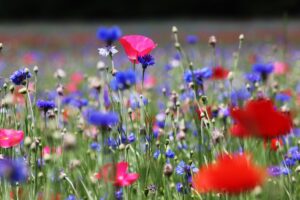
Flowers of remembrance. Photo by Gabrielle Hensch on Unsplash.