

Ecumenism is a neologism.
While that sentence hits the ear with all the clumsy force of a Dr. Seuss-like bit of doggerel, it is simply a statement of fact. Traditionally, the word “ecumenical” denoted “of or pertaining to the inhabited world,”1 and its use in the Catholic lexicon was generally limited to consideration of ecumenical councils. The -ism form of the word did not come into being until 1937, though the older form, ecumenicalism, has been around since 1870.
Ecumenism was coined in the context of a Protestant movement of Christian unity that sought to facilitate missionary efforts in pagan lands by presenting a “united front” to the heathen (see 1910 World Missionary Conference). The movement was not supported by the popes, who forbade Catholics to join in the ecumenical effort for the simple reason that there is one and only one way to achieve the unity of Christians, and that is inside the Church established by Jesus Christ Himself (see Pope Pius XI’s Mortalium Animos).
Over time, Catholic resistance to the movement weakened. Already, in the 1940’s our own Sister Catherine wrote a polemic entitled The Failure of Interfaith, using a then-popular name of the movement. Official Catholic participation in ecumenical gatherings was given at first a very limited sanction under Pope Pius XII; then, under, John XXIII and Paul VI, the movement was enthusiastically embraced. During that latter phase of ecumenism, the liturgical movement was hijacked for ecumenical purposes, which is why the new Mass is comparatively inoffensive to Protestants.
The papal embrace of ecumenism was not without ambiguity.2 If ecumenism is seen as a quest for Christian unity, that generic notion might be understood by Catholics in two very different specific ways, with two very different goals:
- The unity of all the baptized in the Catholic Church. Such a goal would entail efforts at the conversion of non-Catholics. This would be the only true Christian unity, as Pope Pius XI, summarizing the entire Catholic tradition, made clear.
- The unity of Christians by cooperating on matters upon which we agree, while relegating to a secondary importance those things upon which we differ. Concerning those secondary matters, we may engage in “dialogue” in an effort to seek out the truth together. Hence, the seemingly interminable ecumenical discussions that produce scandalous and confusing things like the 1999 “Joint Declaration on the Doctrine of Justification” by the Lutheran World Federation and the Catholic Church.
The first specific difference is very Catholic, rooted as it is in dogma and Christian Charity. We find it as a goal of great saints. The second is essentially Protestant and indifferentist. Given its obvious Catholicity, it is not surprising that the first notion of ecumenism is derided by many professional ecumenists with the horrible pejorative (in their eyes), “an ecumenism of return,” which constitutes a revelation of their essentially non-Catholic outlook on Church unity.
No Love Without Faith
No Living Faith Without Love
Catholics must cultivate an implacable hatred of heresy. That there is such indifference to heresy is itself a sign that faith is weak. Perhaps a deeper consideration of the nature of, and the interplay between, the three theological virtues will help us to form the strong convictions we need on the horror of heresy.
We name the theological virtues in a specific order, as did Saint Paul: Faith, Hope, and Charity. There is an ascending metaphysical order of dependence here. Faith is foundational, and without it, we cannot have Hope or Charity. Once Faith — the beginning of salvation — is in place, we can put Hope on top of it; and upon that two-fold foundation of Faith and Hope, Charity can rest secure. Eliminate Hope by a grave sin of presumption or despair, and both Hope and Charity leave the soul. Eliminate Faith by a grave sin of unbelief (heresy, apostasy, superstition), and the entire edifice crumbles, for Hope and Charity cannot remain when their foundation has been removed.
If we were to give it more than a moment’s notice, the foregoing is sufficient to motivate us to hate heresy with a virile hatred, for heresy destroys the supernatural Love of God in the soul! Without Faith, which heresy destroys, we cannot Love God and neighbor supernaturally. And doing that is what Jesus said is necessary to possess eternal life.
This thought should motivate us to work and pray for the conversion of our non-Catholic loved ones. It should shake us out of our indifferentist lethargy.
Is it “hateful” to think like this? No, it is not; it is supremely loving.
In addition to the ascending order of dependence outlined above, there is another that works inversely. It is a descending order of dependence, and it works this way: Just as we cannot have Hope and Charity at all without Faith, so, too, we cannot have living Faith and Hope unless they are animated by Charity. In the case of the first of the theological virtues, this is what Saint Paul calls, “faith that worketh by charity” (Gal. 5:6). Its opposite is the “dead faith” that Saint James warns us about, and concerning which Saint Paul writes, “if I should have all faith, so that I could remove mountains, and have not charity, I am nothing” (I Cor. 13:2). Twelve hundred years in advance, Saint Augustine condemned the Protestant heresy of “faith alone” precisely in terms of what Saints James and Paul said on this.
If we Catholics have Faith that works by Charity, we will love our non-Catholic friends and family enough to pray and labor for their conversion.
Even more fundamentally, if we have Faith working by Charity, we will love God enough to want Him to be known and loved with the supernatural Faith and Charity that are rendered impossible by heresy.
Love of God and Love of neighbor: Jesus said that the whole of the law and the prophets depends on these. Ultimately, this sublime reality of divine Love is the only remedy to the clumsy neologism that is ecumenism of the evil sort.
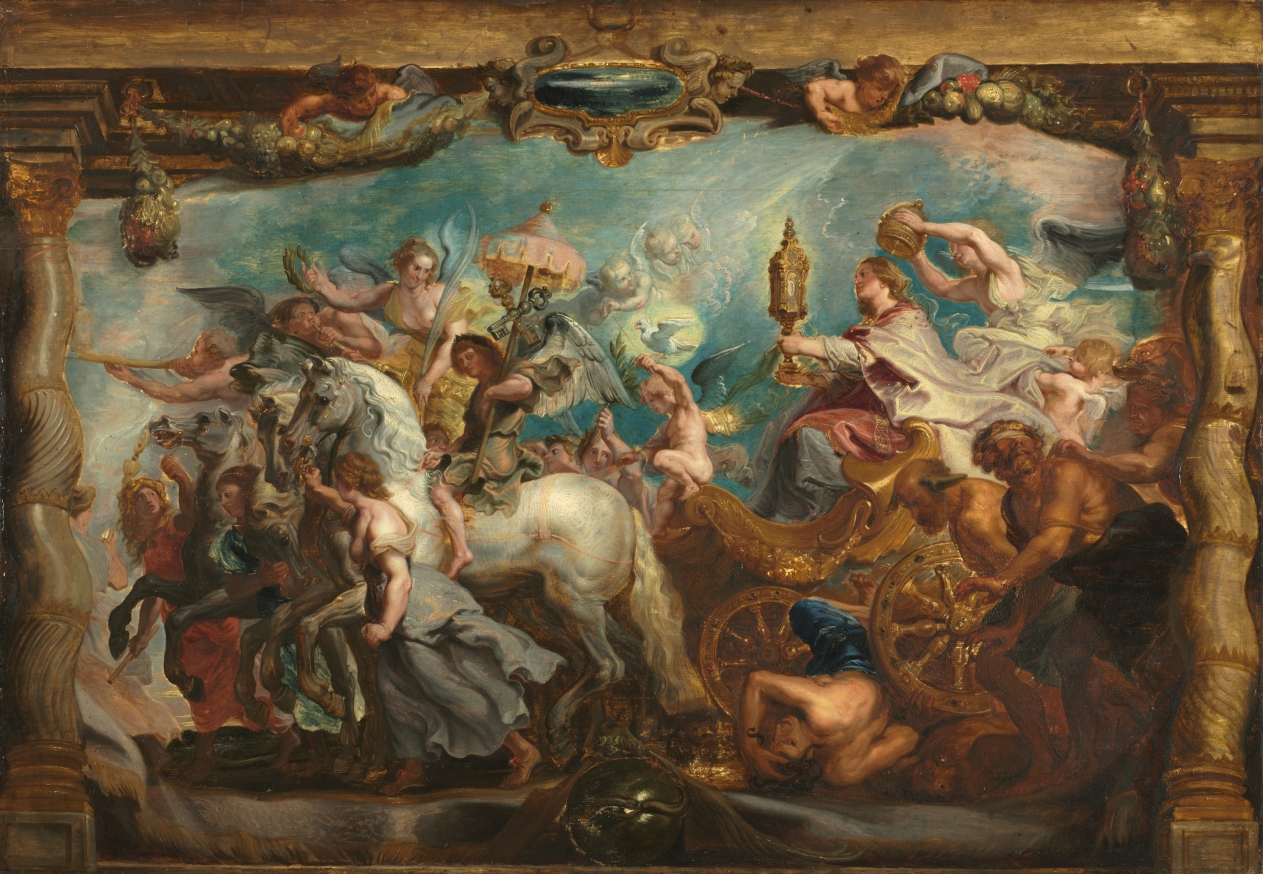
The Triumph of the Church, after 1628. Follower of Peter Paul Rubens (Flemish, 1577–1640). Oil on wood; framed: 129.5 x 96.5 x 8.5 cm (51 x 38 x 3 3/8 in.); unframed: 74.1 x 105.7 cm (29 3/16 x 41 5/8 in.). The Cleveland Museum of Art, Gift of Mr. and Mrs. J. H. Wade, 1916.1037. Public Domain.
— Footnotes —
1. See the entry for “ecumenical” at Etymonline.
2. The ambiguity can be seen in the texts of Vatican II: see Dom Pietro Leone, Vatican II and the Eclipse of God and Three Damning Paragraphs from Abbé Claude Barthe on Ecumenism. See also Father John Hardon’s definition of ecumenism, which is revealingly ambiguous coming as it does from this usually very clear thinker: “The modern movement toward Christian unity, whose Protestant origins stem from the Edinburgh World Missionary Conference in 1910 and whose Catholic principles were formulated by the Second Vatican Council in 1964.
“These principles are mainly three:
“1. Christ established the Church on the Apostles and their episcopal successors, whose visible head and principle of unity became Peter and his successor the Bishop of Rome;
“2. Since the first century there have been divisions in Christianity, but many persons now separated from visible unity with the successors of the Apostles under Peter are nevertheless Christians who possess more or less of the fullness of grace available in the Roman Catholic Church;
“3. Catholics are to do everything possible to foster the ecumenical movement, which comprehends all ‘the initiatives and activities, planned and undertaken to promote Christian unity, according to the Church’s various needs and as opportunities offer’ (Decree on Ecumenism, I, 4).” It is not at all clear in this third point that “Christian unity” can only be achieved in the Catholic Church, which is exactly where Jesus Christ Himself put it!



