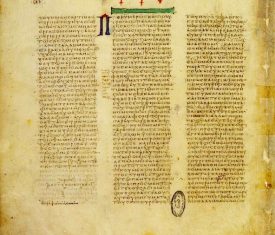
(This piece is an excerpt from a lecture Brother Francis gave in the 1970s.) The Bible is the book that makes saints.
A great sage of our time, Hilaire Belloc, foresaw what was coming upon our civilization. He saw its approach half a century ago more clearly than most people today see it now that it is here.
The importance of the Council of Trent lies in its being two things at the same time: 1) the heart and soul of the Catholic Reformation (the authentic reform of the Church); and 2) the definitive moment of the Counter … Continue reading
Catholicism.org introduction: This is classical apologetics from a real American Apostle of the Catholic Faith. Readers can learn more about Father Damen here: A missionary in Chicago: Fr. Arnold Damen S.J. by Cardinal Francis George, O.M.I.
St. Maximus, the monastic mystic and eminent controversialist of orthodoxy against the Monothelites, earned his title “the Confessor” because he died in exile for his heroic confession. In his defense of the orthodox faith against an heretical emperor and supine … Continue reading
Introduction: This is a work in progress. It is a section of a larger work on the various levels of magisterial teaching, the assent due to each, and where Vatican II fits into these categories. According to standards presently employed … Continue reading
This problem is important in establishing the relationship of nature to grace because it offers something of a “test case” by which we can illustrate certain fundamental truths of the Catholic Faith. These truths regard man’s natural powers and the … Continue reading
Here is the assignment: “The Church teaches that Christ is truly human and truly divine. Comment on the significance of each of the aspects of the mystery of Christ with regard to our sanctification and our salvation.” The title I … Continue reading
It is well known that J.R.R. Tolkien, the celebrated fantasy writer who gave us The Hobbit and The Lord of the Rings, was a Catholic. He was not a writer who just happened to be also a Catholic; he was … Continue reading
“Ensoulment” is the word which describes the point at which the body of the conceptus is said to be informed by a human soul. (The notion of a living being having “no soul” is a philosophical oxymoron, since the soul … Continue reading
On September 14, 1952, Pope Pius XII gave an address to the First International Congress on the Histopathology of the Nervous System. On that occasion, the Holy Father discussed the Principle of Totality at length and in the contrasting terms … Continue reading
The eighteenth-century Enlightenment mounted a severe offensive against the Church, one which combined various malignant cultural and intellectual trends that had gradually come into ascendancy since the Renaissance. “For the most part, the Church did not respond to this attack … Continue reading
It would be a gross oversimplification to put an equal sign between the words “Americanism” and “Modernism,” as if the former were merely the American embodiment of the latter. However, while we must avoid this facile identification of the two, … Continue reading
This phrase – “the synthesis of all heresies” – shows up toward the end of the Encyclical Pascendi Dominici Gregis, placed in the context of a rhetorical question.[1] After an apology for taking so long to explore the entire scope … Continue reading
The Catholic historian, A. Dufourcq, called the papacy of 1447 to 1527, la papauté princière, “the papacy of princes.”[1] This trenchant appellation conveys Fr. Maurice Sheehan’s meaning when he says “these popes were more men of culture or rulers than … Continue reading
Site development: Bonaventure