
Pennsylvania’s Eric Armusik Works with FSSP to Restore the Catholic Faith
There has been a liturgical Renaissance within the Church over the past two decades. This includes, not only greater access to traditional sacramental rites, but to other things that beautifully accompany them. Marble high altars, stained glass depictions of Christ and His saints, and Scripture etchings in Latin are among the many things that aid in visually teaching the faith, encouraging prayer and providing an appropriate dwelling for the Blessed Sacrament.
Painting human forms is the aspect of sacred art that Eric Armusik specializes in. The 51-year-old eastern Pennsylvania native and current resident has been commissioned to create portraits to adorn sanctuaries and other areas of church buildings across the country.
Armusik considers it a great honor and responsibility to be so closely associated with the official worship of the Church, but also maintains a holy comfort with the creative process. Having helped his carpenter-father on projects long before painting became his focus, Armusik considers it second nature to work with his hands. He sees the dignity in human efforts to create great works of art—works which themselves reflect this effort toward perfection rather than gloss over it.
The Penn State graduate’s most recent project is a replica of “St. Stephen Offering his Crown to Mary.” This altarpiece found in the Cathedral-Basilica of Saint Stephen in Budapest, Hungary, was fittingly chosen for his home parish of St. Stephen of Hungary, located in Allentown, Pennsylvania.
Also associated with eastern Pennsylvania is possibly his most-seen work to date: an 18 x 24-inch portrait of Saints Peter and Paul, commissioned by the Priestly Fraternity of Saint Peter in 2023. It was then used in 2024 as the cover image for a 5.5 by 8.5-inch novena flyer, 28,000 of which were distributed before the Feast of Saints Peter and Paul.
Armusik took time out of his busy schedule to speak of his spiritual, familial, and artistic heritage—and how he expands on it today—in this interview.
How did you become interested in art?
I don’t know if I can remember a time when I wasn’t doing something artistic. I started drawing at an early age and won my first drawing contest in kindergarten. Throughout my youth, I drew primarily in pencil, but I didn’t receive any formal instruction and knew nothing about art history.
My only exposure to art was attending Mass every Sunday at my parish of St. Hedwig in Edwardsville, Pennsylvania and later St. Leo in Ashley, Pennsylvania. It wasn’t until college—at Penn State University, where I majored in painting and drawing, with a minor in art history—that I had the opportunity to draw in charcoal and learn how to use oil paint.
At that time, I was also introduced to art history classes and immediately became captivated by the old masters, especially Caravaggio. I believe it was at that moment that I made a connection with my youth, reflecting on attending Mass and gazing at all the artwork on the walls and ceiling.
Each week, I would look at the artwork and wonder how it was possible to bring those biblical characters to life, so to speak, via paint and other materials. From that time on, I was dedicated to pursuing art.
In addition to figural painting, do you also engage in decorative painting or mosaics or other artwork?
The only graphic disciplines I work in are traditional oil painting and charcoal drawing. However, I also build my own tabernacle frames—the ornamentation, including a base, that directly touches the tabernacle—and panels for some of my artwork, many of which are in churches that have commissioned me.
My father was a carpenter, and when I was nine years old, I began working with him on remodeling and building homes. Over the past thirty years as an artist, I’ve been able to use this skill not only to build tabernacle frames but also to construct panels to size for my clients.
For decorative painting and other aspects of artistry, I defer to my gracious wife, Rebekah. She is a very talented writer who majored in Literature at King’s College in Wilkes-Barre, Pennsylvania. We were married in 1997 in the traditional Latin rite and we share a very deep and profound connection.
Rebekah is an amazing interior designer and has worked with me over the past twenty years to restore our beautiful 1860 Victorian home. She’s the only person I turn to for perspective on all of my ideas. From the compositions I paint to the business side of the work, Rebekah is the only one I trust for direction. Her wonderful insight has never failed me, and she’s always challenged me to give even more of myself than I thought possible.
How many kids do you have—and have they taken up art?
We have three children, each of whom is artistic in their own way. Our oldest daughter, Nadija (21) is a professional artist and one of my apprentices. Our next daughter, Milla (19) is a very talented baker who designs beautiful cakes, and our son, Alexei (16) is a musician and very gifted visual artist. He also serves 7 am Low Mass every Sunday at our parish of St. Stephen of Hungary in Allentown, Pennsylvania.
Have you done work in the parish?
Well, quite fittingly, I’m currently painting a replica of “St. Stephen Offering His Crown to Mary—an altarpiece by Gyula Benczúr at the cathedral in Budapest, Hungary—for our parish of St. Stephen of Hungary in Allentown.
The parish has been growing so quickly over the last seven years, that the FSSP has acquired a second parish, Holy Ghost, in nearby Bethlehem. Maybe I’ll get to do some work there, too, but I’m open to contributing to the re-traditionalization of any parishes that have been acquired by the FSSP, Institute of Christ the King, dioceses, etc.
Last year, I worked with the FSSP Headquarters in South Abington Township, Pennsylvania, on a commissioned painting of Saints Peter and Paul. The original is at the headquarters and a smaller version has been used in a glossy novena handout—28,000 of which have been printed for FSSP parishes.
Well, quite fittingly, I’m currently painting a replica of “St. Stephen Offering His Crown to Mary—an altarpiece by Gyula Benczúr at the cathedral in Budapest, Hungary—for our parish of St. Stephen of Hungary in Allentown.
The parish has been growing so quickly over the last seven years, that the FSSP has acquired a second parish, Holy Ghost, in nearby Bethlehem. Maybe I’ll get to do some work there, too, but I’m open to contributing to the re-traditionalization of any parishes that have been acquired by the FSSP, Institute of Christ the King, dioceses, etc.
Last year, I worked with the FSSP Headquarters in South Abington Township, Pennsylvania, on a commissioned painting of Saints Peter and Paul. The original is at the headquarters and a smaller version has been used in a glossy novena handout—28,000 of which have been printed for FSSP parishes.
Who are your favorite artists and what are your favorite projects?
Some of my favorite artists are Caravaggio, Bouguereau, Artemisia Gentileschi, Léon Bonnat, John Waterhouse, Lawrence Alma-Tadema, and Jean-Léon Gérôme. What I draw from many of these artists is their sense of drama, painterly skill, and the way they capture human emotions.
I am not an artist who paints “ideal” subjects unaffected by the trials and tribulations of life. Those works of art certainly do have their place in the Church—especially in Byzantine iconography—but they are not my specialty.
I enjoy the dramatic imperfections seen in the works of the artists just mentioned. Caravaggio, for example, painted saints with dirty feet, which was considered a grave sacrilege at the time.
This “real-life” approach serves as a foundation for my own artwork. It is inspiring to realize that saints were ordinary people, like you or me, rather than idealized figures devoid of personality. They surrendered their human comforts, sacrificing everything to follow God’s instructions. I want to create artwork that inspires all of us to walk that arduous path to perfection.
Tracy Christianson, an FSSP parishioner at North American Martyrs in Edmonds, WA, runs Portraits of Saints, which offers artwork done with colored pencils. It seems like painting would be more difficult because of the “commitment” one would have to make with bulkier strokes. Do you ever get halfway through a painting and start over?
Over the years, I have learned many things, and based on your question, I would say that the most important advice I can give is to have a good plan going into a painting project. The better prepared you are with good references, the better your artwork will be.
A typical project starts with some thumbnail sketches exchanged between me and the client. Once a direction is agreed upon, I hire models to “act out” the scene, and I either draw sketches or take reference photographs. From there, I build a scene with figures and background and present a final sketch to the client.
Only if the sketch is approved do I begin painting. If more changes need to be made, I make them before I start painting. It is much easier to make edits on a sketch than on nearly finished artwork. This process is very efficient, and I can proudly say I have a very happy and loyal client list.
How does the FSSP’s overall mission mesh with and inspire your work?
I believe deeply in the mission of the FSSP to uphold and teach the teachings of the Church. As an artist, I feel I have an important role to play in this mission. Over the past 60 years, we have witnessed not only a troubling trajectory in the modern Mass, but also the negative impact of modernism on art and architecture intended to inspire the faithful.
I would argue that this modern, lackluster art has done the exact opposite. Our churches are no longer built in the traditional cruciform layout, and in some parishes, it is even difficult to find the altar. What kind of justification could there be for a building whose very purpose is concealed or compromised?
By contrast, I see the remarkable effect that good pastoral care and proper catechesis can have on a congregation. Having appropriate artwork plays a crucial role in supporting these traditional efforts to portray the faith accurately to souls today.
I can say that every Latin Mass I attend brings me peace and consolation. It inspires me as an artist, and I act on that inspiration to create, using the blessings God has given me.
Do you often have to correct misconceptions about sacred art or do people usually approach you with a good understanding of what can be done?
To be honest, most projects I work on have been very fulfilling. There haven’t been too many jobs over the years that I’ve had to decline. Most projects provide a great opportunity to work with a client’s vision, and they generally defer to my artistic expertise.
The majority of my clients, even in Novus Ordo parishes, have been very sympathetic to the traditional aspects of sacred art. This has been especially noticeable over the past twenty years, particularly with younger priests and seminarians.
Long before his papacy, Pope Benedict said that “The only really effective apologia for Christianity comes down to two arguments—namely, the saints the Church has produced and the art which has grown in her womb.” He also said that Christians “must make their Church into a place where beauty—and hence truth—is at home. Without this, the world will become the first circle of Hell.” Have you found these statements to be true?
I completely agree with His Holiness, Pope Benedict. The Church is our refuge from the world. I have found this to be true even as a child.
I lived in an economically depressed, former coal-mining town. My great-grandmother tragically died at age twenty after having given birth to her second child, and then my great-grandfather immigrated here from Białystok, Poland around 1900. He spent his life in the mines, and died because of it. My grandfather did the same, dying from lung cancer.
Somehow, these poor immigrants, with their meager wages, built beautiful churches all over the region we lived in. They were as beautiful as almost any in Europe. These churches were their refuge. They went to them, knowing they might not be with their families next week because of the dangers involved.
As a child, I stared in wonder at those same sacred spaces. A decade later, I spent a semester in Italy and marveled at the greatest sacred artworks ever created. There is a power and an undeniable beauty that comes from the divine in those artworks and architecture. There is a harmony those artists tapped into because they drew inspiration from God.
I do not feel that same perfection in the art of the secular world or the art seen in modern churches today. As sacred artists, we have a responsibility to create inspiring works of art that will draw people closer to God, rather than push them away or leave them with a thousand questions.
Beauty comes from symmetry, balance, and a sense of order that can, in turn, only come ultimately from God. The most beautiful creations we humans have ever made have come from, and have been intended for, the adoration of God.
Modern art stands in opposition to these ideals, and this art has no place in the Church. Why would we want to co-opt an artistic style that embraces the ugly secular world? We must do better. We must return to the past, to our true, traditional Catholic identity.
Trent Beattie is the author of Scruples and Sainthood (Loreto Publications) and Fit for Heaven (Dynamic Catholic). He is also the editor of Saint Alphonsus Liguori for Every Day (Mediatrix Press), Finding True Happiness (Dynamic Catholic) and Apostolic Athletes (Marian Press).
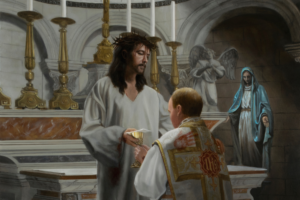
“Ordination” by Erik Armusik. Image supplied by author.



