
In the name of the Empress of India, make way,
O Lords of the Jungle, wherever you roam.
The woods are astir at the close of the day—
We exiles are waiting for letters from Home.
Let the robber retreat—let the tiger turn tail—
In the Name of the Empress, the Overland Mail!With a jingle of bells as the dusk gathers in,
He turns to the foot-path that heads up the hill—
The bags on his back and a cloth round his chin,
And, tucked in his waist-belt, the Post Office bill:—
“Despatched on this date, as received by the rail,
“Per runner, two bags of the Overland Mail.”Is the torrent in spate? He must ford it or swim.
Has the rain wrecked the road? He must climb by the cliff.
Does the tempest cry halt? What are tempests to him?
The Service admits not a “but” or an “if.”
While the breath’s in his mouth, he must bear without fail,
In the Name of the Empress, the Overland Mail.From aloe to rose-oak, from rose-oak to fir,
From level to upland, from upland to crest,
From rice-field to rock-ridge, from rock-ridge to spur,
Fly the soft sandalled feet, strains the brawny brown chest.
From rail to ravine—to the peak from the vale—
Up, up through the night goes the Overland Mail.There’s a speck on the hillside, a dot on the road—
A jingle of bells on the foot-path below—
There’s a scuffle above in the monkey’s abode—
The world is awake, and the clouds are aglow.
For the great Sun himself must attend to the hail:—
“In the name of the Empress, the Overland Mail!”
—Rudyard Kipling, “The Overland Mail.”
American Thanksgiving is traditionally a family feast observed on the fourth Thursday of November. Unlike the Canadian Thanksgiving, which falls on our Columbus Day and is more of a generic harvest thanksgiving festival rather than a commemoration of any specific historic event, we also celebrate the memory of the Pilgrim Fathers, and their “First Thanksgiving.” At Plimoth Patuxet Museums — renamed from Plimoth Plantation during a spate of national self-hatred — it shall be heavily re-enacted. Pilgrim Hall Museum, in Plymouth itself, shall be similarly employed. The Old Colony Club, founded in 1769, is at the very centre of festivities in Plymouth — Thanksgiving is second only in importance in their calendar to the club’s celebration of Forefathers’ Day, commemorating the actual landing of the Pilgrims at Plymouth Rock in 1620. All of this is even more meaningful in the 250th year since the Declaration of Independence.
In the popular mind, the United States are the result of a sort of Salvation History, wherein the Pilgrims partook of an “Old Covenant,” while the Founding Fathers were part of a New Covenant. But rather than being bound directly with God (although some maintain that the Constitution was inspired by the Holy Ghost directly), these covenants were with a sort of ill-defined deity called “Liberty” or “Freedom.” Thus comes the sacredness of Plymouth at Thanksgiving (not unlike its sister Massachusetts town of Salem at Halloween, but that is a totally different vibe). It is the sacred origin of our country and her independence.
Of course, this view is actually false. The first permanent European settlement in our country was made by the Spanish at St. Augustine, Florida, in 1565. Then came what is now El Paso, Texas, 33 years later. It was not until 1607 that the English founded Jamestown, Virginia. This — not Plymouth — was the first settlement in Anglo-America — and three years later, the Spanish would follow it up with Santa Fe, New Mexico. Neither Spanish nor English settlements were founded to establish freedom from their respective Mother Countries — but rather to extend these countries into the newly discovered climes Columbus and his successors had added to Europe’s vision.
But surely, the Pilgrims founded Plymouth to escape England’s tyranny? Only in a sense, because they wanted a place where they could do what they wished to, regardless of any supervision from home. But independence was the furthest thing from their minds, as witnessed by the actual text of the Mayflower Compact. “IN THE NAME OF GOD, AMEN. We, whose names are underwritten, the Loyal Subjects of our dread Sovereign Lord King James, by the Grace of God, of Great Britain, France, and Ireland, King, Defender of the Faith, &c. Having undertaken for the Glory of God, and Advancement of the Christian Faith, and the Honour of our King and Country, a Voyage to plant the first Colony in the northern Parts of Virginia; Do by these Presents, solemnly and mutually, in the Presence of God and one another, covenant and combine ourselves together into a civil Body Politick, for our better Ordering and Preservation, and Furtherance of the Ends aforesaid: And by Virtue hereof do enact, constitute, and frame, such just and equal Laws, Ordinances, Acts, Constitutions, and Officers, from time to time, as shall be thought most meet and convenient for the general Good of the Colony; unto which we promise all due Submission and Obedience.
“IN WITNESS whereof we have hereunto subscribed our names at Cape-Cod the eleventh of November, in the Reign of our Sovereign Lord King James, of England, France, and Ireland, the eighteenth, and of Scotland the fifty-fourth, Anno Domini; 1620.”
The reasons given by the Pilgrims for settling Plymouth, “the Glory of God, and Advancement of the Christian Faith, and the Honour of our King and Country,” were precisely those of all the other nations — Spain, Portugal, France, and so on — who cast off into the unknown in the wake of Da Gama and Columbus. Of course they were also after riches, and of course there were evils done — as have been done by every people since Adam fell. But what set the Europeans apart from the many other conquerors, great and small, who had bedevilled the heathen parts of the World since the beginning was that they brought gifts worth far more than the wealth they hoped to derive from the new colonies overseas.
To begin with, they brought the Light of Christ. The Spanish Patronato Real, the Portuguese Padroado Real, and the French subsides du Roi financed the work of the Church in their respective overseas possessions. Unfortunately, the expansion of Europe across the globe began as the Protestant revolt got under way; its divisions were thus exported into the colonial world. Not only did it set Spain, France, and Portugal against the English/British and Dutch, but the religious divisions within Protestant nations were introduced into their possessions. So it was that in 1628 Calvinist Plymouth’s small force suppressed Anglican Merrymount. When the Wars of the Three Kingdoms broke out in 1642, Catholic Maryland and Anglican Virginia backed their King Charles I; the New England colonies sided with Cromwell. The New Englanders rejoiced at the King’s murder, and the last battle of those wars was fought in Maryland in 1655. But the Restoration saw New Netherland’s conquest and conversion into New York, New Jersey, and Pennsylvania, and the founding of Carolina. The overthrow of James II and VII in 1688 was mirrored in the colonies as well. Bad as these were, they paled beside the conflicts with the Catholic powers.
Nevertheless, colonial expansion continued. The American Revolution led to the French Revolution on the one hand, and the Latin American Wars of Independence on the other. As explored in these pages, that conflict was a complex civil war, and not the simple war of liberation the national hagiography has always claimed it to be. The build-up to the revolution even split Plymouth’s own Old Colony Club — with the Loyalist members eventually excluded and then literally exiled. The Loyalists in general deserve a great deal more study than they have received — not least because we seem to be in the midst of changes not unlike those they faced — in degree, if not in kind. When the British were defeated, the new nation appropriated all the apparatus of government the British had installed — Governors, legislatures, courts, Common Law, counties, sheriffs, coroners, juries, notaries public, and all the rest of it — even our oldest national guard units date back to 1636. The British, on the other hand — George III’s attempts at reform having been defeated — began the long road to where they are to-day.
After the French Revolution and the Napoleonic Wars, several things happened. The United States almost immediately became an expansionist power on their own, first buying Louisiana, and then defeating Mexico for the Southwest and making a deal with Britain for the Northwest; this process would culminate in the snatching of Puerto Rico, Guam, Cuba, and the Philippines from Spain in 1898. In the meantime, Latin America had gone through its own disastrous wars of independence, which set the stage for further chaos. Here too, the Royalists deserve a lot more study.
But in addition to the United States entering the colonial fray, the 19th century saw some changes in the race for colonies. Vast areas in Asia and Africa were annexed; instead of their indigenous peoples being assimilated into the colonial system, many of their pre-existing social structures were maintained intact. The British and Dutch altered their attitude to Catholic missions from opposition to support. In addition to the United States, newly united Germany and Italy entered the colonial world.
Regardless of political status, the 19th century saw a huge distinction between settler colonies — such as the United States, the Latin American countries, Canada, Australia, New Zealand, and to a great degree South Africa — and the others, whose function was primarily economic. While, as mentioned, some care was taken to preserve their native societies, in addition to evangelisation by Christian missionaries, another great goal was preached: the civilising mission. In a word, this meant that in repayment of sorts for the raw materials being extracted, modern education and infrastructure would be implanted — complete with modern medicine. This was Kipling’s “White Man’s Burden”: the savage wars of peace, filling the mouth of famine, and bidding the sickness cease. Again, as with all things human, there was plenty of both error and malice; but on the whole, it was better than what preceded it.
World War I removed Germany from the colonial epic. World War II saw the European powers entirely replaced as masters of their destiny by the Americans and Soviets. Together, the victorious powers — enemies in some places — successfully cooperated to push America’s European Allies out of their Empires. Post-WWII decolonisation resulted in the deaths of an estimated 3.5 to 4.5 million people across Asia, Africa, and the Middle East. Most of the independent countries created by this process have lurched from one disaster to another in their histories, ranging to-day from banana republics to utterly failed states. As Sir James Wilson Robertson, last colonial Governor-General of Nigeria, remarked in his memoirs, “Americans have asked me: ‘Why did you leave so soon, before the colonial territories were ready to rule themselves?’ And when I have answered, ‘Partly, I am sure, because of your pressure on us to go,’ [they] have answered that they did not know then what they know now, and that we should have resisted their pressure.”
To-day, the Woke will babble about “decolonising literature” and the like. Google AI provides a useful and concise guide to this drivel. “The term ‘decolonising’ has gained prominence in the context of the so-called ‘woke’ discourse. It has taken on metaphorical and socio-political significance that extends far beyond the historical end of colonial rule.
“Core concepts of ‘decolonising’ in Woke terminology
“Deconstruction of knowledge and language: Proponents argue that Western languages, academic disciplines, and education systems are shaped by a Eurocentric or colonial past. ‘Decolonising’ here means questioning vocabularies, narratives, and thought patterns that relegate minorities to marginalised groups or establish dominant Western perspectives as the universal norm.
“Decolonising the Curriculum: In educational institutions, this approach calls for diversifying reading lists and teaching content. The goal is to reduce the proportion of white, Western male authors and instead include more voices from women, non-Western authors, and marginalized groups.
“Critical examination of power structures: This approach assumes that Western societies are based on a ‘network of power systems’ that favors certain groups and oppresses others. ‘Decolonising’ calls for examining institutions, monuments, traditions, and ways of thinking for these power asymmetries and for decentering Western-centric perspectives.”
Of course, it is only colonial languages and colonial technology that make this kind of prattling possible. Were such folk honest, they would simply learn indigenous languages, resign from academia, and retreat to some sort of remote lifestyle. But hypocrisy is what it is.
It was precisely during the period of real decolonisation that the European nations also underwent severe secularisation. The real reason for their superiority ebbed away. Dom Guéranger had made several predictions during the 19th century regarding this very reality. He first evaluated the Christian nations and their relationship with the pagan world thusly: “The Christian People (in which both prince and beggar are equally subjects) is superior to every other, in intellectual and moral worth. It carries civilisation with it wheresoever it goes, for it carries with it the true notion of God and of the supernatural end of man. Barbarism recedes; pagan institutions, how ancient soever they may be, are forced to give way. Even Greece and Rome laid down their own to adopt the laws of the Christian Code—the Code which was based on the Gospel. So, too, in our own times, the mere sight of a Christian army, though composed of but a few thousand men, struck terror into the heart of an immense Empire of the East: its Ruler who counts four hundred million subjects and calls himself the ‘Son of the Celestial Empire,’ was so overcome by fear that, without offering the slightest resistance, he fled from his palaces and Capital. Yes—this is the superiority given by Baptism to Christian Nations; for it would be absurd to attribute this superiority to our civilisation, seeing that civilisation itself is but a consequence of Baptism.”
Yet this superiority is entirely conditional on the Christian Nations retaining their Faith: “And we, the western nations, if we return not to the Lord our God, shall we be spared? Shall the flood-gates of heaven’s vengeance, the torrent of fresh Vandals, ever be menacing to burst upon us, yet never come? Where is the country of our own Europe, that has not corrupted its way, as in the days of Noah? That has not made conventions against the Lord and against His Christ? That has not clamored out that old cry of revolt: Let us break their bonds asunder, let us cast away their yoke from us? Well may we fear lest the time is at hand, when, despite our haughty confidence in our means of defense, Christ our Lord, to whom all nations have been given by the Father, shall rule us with a rod of iron, and break us in ‘pieces like a potter’s vessel.’” So it has proved, as we may see not only by Europe’s condition, but that of all the Western countries.
But our learned author has hope, even so: “If, later on again, our Europe be misled by false theories and break with the Church; if this beloved Spouse of Jesus be betrayed and pillaged, calumniated and deprived of her rights by those very Nations which she had protected for so many ages, as the most loving of Mothers;—fear not; the Holy Ghost will add to her glories in some other way. Look at his present workings in the Church. Whence, if not from him, are those ever-increasing vocations to the apostolic ministry? Moreover, while conversions from heresy are more numerous than at any previous period, there is not an infidel country where the Gospel is not being preached. Our century has had its Martyrs for the Faith; it has heard the authorities of China and Cochin China, like the Proconsuls of old, putting the Christians through an examination; it has heard the sublime answers, suggested by the Holy Ghost to these brave Confessors, as Christ had promised. (Matthew 10:20) The farthest East produces its elect; the negroes of Africa are evangelized; and if a fifth part of the World has been made known, it already counts its Faithful by thousands, flourishing under a hierarchy of lawfully appointed Pastors.”
All of this is true — but the foundation of all of that was precisely Colonialism in Europe’s days of Faith and greatness. The foundations she laid were deep and strong — and all the world still benefits from them, not least we Americans. Let this rich heritage be part of what we are thankful for as this year of 2026 crawls slowly toward its close.
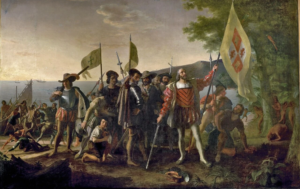
John Vanderlyn, Public domain, via Wikimedia Commons