
LOUGH DERG, IRELAND (Bénédicte Cedergren/National Catholic Register) — Every year, more than 10,000 pilgrims make their way to Lough Derg, to take part in an intense three-day pilgrimage, following a 1,000-year-old tradition of strict fasting, keeping vigil and barefoot prayer.
Tradition links Patrick to the island through his disciple St. Dabheog, “a young man remembered as a disciple of St. Patrick,” Father Laurence Flynn, prior of Lough Derg, told the Register.
The disciple presided over and likely established a monastery on Lough Derg in the fifth century, just a few decades after the arrival of Christianity in Ireland.
“St. Patrick, in his own writings, makes no mention of this place,” Father Flynn said, adding, “In the two texts that Patrick himself wrote — his Confession and Letter to the Soldiers of Coroticus — which scholars have accepted as coming from him, Lough Derg is not mentioned.”
Read more at National Catholic Register…
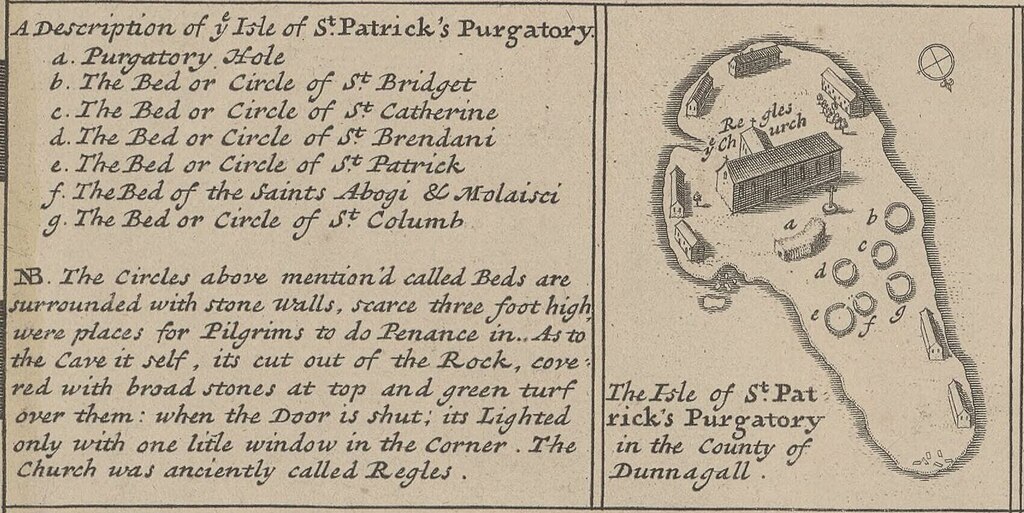
A map of British-occupied Ireland c. 1736 with bishoprics, cities, market towns, English estates, barracks, and fortifications, post and cross roads, ferries, bogs, and major sand bars along the Eastern shore marked. A chart on the bottom right lists the “troops” and companies of British soldiers stationed at various locations. Inset maps show the British Isles in Europe and detail maps of Dublin, Cork, Kinsale, Limrick, Waterford, Galway, the island of St. Patrick’s Purgatory, and the area around the Giant’s Causeway. Notes: A Description of ye Isle of St. Patrick’s Purgatory a. Purgatory Hole b. The Bed or Circle of St. Bridget c. The Bed or Circle of St. Catherine d. The Bed or Circle of St. Brendan’s e. The Bed or Circle of St. Patrick f. The Bed of the Saints Abogi & Molaisci g. The Bed or Circle of St. Columb NB. The Circles above mention’d called Beds are surrounded with stone walls, scarce three foot high were places for Pilgrims to do Penance in.. As to the Cave it self, its cut out of the Rock, covered with broad stones at top and green turf over them; when the Door is shut, its Lighted only with one litle window in the Corner. The Church was anciently called Regles. Printed for H. Moll over against Devereux Court in ye Strand, I. Bowles at the Black Horse in Cornhill, P. Overton Map & Printseller near St. Dunstans Church Fleetstreet, and T. Bowles Print & Mapseller next to the Chapter house in St. Pauls Church Yard. And by I. King Map and Printseller at the Globe in the Poultry. Public Domain via Wikimedia Commons.



