

Beautifying Churches Means Beautifying Souls
Many traditional Catholics recognize the name of architect Thomas Gordon Smith, who designed the Priestly Fraternity of St. Peter’s Our Lady of Guadalupe Seminary in Nebraska. Similarly familiar is Duncan Stroik, who, at the direction of Cardinal Raymond Burke, planned the shrine in Wisconsin under the same patronage of Our Lady of Guadalupe. Then there’s William Heyer, responsible for the layout of the Abbey of Our Lady of Ephesus in Missouri. However, it seems very few traditional Catholics can name a single studio that decorates church interiors. This is due in part to curiously common articles on church projects that make no mention of which companies were behind the artistic transformations.
Such a journalistic framework is equivalent to writing a story on a baseball game without reference to the teams that played it. Name general managers that put the teams together, the stadium in which the game took place, and even explain the singles, doubles, triples, and homeruns that were hit — just don’t mention that the New York Mets and the Atlanta Braves were the ones who hit them.
To remedy this grand omission, three major companies that beautify church interiors will be spotlighted here: Daprato Rigali Studios in Chicago, Illinois, EverGreene Architectural Arts in Brooklyn, New York, and Conrad Schmitt Studios in New Berlin, Wisconsin. Daprato Rigali Studios has beautified places of worship such as the Cathedral of Saint Mary of the Immaculate Conception in Peoria, Illinois (see photos….); EverGreene Architectural Arts is responsible for the extensive renovation of the Co-Cathedral of St. Joseph in Brooklyn, New York (see photos…); and Conrad Schmitt Studios is primarily responsible for the highly-detailed designs on the walls and ceiling of the Basilica of St. Josaphat in Milwaukee, Wisconsin (see photos…).
In addition to being dedicated to truly sacred art, two of these studios have a long family history. The Rigali family’s commitment to beautifying churches extends back to 1881, when John E Rigali came to the United States to work with the Daprato brothers at Daprato Statuary Company. In 1909, Pope St. Pius X deemed the company a “Pontifical Institute of Christian Art” and in 1960 it started using the name Daprato Rigali Studios. Today it is run by the fourth generation of Rigalis: Mike, Bob, John, and Elizabeth.
Conrad Schmitt Studios has a somewhat similar history, as the company was founded in 1889 by the German immigrant who gave it his name. Bernard O. Gruenke started working with Conrad Schmitt in 1936 and bought the company in 1951. His son, Bernard E. Gruenke, Jr., took over in 1981 and since 2010 the company has been run by the family’s third generation: B. Gunar Gruenke and Heidi Gruenke Emery.
Probably Conrad Schmitt Studio’s most visible project is the re-gilding of the famous golden dome atop of the Main Administration Building at the University of Notre Dame. The studio has been an integral part of many artistic projects at the South Bend, Indiana since 1933, including those in the Basilica of the Sacred Heart.
Another of Conrad Schmitt’s well-known projects is the Basilica of St. Josaphat in Milwaukee, which began in 1926 after the main structure had been completed in 1901. The basilica was decorated in the grand and ornate “Polish Cathedral Style” that took shape in cities such as Milwaukee, Chicago, and Detroit in the 19th and early 20th centuries.
This Basilica of St. Josaphat is a testament to the power of true ecumenism, which becomes clear in the story of St. Josaphat himself. He was born in Poland in 1580, became a Basilian priest and then a bishop. He worked to reunite the Orthodox to the Roman Catholic Church and was rewarded for ecumenical his efforts with a bloody martyrdom in 1623.
St. Josaphat was canonized by Pope Pius IX in 1867, and the Milwaukee basilica named after him was built less than four decades later, not only due to the generosity of Catholics, but also that of non-Catholics. How much sharper of a contrast can there be than that found in murdering a clergyman versus paying for a basilica named after him? I can imagine that the non-Catholic donors not only attended Catholic liturgies at the amazing structure they helped to bring to life, but possibly became Catholic themselves.
Beautiful art has the power to transform souls. Venerable Louis of Granada — whose literary influence extended to no less than St. Charles Borromeo, St. Rose of Lima, St. Francis de Sales, St. Teresa of Avila, and St. Vincent de Paul — knew the power of beauty. This 16th century Spanish Dominican wrote in volume 1, chapter 6 of Summa of the Christian Life — an extremely insightful trilogy from TAN Books that, ironically, would look much better with images from this article on its 1970s-inspired covers — that:
Not only goodness but also true beauty greatly moves the heart to love. For this reason some learned men have said that the object of our will is the beautiful, because they saw with what force it attracts all wills to itself.
Venerable Louis also taught, in volume 2, chapter 47 of his Summa that “Our souls are spiritual substances and they must be sustained by the vision of God as far as it is possible in this life. As the vision of God is, so is the life that results from it…” Quite simply, our image of God determines how we live. Thus, it is of the highest importance to have accurate ideas of The Almighty, since these ideas ultimately determine where we spend eternity.
Rich in Beauty
The importance of theological vision can be clearly seen in the story of Charles Rich, a convert to the Catholic faith. Rich, born in 1899, was raised a Jew and then became an atheist. Despite studying philosophy and religion in his twenties, he was overcome with depression and became suicidal. Of particular note here is that even though his studies included the writings of great saints, he remained empty.
However, prayer and sacred art would eventually fill him up, starting on one warm day during the 33rd year of his life. He was in New York City when he overcame his hesitancy to enter a religious building that did not reflect his own beliefs. Once inside a Catholic church, Rich looked up at a beautiful stained glass window depicting Christ calming the storm for the apostles. He longingly thought of how wonderful it would be if the Catholic faith, a part of which was right before his eyes in colorful form, were actually true.
Rich had been “pulverized” by the apparent meaninglessness of life, like a rock reduced to a pile of sand. Yet on this warm day, the “sands of his soul” were baked and molded by the Divine Artisan into a living reflection of what was portrayed before him.
The previously discontented young man, after many years of studying religion, became convinced, through sacred art, of the truth in his Catholic studies. Rich’s prayers were answered and he spent the rest of his 99 years of life immersed in the peaceful bark of Saint Peter. Rich wrote about his amazing conversion in Honey From the Rock. (Ignatius Press, 2007), asking,
Do we wish to become beautiful with Christ’s own beauty? If we do, it is to the Church of Rome that we must go for that kind of beauty, and beauty [is] to be found in everything she promulgates by way of her liturgy, her chants, her statues, and her paintings. It is to the Church of Rome we have to go to get a living experience of the beauty of Christ’s being, seeing that that beauty of His is enshrined and interwoven with everything she does and is. (pg. 89)
Without a doubt, the way our churches are decorated will inspire, delight, comfort, disgust, bore, or confuse us, so we should take the initiative to ensure the first three verbs are operating rather than the last three.
Highways to Heaven and Hell
This active appreciation for beautification seems easy enough, but many readers, despite being thoroughly convinced of the glory of the projects shown here, will be tempted not to follow up. As Venerable Louis of Granada wrote in Volume 2, chapter 25 of his Summa:
The intellect is the door through which truths enter and reach the will, but sometimes truths are so long detained at the doorway of knowledge that they never reach the will, with the result that the intellect is fully satisfied but the will is empty and dry and the entire man remains empty and fruitless.
We can become so thoroughly impressed by, and convinced of, the truth of something that we imagine our mere acceptance of it equals living it out. We’ve all heard that the road to Hell is paved with good intentions, but fewer of us have heard the completion of the expression — that the road to Heaven is paved with good works. We can agree, appreciate, and theorize all we want, but our mental activity will not gain us Heaven. Our grace-aided works, motivated by faith in God’s command to perform and His promise to reward them, will.
We read in Romans 2:6 that God will “render to every man according to his works.” In the next verse, we are told that “Life eternal indeed He will give to those who by patience in good works seek glory and honor and immortality…” Our actions, then, should be focused on God, attempting to draw all souls into communion with Him — a communion that will endure forever in Heaven.
Beautifying a church building is a thoroughly evangelistic thing to do, and it can often be more effective than efforts made through reason alone. For example, when was the last time you heard someone say, “That painting is so judgmental; it should stop trying to tell me how to live my life!” On the contrary, sacred art can be the means through which someone becomes completely Catholic, as was the case with Charles Rich. Facts alone do not seem to lead to many conversions, but prayerful acceptance of those facts beautifully portrayed, does.
This is not to say that everyone must beautify his church, as some churches are in no need of this. However, most of us can probably name a nearby church that does need beautification. In fact, many of us can probably name several needy structures. Do we have enough charity (the theological virtue of the love of God and neighbor) to engage in what most people limit the word to meaning (donations of money or material goods)?
Sure, we may not have enough money or influence to completely renovate an entire neighboring church, but how about suggesting project to the pastor or buying one colorful portrait of a parish’s patron saint from, say, Monastery Icons? Each church’s needs vary, but it’s not too difficult to imagine a portrait here or a statue there, especially in today’s all-too-often colorless and vacuous church milieu.
The Duty of Beauty
We should also remember that providing for the material needs of the Church according to our ability is a duty rather than a hobby. It is one of a very small group of precepts, or actions we are obliged to undertake in order to meet the bare minimum of life in Christ.
The “duty of beauty” is affirmed in No. 124 of Vatican II’s Constitution on the Sacred Liturgy, Sacrosanctum Concilum, which reads, in part,
Let bishops carefully remove from the house of God and from other sacred places those works of artists which are repugnant to faith, morals, and Christian piety, and which offend true religious sense either by depraved forms or by lack of artistic worth, mediocrity and pretense.
Then local church leaders are directed in No. 127 of the same document, not only to eliminate art that is lacking, but to actively promote truly sacred art:
Bishops should have a special concern for artists, so as to imbue them with the spirit of sacred art and of the sacred liturgy…It is also desirable that schools or academies of sacred art should be founded in those parts of the world where they would be useful, so that artists may be trained.
These ideas are reiterated, somewhat surprisingly, in Article 8 of the section on the Ten Commandments in the Catechism of the Catholic Church. This seemingly odd placement is clarified by numbers 2500-2503, which explain the relationship of truth and beauty, making it clear that sacred art should facilitate our adoration of the gloriously transcendent Trinity. Of course this can never be done with perfection through stone, paint, plaster, and glass, but the Church nevertheless instructs us to put forth our best efforts.
Hollow the Money
For those church buildings in need of improvement, not everyone is able to donate large sums of money, but this does not mean nothing need be done. “Because I cannot do everything, I will do nothing” is not a good maxim to live by. Remember how Our Lord was pleased with the seemingly meager offering of the widow in Matthew 12:41-44? In fact, He said she had given more than the others, because it came from what she had to live on rather than from surplus.
Besides that, many of us are actually wealthier than we realize. We have become so accustomed to luxuries that we do not see them as such. I recently had a conversation with someone who complained that her property taxes were too high and also mentioned that cat insulin is terribly expensive — even at Costco, mind you.
Can you imagine the perplexed look on the face of an Ethiopian hearing someone from the United States say she’s poor because she can barely afford cat insulin for one of her many pets? Perhaps if we stopped buying cat insulin, $5 cups of coffee, and other hollow luxuries, it would be much easier to pay property taxes and give something “sizeable” to the Church. For some, the choice is between lowered feline blood sugar and heightened participation in the majesty of God.
Those who have lots of money, regardless of expenditures on cat insulin, coffee, and a hundred other things should be all the more generous, heeding the words of Venerable Louis of Granada on the Parable of Lazarus and the rich man from volume 2, chapter 28 of his Summa:
The rich ought to take special notice of this parable and consider, as St. Augustine says, that the rich man was not condemned for having taken the possessions of others, but for not having given out of his own possessions.
The rich man may have earned all of his money lawfully, but we are told that this is no reason to sit on it or use it merely for one’s own entertainment. Rather, we should use money for noble ventures. Lazarus was looking for scraps of food, while most people in our country are in desperate need of spiritual sustenance. Thus, Lazarus can be seen for our purposes as representing those in need of holy things.
Venerable Louis then quotes St. Basil’s wise words, which grow stronger and sharper:
You ask whom you are harming if you keep what is yours. What do you call yours? Did you bring anything into this world? …
Understand that riches may mean the salvation of souls. In preserving riches, you cause souls to be lost, but in losing your riches for the sake of God, you save souls.
I have seen those who have fasted and prayed and wept over their past sins and performed all kinds of virtuous works that did not cost money. But they were unwilling to give a penny for the love of God, although they had more possessions than they needed. What did it profit them to be so solicitous in the practice of the other virtues if at the end they did not reach the kingdom of Heaven?
Venerable Louis sums up his view of true goods by writing about how death will find the state of the soul:
At the moment of death you will abandon all your worldly possessions and will take with you only the good or evil works you have performed during your lifetime. And if during your life you have considered heavenly things of little worth and have spent all your time and energy on worldly things, you shall lose both in the end. At your death your body will be given over to the worms, your temporal possessions will be given to your heirs, and your soul will be given to the devil.
Is this scene preferable to giving money whose absence will not even be felt? For many, giving large sums of money will mean literally no material change whatsoever in daily life. Meals will not have to be skipped. Furniture will not have to be sold. Begging on the sidewalk will not have to take place. Life will go on exactly as it did before, except for this eternally important difference: one’s baptismal vows will be lived out, transcendent beauty will reappear in churches, and the path to Heaven will be made smoother for oneself and for others witnessing the beauty.
Celebrating Celestial Signs
For those who do recognize a need for beautification, Daprato Rigali Studios, EverGreene Architectural Arts, and Conrad Schmitt Studios are three of the top design firms in the country today. Who knows, maybe with prayer and planning, a church even more glorious than those shown here will be constructed for the glory of God and the salvation of souls.
Pope Benedict XVI knew this power of sacred beauty. Long before his papacy, he was quoted as saying, in The Ratzinger Report (Ignatius Press), that,
If the Church is to continue to transform and humanize the world, how can she dispense with beauty in her liturgies, that beauty which is so closely linked with love and with the radiance of the Resurrection? No, Christians must not be too easily satisfied. They must make their Church into a place where beauty — and hence truth — is at home. Without this the world will become the first circle of hell. (pg. 130)
Has this not been the common observation of all in the past half-century? As ugliness has become more common in the Church, most Catholics have either fled or stayed behind to suffer from artistic and liturgical distortions which, sooner or later, mean doctrinal distortions. Very few have been able to escape the effects of removing beauty from the Church.
Now that we know, not only from Church authority, but also from personal experience, that ugly churches mean ugly souls, and beautiful churches mean beautiful souls, it is up to us make sure our churches, and therefore our souls, are beautiful. The sublime order of the Catholic faith should be reflected in the architecture we use, so that it will be all the more readily reflected in us.
In this sense, we can say we build our eternal dwellings here, not because we or our stone structures will last forever, but because, as we build, decorate, and worship in them, we are indeed building our future dwellings in Heaven. This corresponds to the message behind Our Lord’s words in Luke 16:8-9 about using material goods wisely so that when we leave them behind forever, we will have an everlasting reward. When our actions are not only meritorious in themselves (such as feeding the hungry as we would Christ), but relate directly and explicitly to helping others reach Heaven, we are in the business of making celestial road signs. We are overtly yet pleasantly pointing people in the right direction.
Knowing the value of a sacred sign is the beginning, and deep prayer will help us bring this knowledge to active completion in our own specific circumstances. Of course, the Father, Son, and Holy Spirit are the most important Persons to inquire with, since it is Their beauty which we are to adore. However, Mary, Queen of All Saints and the Living Temple of God, and St. Joseph, Patron of Artisans, are the most ideal human persons to beg for guidance. Among others whose intercession is valuable for generosity, construction, and artistry are St. Mary Magdalen, St. Luke, St. Thomas the Apostle, St. Helen, St. Basil, St. Gregory the Great, St. Catherine of Bologna, St. Teresa of Avila, Blessed Fra Angelico, and, of course, our noted and beloved professor here, Venerable Louis of Granada.
It is always fitting to be immersed in the lives of holy men and women of God, but in a special way when praying about, commissioning, creating, and enjoying sacred art. Holy men and women are sense-perceptible reflections of God’s grace, and sacred art can be described in the same way. The two interact with each other and are so similar that former Pope Benedict was even credited with this observation, also in The Ratzinger Report: “The only really effective apologia for Christianity comes down to two arguments, namely, the saints the Church has produced and the art which has grown in her womb.” (pg. 129)
Those who are serious about spreading the Kingdom of God will be serious about promoting truly sacred art. This is a matter of vital importance that Catholics are slowly but surely recovering an active appreciation for. Thanks be to God for allowing us to live in a time such as this, when it is becoming increasingly clear that we are called to repave the royal road to Heaven.
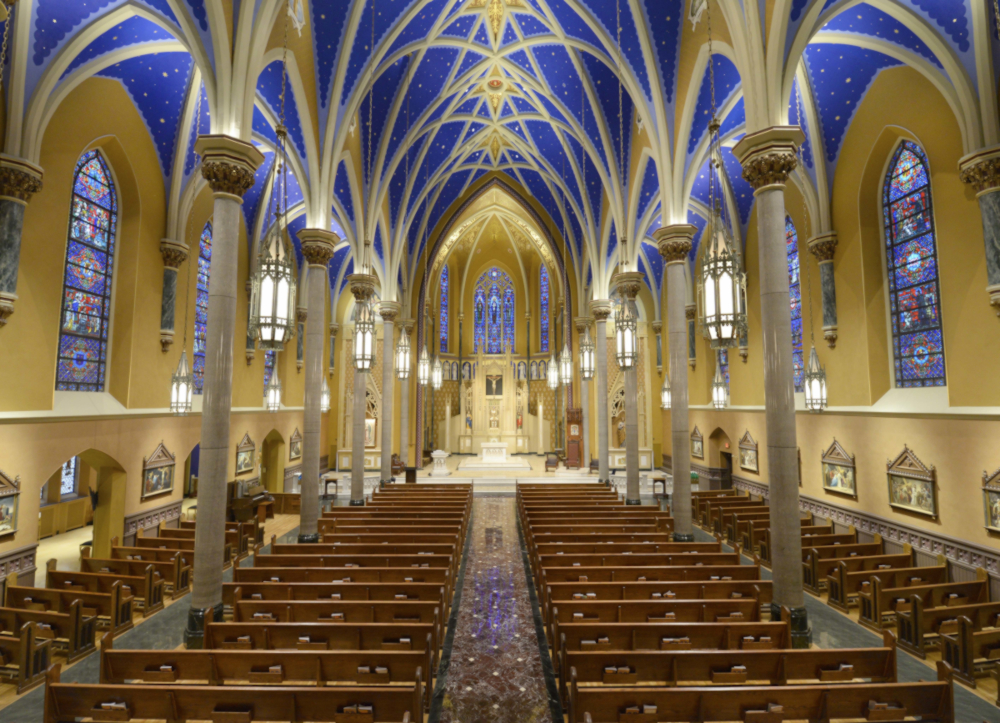
Interior of the Cathedral of St. Mary of the Immaculate Conception, in Peoria, Illinois. The work of Daprato Rigali Studios.
Trent Beattie is the author of Scruples and Sainthood (Loreto Publications) and Fit for Heaven (Dynamic Catholic). He is also the editor of Saint Alphonsus Liguori for Every Day (Mediatrix Press), Finding True Happiness (Dynamic Catholic) and Apostolic Athletes (Marian Press).



