
Slovenia ranks 38th in size among European countries; covering a total area of 7,827 square miles, it is one of the smaller nations on the continent. Nevertheless, it has an impressive history and a remarkable culture, anchored in the Catholic Faith. The Slovenians themselves, although for historic and geographical reasons often placed with the South Slavs, are genetically closer to the West Slavs – the Czechs and Slovaks; Americans often confuse them with the latter, but they are quite different. For one thing, for most of their history, the Slovenians were dominated by the German-speaking Austrians, whereas the Slovaks were under the Magyars.1
Slovenia was inhabited by Illyrian2 and Celtic tribes until the 1st century BC; then the Romans came. The Romans established settlements at Emona (Ljubljana), Poetovio (Ptuj), and Celeia (Celje). They constructed trade and military roads connecting Italy with Pannonia, and so the region became an important strategic crossroads. But as the western empire weakened through the 5th and 6th centuries, Huns and Germanic tribes invaded during their incursions into Italy. Rome pulled out of the area at the end of the 4th century. While most of the cities were destroyed, the remaining locals fled to the highland areas; there they established fortified towns. The 5th century saw the area become part of the Ostrogothic Kingdom. Later the Ostrogoths, the Byzantine Empire, and the Lombards fought over it, with the last becoming temporarily victorious. But pressures in Italy from the Byzantines led the Lombards to withdraw in 568.
In their wake came the Slavic tribes driven by the Avars. They came from today’s East Austria and Czechia, settling around today’s Carinthia and west Styria, and from today’s Slavonia). Settling around what is now central Slovenia, they became known as the Alpine Slavs. From 623 to 624, King Samo united both the Alpine and Western Slavs against the Avars and Germanic peoples, establishing Samo’s Kingdom. Following his death around 658, his kingdom broke into the duchies of Carantania and Carniola. Although the Avars temporarily reclaimed the area, Charlemagne defeated them in 803, bringing the entire region into his empire.
The Carantanians, were the first Slavic people to accept Christianity at the hands of Irish missionaries — chief among these was St. Modestus, the “Apostle of Carantanians.” Carniola was Christianised from Aquileia. What this Irish and late Roman evangelisation meant was that what became Slovenia was tightly connected to the West, rather than to Constantinople. Following the rebellion of Liudewit in 818, the Carantanian princes were replaced with the Empire’s own border dukes. Under Emperor Arnulf of Carinthia, Carantania briefly emerged as a regional power; this was destroyed by the Magyar hordes in the late 9th century.
In 976, Emperor Otto I, “the Great,” made Carinthia the sixth duchy of the Holy Roman Empire. Due to the continuing Magyar threat, the late 10th and beginning of the 11th century saw the southeastern border region of the Empire organised into so-called “marks” (or “marches”). Among these were the Carniola, the Styria and the western Goriška/Gorizia marks. With these, the emperors enfeoffed such feudal families as the Dukes of Spanheim, the Counts of Gorizia, the Counts of Celje, and finally and most permanently, the House of Habsburg.
During the 14th century, most of modern Slovenia came under Habsburg rule. Henry of Gorizia, Duke of Carinthia, Landgrave of Carniola and Count of Tyrol, died without a male heir in 1335. Emperor Louis IV gave Carinthia and the Carniolan march to Duke Albert II of Austria. Carinthia and Carniola remained a semi-autonomous state with its own constitutional structure, under the Habsburgs.
Recognised as a nationality by this time, Slovenians were the majority in the Duchy of Carniola and the County of Gorizia and Gradisca, Lower Styria, southern Carinthia, and most of the territory of the Imperial Free City of Trieste. Turkish raids inflicted serious economic and demographic setbacks after the fall of Hungary in 1526. The Turks destroyed many flourishing towns, including Vipavski Križ and Kostanjevica na Krki. But in 1593, the Carniolan noblemen’s army defeated the Ottomans in the Battle of Sisak of 1593. Thus ended the largest part of the Turkish menace, although raids would continue.
But no sooner was this enemy defeated, than the 16th and 17th century wars between Venice and the Habsburgs arose, and were largely fought in Slovenian territory, due to its strategic location. But with the fall of the Republic of Venice in 1797, Venetian Slovenia passed to the Austrian Empire. Napoleon’s victory at Austerlitz brought it to the French-administered Illyrian Provinces. In 1815 all of it was returned to the Austrian Empire. In 1867, the Dual Monarchy of Austria-Hungary was created. Slovenians inhabited most of Carniola, the southern part of the duchies of Carinthia and Styria, the northern and eastern areas of the Austrian Littoral, and Prekmurje in the Kingdom of Hungary.
In the period after the Napoleonic wars, the gradual development of Slovenian culture and language continued, and national consciousness rose amongst the politically scattered Slovenian people. Of course, similar trends were growing amid all eleven nationalities in the Empire. At the same time, however, there was a renewal of the Catholic Faith within each of the peoples of the Empire. Inspired by the work of St. Clement Maria Hofbauer, it reached Slovenia and, thanks largely to the development of a Catholic Press, it produced Ven. Frederic Baraga. He was ordained a priest for the Archdiocese of Ljubljana at age 26 on September 21, 1823. He was assigned as assistant pastor at St. Martin’s Parish near Kranj and then at a parish in Metlika in lower Carniola. Baraga was a staunch opponent of Jansenism.
Now, in 1829, after an appeal by Bishop Edward Fenwick of Cincinnati for help for the fledgling Church in America, the Leopoldine Assocation was formed in Vienna, under the presidency of the Emperor, Franz I. From then until 1914, the Society would send over 24 million 19th century dollars as well as vestments, sacred vessels, and art work to the mission in the United States. The Society would found 400 parishes and fund 300 missionaries, including St. John Neumann. Of these, Ven. Baraga would be the first.
But much else was going on in the Slovenian lands at that time. As mentioned, a Catholic press was in operation – but even the secular press was pro-Catholic, and both supported the Emperor. When the 1848 risings occurred, there was no question of the loyal Slovenians taking up arms against the Habsburgs. But they did present a request for uniting all the Slovenian territories into one under the Emperor. The exigencies of the time were such that no attention was paid to the request.
In the following period, until his death in 1881, Janez Bleiweis was the leader of the national – or, as it came to be called, the “Old” Slovene movement. As opposed to the Young Slovenes, who were critical of the Catholic hierarchy, the Old Slovenes promoted traditional values, such as family, religion, and loyalty to the Habsburg dynasty. Their motto was “All [things] for Faith, Home, and Emperor!” (Vse za vero, dom, cesarja!). Eventually, in the 1870s, the two sides allied. But in the 1880s, a new, more militant Catholic Party emerged. Founded in 1892, the People’s Party was allied with the other Catholic Parties in Austria-Hungary, and was strictly loyal to the Monarchy. It was always more powerful than the Anticlericals and won elections handily. Its Chairman was the redoubtable Ivan Šusteršič, who remained loyal to the Habsburgs and to Bl. Karl in October of 1918. At that time, the majority of the party, led by the priest, Fr. Anton Korosec defected to the idea of Yugoslavia. Šusteršič went into exile in Switzerland in response.
Under Fr. Korosec, Slovenia entered the Kingdom of Yugoslavia. As with the Croats, their enthusiasm for unity with the Serbs soon waned – but it was too late. Slovenia followed the same course as the rest of the country. However restricted the Slovenians felt under the Yugoslav Monarchy, it was much worse during the war. After the defeat of the Yugoslavs in 1940, Slovenia was divided into German and Italian occupation zones. They were faced with the questions of Resistance and Collaboration that plagued the rest of Europe. “Within six weeks of the Nazi occupation, only 100 of the 831 priests in the Diocese of Maribor and part of the Diocese of Ljubljana remained free. Clergy were persecuted and sent to concentration camps, and religious orders had their properties seized,” says Wikipedia.
After those horrors, came the victory of Tito, and the subjugation of the whole country by Communism. Some 12,000 members of the Slovene Home Guard were killed in the Kočevski Rog massacres; thousands of anti-communist civilians were killed in the first year after the war. So things stood until 1990, and amid the post-Tito breakup of Yugoslavia – the Ten Day War. This was a brief armed conflict following Slovenia’s declaration of independence from Yugoslavia on 25 June 1991. Fought between the Slovenian Territorial Defence and the Slovenian National Police Force on one side, and the Yugoslav People’s Army (JNA) on the other, it lasted from 27 June 1991 until 7 July 1991, when the Brioni Accords were signed. For the past 35 years the country has struggled with all the questions of identity that currently plague Europe.
To learn more about Bishop Baraga, you can read:
- Bishop Baraga, Apostle to the Chippewas — book by Joseph Gregorich, for sale at store.catholicism.org
- ‘The Snowshoe Priest’: Venerable Frederic Baraga — article by Brian Kelly at catholicism.org
Crusade Channel subscribers can also listen to Brother André Marie’s Reconquest Episode 524: Venerable Frederic Baraga. Guest: Peter Messing.
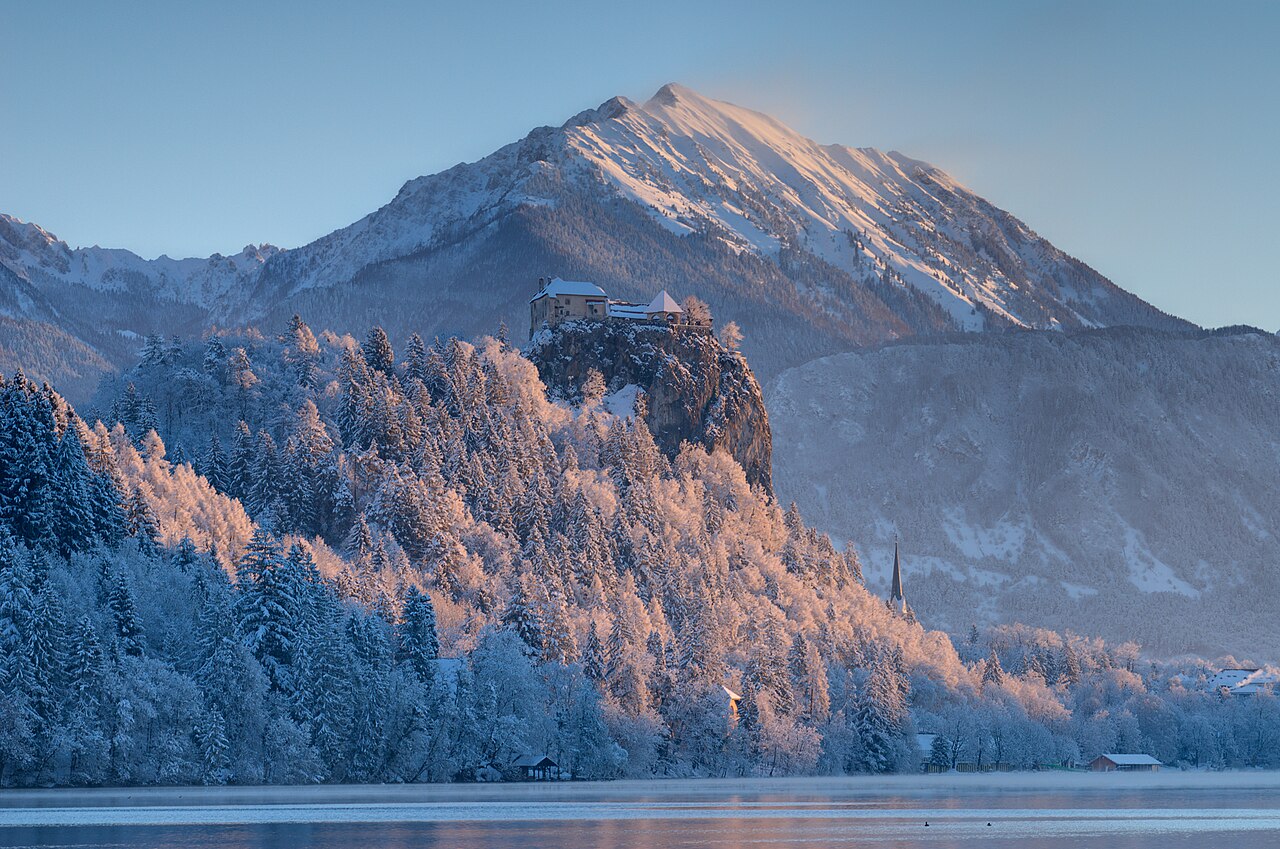
Slovenia’s Bled Castle in winter. Photo by Mihael Grmek, CC BY-SA 3.0, via Wikimedia Commons.
— Footnotes —
1. According to Wikipedia, “South Slavs today include Bosniaks, Bulgarians, Croats, Macedonians, Montenegrins, Serbs and Slovenes”; West Slavs are “Poles, Czechs, Slovaks, Silesians, Kashubians, and Sorbs,” while “Belarusians, Russians and Ukrainians are the existing East Slavic groups.” Magyars are, of course the people we call the Hungarians.
2. “Illyria, northwestern part of the Balkan Peninsula, inhabited from about the 10th century [B.C.] onward by the Illyrians, an Indo-European people” (Britannica.com).



