Adapted from Sr. Marie Gabrielle’s talk, “A Thousand Times Happy”
Fear sabotages happiness as few other things can. Happiness is a contentment that we experience in the contemplation of the good, the true, the beautiful. That is Aristotle’s definition that St. Thomas Aquinas baptized. Happiness is in the intellect: we think of the good things we possess, either natural or supernatural — our nice home, our fun hobbies, our cute pets, our dear loved ones, and even our Faith with all of its wonderfulness-es — and the thought of these things makes us happy. But it is a little hard to take delight in thinking of the good things we possess when we are preoccupied with the thought of a present or impending evil threatening to take them away from us.
In as much as it is our Blessed Mother’s duty and privilege to vanquish all that is evil in this world, the proper place for each of the many heads of the hydra of Fear is squashed into the dust beneath Her holy heel. And happy are we — indeed, a thousand times happy! — if we can, by our childlike abandonment to Her, bring this monster to Mary’s feet that She may commence said squashing — one ugly head at a time.
Ugly Monster Head Number One: The Fear of Difficulties
If the Fear of Difficulties sinks his nasty teeth into your heart, the symptoms will be easily identifiable: your head droops, your shoulders sag, your voice (when you bother to use it) takes on a monotonous quality; your hands may unaccountably seek to bury themselves in your pockets, and you may even experience a previously unknown craving for alone-time in your room behind closed door and drawn curtains.
This may sound comical, it really is not. There are people out there who will read certain Catholic periodical or listen to certain podcasts and turn Eyore for weeks at a time. It is bad. The Fear of Difficulties takes regular mouthfuls of such individuals, and there is only one name for resulting wound — discouragement.
The Wound of Discouragement
Discouragement, is a kind of sadness brought on by our perception the obstacles facing us: they are either so great or so many as to make whatever good we desire appear as impossible to attain. Discouragement is related to despair much as impatience is related to anger. Impatience is a sort of getting angry, even if we have not officially gotten angry; so, too, discouragement is a sort of giving up even though we have not officially given up.
And it is a completely normal, human sentiment. Elias the prophet got discouraged. After his glorious triumph over the 450 priests of Baal, he finds himself on Queen Jezabel’s hit list and has to flee for his life. At a certain point, he pretty much just gives up. He goes a day’s journey into the desert, lies down under a tree, and basically says, “Dear God, just let me die” (cf. III Kings 19:4). Why was he discouraged? The obstacles were too great. He had been given a mission to bring Israel (then in one of her recurring phases of paganism) back to the worship of the true God, and on the whole, God’s people had zero interest in re-converting. What was a prophet supposed to do then?
Another Old Testament example of discouragement, quite a bit earlier than Elias, is when Moses sends out scouts into the Promised Land to see what it is like and how hard its inhabitants will be to conquer. So they go, they see, and they come back with the report: “Yeah, well, the land is amazing; grapes as big as basketballs, and all that. But the men over there…uh…they Paul Bunyan — we Tom Thumb. Sorry, Moses. No can do” (cf. Num. 13:34).
Even among Christians, and even among saints, we find this Fear of Difficulties helping himself to the proverbial pound of flesh as often as he can get it. St. James the Greater, working with a handful of companions for the conversion of what is now the country of Spain, was discouraged because their missionary efforts had born so little fruit. St. Augustine of Canterbury, setting out from Rome by special commission of the Pope to labor for the conversion of England actually turned back because the reports of the difficulties they would face in that land were so discouraging. We can think, too, of the entire nation of France just before St. Joan of Arc showed up on the scene. Pretty low.
Hold Fast to Hope
As it is a human sentiment, and we are human (pace, anyone who identifies as a robot), it stands to reason that, as humans, we are in nowise immune to discouragement. Unfortunately, as Catholics, we tend to be even more susceptible than most to a sort of spiritual discouragement. This generally comes from three sources: the obstacles we see to our own salvation and that of our loved ones, the obstacles facing the reorientation of the Church towards Tradition, and the obstacles preventing the conversion of modern society. Now, our Blessed Mother in order to treat and heal the discouragement we feel when considering these difficulties, will do this: She will make us hold fast to hope.
We Fear for Our Own Salvation
Let us get more specific. First of all, we fear for our own salvation. Sounds reasonable. St. Paul says, “Work out your salvation in fear and trembling” (Phil. 2:12). We are surrounded by a society that makes it really easy to eat rat poison but makes us feel and look like the weirdos for saying, “Thanks but no thanks.” We have the ghosts of our past sins that haunt us, the scars of past wounds that have weakened us, the repeated attempts to overcome this addiction, break this bad habit, acquire this virtue — all of them as yet unsuccessful. Discouragement is the demon that whispers to you, “You can’t do it, so what’s the point in trying? It’s too hard.”
Right, well, the next time you hear that voice, you just tell him to go straight back to whatever fiery little chasm he crawled out of, turn your attention to Her, and hold fast to this hope: you cannot love Mary and be lost. Let me repeat that because if you do not remember anything else from this article, please remember this: You cannot love Mary and be lost. It is not possible. Which means that, in a sense, She Herself IS our hope. And here is a happy thought if ever there was one — when you have made your Total Consecration, saving your soul becomes far more Her job than yours. You gave yourself to Her, right — body and soul? That means your soul is Hers to save. Do not think that is a responsibility She takes lightly.
We Fear for the Salvation of Others
“But,” you might say, “I’m not really afraid for myself. I am doing my best to live my Faith. I have hope that God will give me the means to eternal life, and that Mary will give me the grace to cooperate with those means. It’s my children I’m worried about. It’s my parents. My spouse. My brother, my sister, my friendly neighborhood atheist, and the poor cashier at my local grocery story because I can’t tell if he’s a…he. I fear for them.”
Well, if I may make a suggestion — do not fear for them — hope for them instead. Their salvation is not your responsibility. That might sound callous but remember that when you solemnly took Mary for your Mother and Mistress, you delivered and consecrated to Her your body and soul, your goods both interior and exterior, all that you are and all that you have. In as much as these other people belong to you by blood or by marriage or by friendship or by any other tie whatsoever, you gave them to Her. She will take care of them. Let Her do Her job.
“Don’t I have to do anything to help them?” Yes! You have to love Her more. St. Maximilian Kolbe was emphatic on this point. He says, “Let everyone strive not so much to change his environment as to perfect himself and personally to come closer to the Immaculata” (One More Gift: Total Consecration to the Immaculata According to the Spirituality of St. Maximilian Kolbe, 62). Why? Because, he says, “it is only insofar as we approach Her that we too can become channels of grace” (Mary’s Knight, 145). When we draw near to Her, when we are attentive and docile to Her inspirations — say, for instance, to go talk to such-and-such a person, to offer so-and-so a Miraculous Medal, to invite him to Mass, etc. — She will use us. But it will be She who is using us, not we ourselves acting on our own initiative.
Do you realize what this means? This means the pressure is off. Our job is so easy! We just tell Our Lady, “Blessed Mother, if you want to use me to help these people get to Heaven, here I am. Tell me what to do. If you know that I would just mess things up, then, by all means, choose someone more competent. You know best. I trust you.” Is that not marvelous? Is it any wonder that St. Louis Marie says, “How happy is the man who has given everything to Mary”? Happy, yes, a thousand times happy. “He who is growing in devotion to the Mother of God,” Fr. Faber also says, “is growing in all good things. His time cannot be better spent; his eternity cannot be more infallibly secured.”
We Fear for the Church
But what about the second source of our Fear of Difficulties? What about the Church? It does not seem like the Church quite falls into the category of it-belongs-to-me-so-I-can-hand-it-over-to-Mary. True. The Church is in a unique position in the divine economy: She is Christ’s Bride. By this very fact, though, she already belongs to Him fully, inseparably, and forever. And so we have every hope for the Church. The Church right now, like her Divine Spouse during His Passion, is what you might describe as a bloody mess. And our hearts go out to her. But we know she does not stay that way any more than Our Lord did. Were we to remind ourselves often of this, we would be more encouraged and less discouraged. He is the Savior of His Body.
Yes, there is a lot of disorder in our holy Church, a lot of scandal, a lot of confusion. None of that justifies our being discouraged, though. Our own Br. Francis Maluf says that “With us in the Church Militant are those who are unaware of the magnitude of the battle, of the weakness in our ranks, and of the hidden forces of the enemy; but there are also those who know enough about these things to be discouraged. The latter are worse than the first because to be discouraged is a practical denial of God” (The Challenge of Faith, 22). It is true there is not a whole lot we can do for the Church from a natural standpoint. But we can — and must — hold fast to hope. “Do not lose heart, children,” St. Anthony of the Desert once told his disciples, “for as the Lord has been angry, so later He will bring healing. And the Church shall quickly regain her own beauty and shine as before. And you shall see the persecuted restored and impiety retiring to its own hiding places, and the True Faith in all places speaking openly with all freedom” (Saint Anthony of the Desert, 95).
We Fear for the World
Okay, so we see that God is taking care of His Church, but what about the rest of the world — the world that wants nothing to do with His love and His peace? Here, too, our Blessed Mother would have us hold fast to hope. In the words of the great apologist Orestes Brownson:
Efforts to increase devotion to the Blessed Virgin are, to me, among the most encouraging signs that God has not forgotten us, that there are still faith and love on earth, and that there is still a recuperative principle in Christian society. I thank God, for society itself, that there are still those who delight to call themselves children of Mary and to keep alive in our cold, heartless world the memory of Her virtues. While She is loved and reverenced, there is hope for society.
Nothing Is Impossible for Her
There are no two ways about it: Catholics as humans might feel discouraged from time to time, but Catholics as Catholics are bound to fight that discouragement, and the best way is by appealing to Our Lady for help. It was She who appeared to the weary St. James in Spain (bilocated actually, since She was still living in Ephesus in the year 40 AD) and assured him that not only the pillar She was standing on at that moment, but also the Holy Faith it signified would endure in Spain until the end of the world. What a lesson for us! Whatever the difficulties that seem so insurmountable — whether in our personal lives, our spiritual lives, our Church, or our country — they are not. Not for Her. Nothing is impossible for Her.
Take that, Ugly Monster Head Number One!
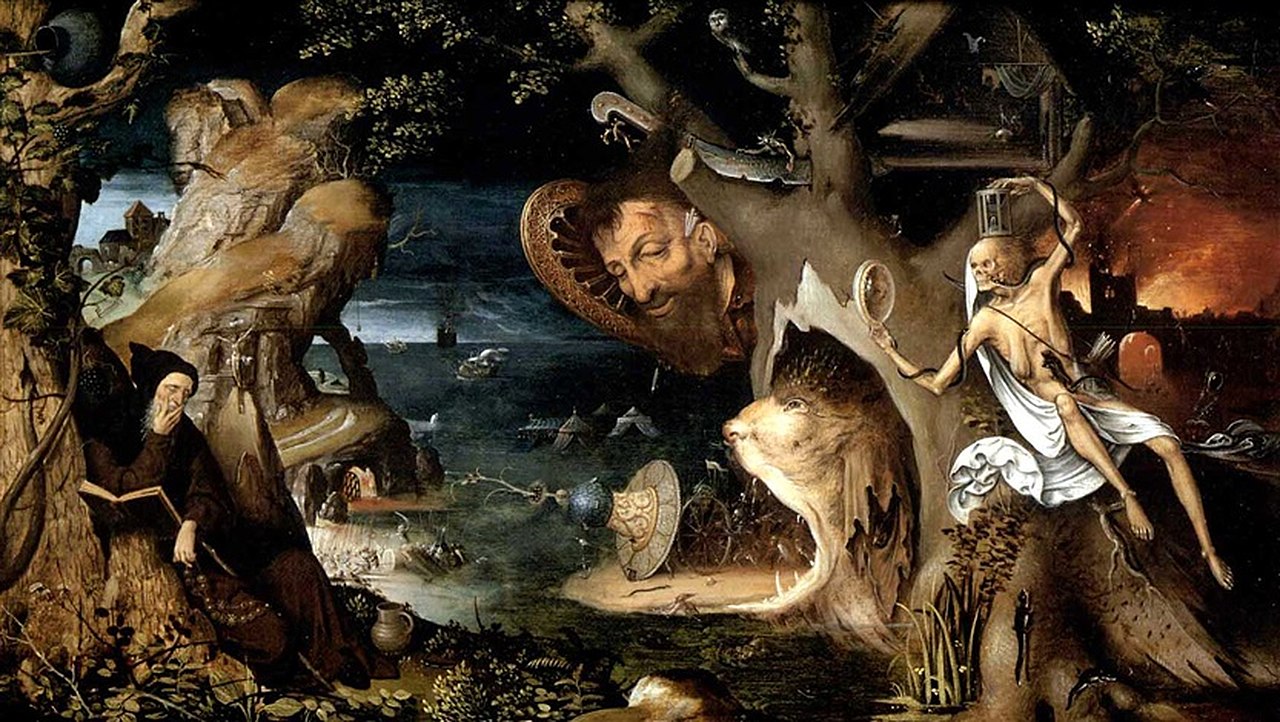
The Temptation of Saint Anthony, by Jan Mandijn (circa 1500–circa 1560). Public domain, via Wikimedia Commons.