

On 18 August Charles Coulombe published an article for Catholicism.org under the title Which Christian Nation Are We Defending? Using the peg of some rather parochial in-fighting between Tucker Carlson, Nick Fuentes and others, Mr Coulombe took the opportunity to expound the “Catholic Grand Narrative” (to use his own phrase), a genre of which he has shown himself a master. Briefly, he describes how, in the past two thousand years, Christianity has shown itself as the presence of our Creator in human society.
In general I share Mr Coulombe’s vision, but I wish here to dissent from a detail of it, which is the Europe-centred view of salvation history which goes back to St Augustine. This view pays lip-service to the role of the Jews as God’s Chosen People, but slips Western Europe into their place with self-congratulatory ease. The message is that nominally God chose the Jews, but really He meant the Greeks and Romans. Thus, Charles Coulombe notes the successive promises of God to the Jews to tell them of the Redeemer who was to come, and goes on:
“In the meantime the Greeks developed philosophy, and they were, in turn, swallowed up in the Roman Empire. The Romans excelled in law and administration, and conquered many peoples who nevertheless retained their identities. This imperial polity allowed the Jews to settle from Palestine to Western Europe …. In this Providential setting, the Second Person of the Holy Trinity became Incarnate of the senior female representative of the House of David, who had been taken as legal spouse by its senior male. God became Man in Palestine, Judaism was fulfilled, and that fulfilment, explained via Greek philosophy and organised with Roman law.”
This account calls for a number of criticisms. First of all, it reflects the view, dear to the hearts of monarchical legitimists, that at the outset of the first century Joseph and Mary were respectively the senior male and female representatives of the House of David. This assumes that there was some law of Salic or Habsburg precision defining the line of succession to the Jewish throne, but that is an anachronistic idea. Let us consider that even Solomon was only the ninth son of his predecessor David. An even more serious hindrance was that the Jewish monarchy ceased to exist six centuries before the time of Christ.
For four centuries after David his descent was direct enough, and it remained so even after the deportation of the Jews to Babylon. The return from exile was led by the Jewish prince Zerubbabel, who rebuilt the Temple of Jerusalem, and both St Matthew and St Luke trace Christ’s Davidic descent through him. Soon afterwards, however, in the fifth century, this clear senior line was lost, as the Old Testament narrative shows us. For the next few centuries there was no recognised royal claimant to represent the Jewish people before their successive rulers, whether the empire of Persia or that of Alexander. The lack became all the more acute in the Hasmonean period, when the Jews regained their independence. They would have loved nothing better than to offer their crown to the acknowledged heir of David, but none could be put forward. Nor was there a claimant to challenge the alien monarchy of Herod, when that was imposed. By that time there were many descendants of David (including so eminent a figure as the rabbi Hillel, who was president of the Jewish Sanhedrin at the time of Christ’s birth), but there was none who could claim the crown by incontestable right.
The above is not just a matter of history. I cite it because it diminishes the role of Our Lady to think that she was chosen to be the Mother of the Redeemer simply as a genealogical act, like James I being called to the English throne. In theological vein, this is the kind of quirk produced by a deterministic view of history.
Much more glaring an oversight is expressed in Charles Coulombe’s sentence: “God became Man in Palestine, Judaism was fulfilled, and that fulfilment, explained via Greek philosophy and organised with Roman law.” Yes, it is true that Judaism was fulfilled by the Incarnation, but the statement misses the way in which God’s plan was staggeringly frustrated. Let us be clear: God the Son was not incarnated to be rejected by the Jews; he was incarnated to become their King. The prophecy of Gabriel to Mary was in intention literally true: “the Lord shall give unto him the throne of David his father.” The kingdom of God in the world was supposed to be a Jewish kingdom. Yet, when Christ rode into Jerusalem to claim it, the Jewish people, gathered together before the great feast of Passover, replied: “No, thanks. We prefer to be ruled by a foreign pagan despot. We prefer to have no king but Caesar.” This was no providential fulfilment of history — it was a monstrous frustration of it. That monstrosity led to God’s promise to the Jews being transferred to the heirs of the Roman Empire, but let us not lose sight of the monster and treat it as part of a pre-arranged plan.
The great objection to this bland acceptance of the eventus quo1 is that it leads to a serious misvaluing of the place of Our Lady in human history. It is preposterously untrue to think that in the first century AD God decided to substitute the Roman Empire for the Jews as the vessel of His promise, that he chose Joseph and Mary for His purpose, and that they simply carried out His plan. It raises the question, why did other pre-elected actors, the renegade kings of Judea, or Annas and Caiaphas, not simply carry out God’s plan? In reality, there is only one reason why God became incarnate in the reign of Augustus and not in the Bronze Age or the twenty-first century: it is that a young girl in Galilee said the words: “Behold the handmaid of the Lord. Be it done unto me according to thy word.” If she had not done so, we might still be waiting now. Salve porta, ex qua mundo lux est orta!2 This was the door at which God had been knocking in vain for thousands of years, and only Mary opened it to Him. Perish the thought that God was delayed in pouring out His grace by anything except human sluggishness, or that He was engaged in something so trivial as a game of empires.
There are great lovers of Our Lady who strain to pile new titles upon her, and yet diminish her by treating her as a mere instrument. Thus, some ill-instructed Catholics imagine that the Immaculate Conception made Our Lady incapable of committing sin, thus turning her into an automaton. The immaculate Mary was as capable of committing sin as the immaculate Eve, but her unique glory is that she refused to do so. Catholic doctrine is that it was the foreseen merits of Mary that caused her to be granted the privilege of Immaculate Conception. This is difficult for us to understand. Immersed in our temporal experience, we do not see that God is capable, in so important an enterprise, of making the effect precede the cause; instead we see it as some kind of predetermination. Yet there was no more predetermination in the act of free obedience by which the Second Eve restored her sex than in the sin by which the First Eve ruined it.
Frederick Faber’s hymn says: “Through the ages He looked and he found none but thee.” Mary was not a mere pawn in history, chosen to bring God the Son into the world at an opportune moment. She was the maker of that moment. Thus the Catholic Grand Narrative needs to have this truth built into it: as Western Europeans we are the beneficiaries of the divine improvisation by which the royal gift refused by the Jews was passed to Rome; but as members of the human race we benefit from the far more cosmic surprise that Mary of Nazareth alone broke free from the universal disobedience of mankind and gave us our Redeemer.
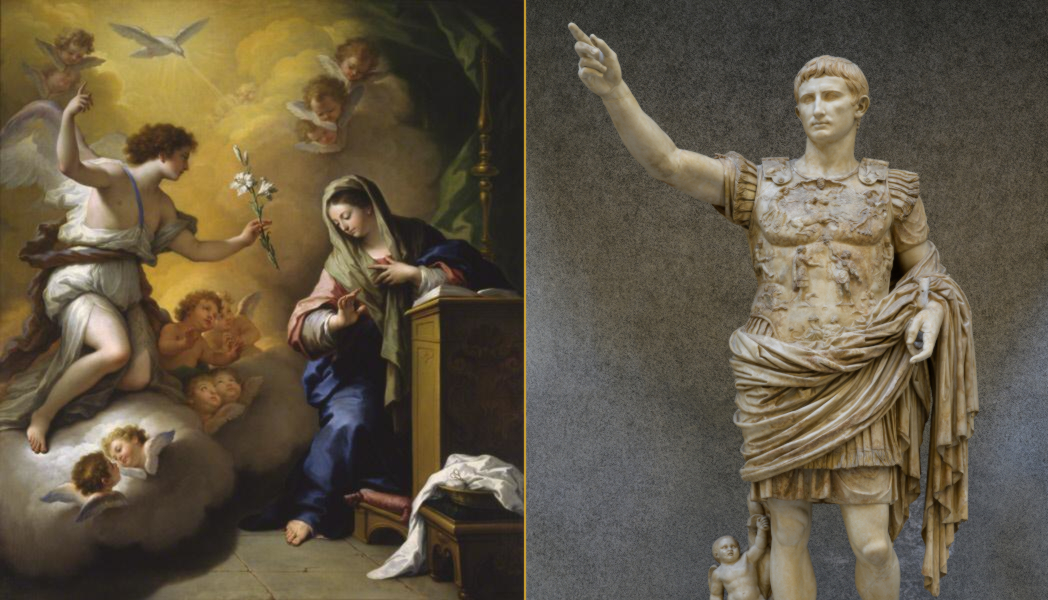
Left: The Annunciation, by Paolo de Matteis, Public domain, via Wikimedia Commons. Right: Augustus of Prima Porta, photo by Justin Benttinen (cropped from original), CC BY-SA 4.0, via Wikimedia Commons.
Footnotes (added by Catholicism.org editor):
- We might translate eventus quo loosely as “historical outcome.” ↩
- From the Latin Liturgical hymn, Ave Regina cœlorum, meaning, “Hail, thou gate from whom into the world, a light has arisen.” ↩



