

And did the Countenance Divine,
Shine forth upon our clouded hills?
And was Jerusalem builded here,
Among these dark Satanic Mills?
—William Blake, “Jerusalem.”
My recent return to New England for the St. Benedict Center annual conference as well as the obsequies for my cousin hit a number of points in my imagination — as indeed, it usually does. Autumn is my favourite season anywhere — but it is of course particularly rich in New England. Due to the funeral, it was a bittersweet visit. Laying him next to my grandmother in the Audette family plot in New Bedford brought back a host of memories — not least that her death in 1965 was the first that I remember, and how bitterly I cried when she died.
It is not an old plot as these go. She had bought it with her siblings back in the 1950s, and so she and several of them and her in-laws are interred therein, and now Albert, who fills it up. This was typical of her; she was already entitled to be laid beside her husband in the Coulombe plot in Fall River. But financially they could not have managed the purchase without her participation. When my grandfather died in 1933, she miscarried. Left a young widow with two children at the height of the Depression, Mémère was devastated. She wore black for a year after Pépère died, and only black and white for seven years after that. But her own mother had struggled the same way with an early widowhood, and so she went to work. (My great-grandmother would live on until 1944; when her large family’s various doings became too much for her, she would flee for a short time to Montreal and seek the counsel of her friend, St. André Bessette — he inevitably calmed her down and sent her back renewed for another round of domestic anarchy.) Having been bookkeeper for the milliner’s shop her mother opened after her father died, she fell back on her skills, and supported herself and her children as an independent bookkeeper; the whaling mansion on Water Street her husband had bought them she turned into a boarding house. So it was until the Second War, when both my aunt and my father joined the forces.
After the interment, our small party adjourned to the Jade Garden Restaurant in New Bedford to enjoy a much beloved and often maligned local delicacy, the Chow Mein sandwich. This dish arouses a great deal of amusement and horror in those who are unacquainted with storied Bristol County. But for those of us who love the place, it is an essential thing to enjoy on every visit.
We then went on to the Coulombe family plot at Notre Dame Cemetery in Fall River, to pray for the souls and honour the memories of our ancestors. My great-grandfather, Joseph Coulombe, was part of the great French-Canadian migration to New England to work the mills after the American Civil War. Unknown to him, his father, Frédéric, who had abandoned the family in Rimouski in 1859, had joined the Union Army and was already in the United States. In any case, Joseph bought the plot, back in 1892, having both acquired some money and decided to become an American. He married the aristocratic Caroline Pelletier, proud of her descent from Laughlin MacKinnon, possibly the last survivor of Culloden. They would have five children — losing the middle three to a typhus epidemic that swept through town in 1901 and permanently damaging my then-infant grandfather’s health. They were the first occupants of the plot. Then followed my grandfather and shortly after his parents. In 1971, my scapegrace Great-Uncle Oscar, who had a colourful life of his own, joined the family. Then my father was laid to rest in 1996; my mother arrived 19 years later. So it was that their children and grandchildren returned. We prayed an Ave and I sang “Danny Boy,” as I promised my mother I would whenever I came to see her.
I have shared all of this because, in our way, we are a typical 21st century Franco-American New England family. For the first three generations (although Pépère had a career in New York City, and would die while the family were staying there — which even then made him stand out, but despite which featured him keeping a home in New Bedford), we kept to our own “Little Canada” — centred on the parishes of the now-demolished Sacré-Cœur and the thankfully-still-extant Saint Antoine. There the French language was still spoken, the French parish schools turned out perfectly bilingual alumni, the more intellectually inclined who wanted the latest ideas from France and Quebec read such journals as La Sentinelle and Le Travailleur, and insurance was provided by such groups as the Association Canado-Américaine and the Union Saint-Jean-Baptiste d’Amérique. It was such a world that produced my father. But it was far from idyllic. Those who worked in the mills faced dirty and dangerous work; there was fishing for those so inclined — Dad tried his hand at both in teenage summers to bring in money and was not especially pleased with either, for all that our Bergeron cousins owned the boat. Much more to his taste was Saltmarsh’s Bookstore; he worked there alongside the owner’s son, Robert, who would be a lifelong friend (in those days it was odd for a French Canadian and an old Yankee to become such firm pals).
But it must not be supposed that such places existed in a vacuum. The Portuguese, Italians, Irish, Polish, Germans, Scandinavians, and other nationalities all had their own ethnic islands scattered throughout New England. They worked at the same arduous industrial, agricultural, and nautical jobs, for all that they went to separate parishes and elementary schools. The Irish ran the Democratic Party in the region, so the Yankees opened Republican ranks to the French Canadians and Italians. Each nationality and each family has its own gripping history of that era.
But after World War II, for better or worse, the barriers began to break down; my father went to New York to pursue acting. Although adept at navigating the Anglo world, he never forgot where he was from, nor what he was. As with Bob Saltmarsh, he made friends from all sorts of backgrounds; when he married, it was not a girl from “down the nord’end,” but an actress he met on a radio sound stage during a show. In the mid ’50s, as radio died, a great many of my father’s friends in the business made their way to Los Angeles, to join the infant television industry. At the same time, a great many of his fellow Franco-Americans went into all sorts of businesses outside, married outside, and even left New England for other places. After Vatican II, Latin Masses and ethnic language sermons were for the most part replaced with English in both — and the Church became as much an agent of assimilation as the State had ever been. All of that history lies in my family plot, as it does in every family plot in New England.
The mingled joy and sorrow, pride and defeat that enshroud every family and every ethnos were very much on my mind as I made another pilgrimage on this trip, to nearby Woonsocket, Rhode Island, and the castle-like structure occupied by the Little Rose Ferron Foundation. As the name will make obvious, it is dedicated to a remarkable lady who lived in Woonsocket when my father was young. Her foundation’s website gives a useful short bio: “Marie Rose Ferron, known as ‘Little Rose,’ was born on the 24th of May, 1902 in a stable in St. Germain de Grantham, Quebec, Canada. The 10th child of Rose de Lima Mathieu and Jean Baptist Ferron, she was baptized Marie Rose Alma on May 25th.
“At the age of two and after a short prayer to St. Anthony, she would quickly go to any lost or hidden object. The children made a game of it and would hide things for her to locate. Their mom scolded them: ‘It’s all right to ask her but you mustn’t hide them and say you lost them!’
“In 1905, the family moved to Fall River, MA, and around that time, Rose became ecstatic and remained so until her death. The Phenomenon of Weight accompanied her ecstasies. During one of them on the 13th of April 1929, in the presence of five witnesses, Rose asked Our Lord if her sufferings were to last very long and repeated the answer saying – Seven Years! She then counted on her fingers to know how old she would be and stopped at thirty-three. Rose was 26 at the time and she died at the age of thirty-three, the same as Jesus.
“In May of 1925, the family moved to Woonsocket, RI, ‘the Quebec of the USA.’ They arrived at a time that the trouble was breaking out between Bishop William Hickey and the Sentinellists. She was visited by Bishop Hickey at her home and asked that she offer her sufferings to stop the threat of schism within the Diocese. She accepted and in time all 56 excommunicated Sentinellists submitted and returned to the fold of the Church.
“At the end of 1926, the stigmata of the flagellation appeared; during Lent in 1927 those of the hands and feet; in November 1927, the reception of Holy Communion without deglutition was noticed; in January 1928, the stigmata of the thorns made their appearance; during Lent of 1929 that of her heart; in the month of August 1929, her eyes shed tears of blood. From that time on, each Friday, she represented the Holy Face. Towards the end of 1929 the crown of thorns fully developed. In 1930, during the month of July, the month of the Precious Blood, the phenomenon of the Holy Face was repeated every day. On the 1st of August 1930, the stigmata disappeared but the pains were felt with more intensity; still on the days she suffered the most her former stigmata became purple and oozed a kind of serum.
“When she died on the 11th of May 1936, one could still see one of the branches of the crown of thorns stigmata.”
Now, the Sentinelle affair split the French-Canadian communities throughout New England. Although unaffected by the excommunications as residents of a different diocese, my grandparents were very aware of what was transpiring next door. They were, to be sure, very aware Catholics: they named my aunt “Fleurette” after the newly canonised St. Thérèse of Lisieux, and my father after Guy de Fontgalland, at the time the youngest non-martyr ever to have a cause opened for beatification — and who had only died the year before. They were outraged when Bishop Hickey of Providence demanded money from French parishes for non-French education (thus violating a long-term gentleman’s agreement) — and more so when the Sentinellistes were excommunicated by Rome; it must be pointed out that while publishing the excommunication, the good bishop neglected to publish Rome’s order to him to cease demanding the money — and so removing the cause of the problem.
In any case, Little Rose’s sanctity healed the schism. It also drew the interest of St. André Bessette, who visited her. He was one of a stream of visitors to the young stigmatic’s bedside. A particularly interesting visit is recorded by a Fr. Leonard, who also came from Montreal to see her: “I learned this October 23, 1930, that a man from South Carolina had visited Therese Neumann on a Friday and without knowing him she said, ‘Why are you here? Why don’t you go and see my little sister Rose Ferron, in your own country? Go and see her. It’s not so far as coming here.’ And she gave Rose’s address. After his arrival in New York, this man came to Woonsocket on a Friday. After explaining matters, the family called up Father X to ask if they should let him in; …with his permission, he was allowed to see her. The stranger came out in tears, saying, ‘I have seen as much here as in Konnersreuth.’ The same fact was mentioned at the Ferrons’ while I was there the following November.”
At Little Rose’s Castle, as the building the foundation occupies is called, a great many of her effects are kept — to include the bed upon which she suffered so long, and a bit of blood which had been sent to Pope Pius XII, and which that Pontiff returned in a reliquary with a blessing. Kneeling before the statue of the Sacred Heart before which she had prayed was an experience I shall never forget.
Little Rose, St. André Bessette, Guy de Fontgalland, and the innumerable dramas worked out under church steeple and mill smokestack throughout New England — and the whole superimposed over a background of Anglo Colonial and Revolutionary buildings and incredible scenery — brought everything home. Our personal and historical human dramas all bring ourselves and our friends and families closer to or further from that Christ who is ever striving to gain the Souls for whom He died. We are all part of a long and great tapestry that started long before us and shall continue until the last autumn leaf finally drops, and the Great Writer calls an end to it all. Then my family plot shall be emptied of its contents, and all of us shall stand together before Him Whom we have alternately served and outraged. May all of ours and all of yours stand with the sheep and not the goats at that day of wrath and mourning — and may all the Saints, Blesseds, Venerables, Servants of God, and suspected holy folk whom we have ever invoked through this earthly pilgrimage intercede for us to that end.
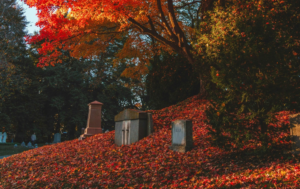
Photo by Yilei (Jerry) Bao on Unsplash



