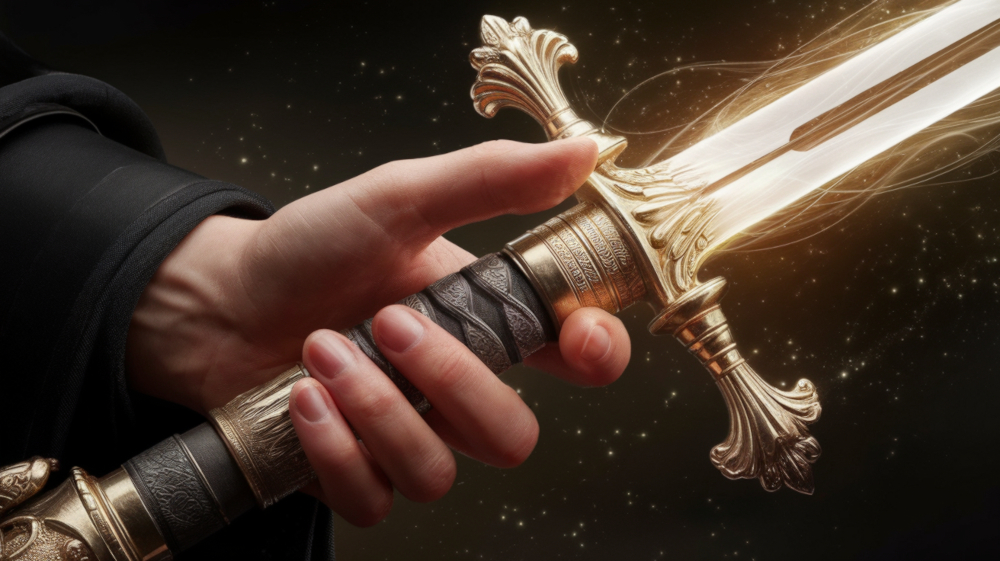
We are all pretty familiar with the idea of sacramentals as weapons. We know St. Maximilian called Miraculous Medals his “bullets”; we have often heard the Rosary spoken of as a “sword.” We probably have at least a vague sense that Sacraments are weapons, too — really, really big ones; explosions of grace flooding the world with God’s light and mercy. But how often do we think of love as a form of spiritual artillery? We should. In fact, it was Our Lord’s weapon of choice, and so it should be ours also.
St. Maximilian said he expected his Knights of the Immaculata to vanquish the world not by acts of brutal carnage, but by deeds of love and mercy. That is beautiful, now let us make it practical. Here are three things to have in mind if we want to wield the holy saber of love effectively: The Where, the Who, and the How.
The Where, the Who, and the How
Where are you fighting? Charity begins at home. St. Maximilian said: “Let everyone regard his surroundings, relatives, acquaintances, working companions, place of residence as the territory of his mission to win all for the Immaculata.” If you want to exercise charity via GoFundMe donations to poor orphaned children in Korea, great. But just know — the essence of your battle is right on your home turf.
Who are you fighting for? Again, charity begins at home. You are fighting for your family, yes, but family actually fits into the broader category of neighbors. Your neighbors are not just the Joneses across the street. Your neighbors are everyone with whom you come in contact: yes, your spouse; yes, your children; but also your boss, your local librarian, your son’s baseball coach, your pizza delivery boy. (By the way, I know a woman who married her pizza delivery boy. They now have ten beautiful Catholic children, and their second-from-the-bottom was one of my sixth graders last year. The moral here is that we should never despise those pizza delivery boys.)
Finally, how are we fighting? Is our focus entirely on the negative aspect of the battle? If so, that is a problem. The negative aspect is real, and it is important. Yes, we hate what God hates. God hates evil in the moral order and error in the intellectual order. Our duty, therefore, is to combat them both. God hates the world, flesh, devil, insofar as these cause real damage to souls that are so precious to Him. But if we only think of ourselves as warring against this evil over here and that enemy over there, we are missing the bigger picture. Ours is a battle for souls. Inasmuch as the people we care about are captives to their own vices, we are fighting to liberate them. If they are victims of their own ignorance or prejudice, our challenge is to teach them. But we must do this in such a way that our neighbor — whether that is your uncle or your Uber driver — will actually hear what we are saying. Not just shut us down or tune us out.
How, then, do we practically succeed in fighting for these souls God has placed in our path? Answer: with kindness.
Kindness Is Key
People do not listen to people they do not like. In our battle for souls, kindness is key. Bl. Dom Columba Marmion said, “I am convinced, and that from experience, that it is not only by controversy, but by kindness, that souls are won or brought back. It is not in trying to convince someone that he is wrong that he is won over, but much more in showing him the truth with gentleness and charity. The truth is beautiful enough to attract of itself. I have never succeeded in converting anyone by argument; as soon as opposition is felt, self-love comes into play, the heart closes, and there is no more of that sweetness which the Holy Spirit uses to touch hearts.”
Fr. Frederick Faber said: “Kindness has converted more sinners than zeal, eloquence or learning — and these three things have never converted anybody without kindness having something to do with it.”
And finally, Fr. Lawrence Lovasik wrote in The Hidden Power of Kindness: “Man can resist force, reasoning, science, and talent, but if someone does good to him, he will yield…. Love always succeeds.”
The Diabolical Perversion of Kindness
One of the reasons it is so beastly hard to convert non-Catholics is that the devil is so frightfully good at aping true kindness. I will never forget a man I met out doing our missionary work years ago. Ricky. Early 70’s, tall but bent over, a little unkempt looking with his shaggy gray hair. He was on the sidewalk, and, as I approached him to give him a Miraculous Medal, I saw around his neck not one, not two, but three big pentagrams. I was horrified. And I grew even more horrified as I coaxed his story out by a few gentle questions.
Ricky was a Vietnam veteran who had seen — and done — horrible, horrible things during war. He came back to the States a total wreck; he could not hold a job, lost his house, and had no family to help him out. After, however, many months of this despair, he was seriously considering suicide as his best option when he met, as he said, “some girls.” They were super sweet to him and told him they wanted to help; would he please let them introduce him to someone who could guarantee him happiness in this world? Ricky agreed.
What do you know, the girls were right — everything changed for Ricky the minute he became a satanist. He suddenly had money, security, pleasure, and best of all — the assurance that he would enjoy these things for rest of life. “But, Ricky,” I said, “what happens when you die?”
He got very sober. “Yeah, they told me about that.”
I said, “Ricky, I am your Sister. I care about you. I do not want you in hell! Here, take this. Please!” and I held out a Miraculous Medal. He took it, thank God. Poor man! I still pray for him.
But do you see what I mean about the devil counterfeiting kindness and winning people over to evil through a diabolical perversion of compassion? It happens all the time. We need to win them back, and kindness is the first key in doing that.
Our Lady as the Ultimate Key
Our Lady is the other key. The ultimate key. Fr. Emile Neubert said emphatically in Life of Union with Mary: “The most efficacious apostolate is to make Mary directly known, loved, and served. As soon as we have introduced the Blessed Virgin into another’s life, She will assume the responsibility of forming him to the likeness of Jesus and of inspiring him with Her own passion for the salvation and sanctification of Her other children. Making someone a convinced apostle of Mary is more than making a hundred ordinary Christians, for the influence of such an apostle extends indefinitely.”
If we are able to cultivate the personal love of Mary in our friends, family, and even acquaintances, we will be giving them the greatest advantage possible towards reaching Heaven. Think how Baron Théodore de Bussières introduced Her to Alphonse Ratisbonne. Ratisbonne was not just a Jew by race, he was a cynic almost by temperament. The man hardly believed in his own religion. A Catholic friend of his gave him a Miraculous Medal and basically dared him to say Memorare once a day — which factors led to one of the most stunning conversions in history.
* * * * *
Our battle for souls is not so much to give other people the Faith (God does that; it is, after all, a divinely infused theological virtue!) as it is to make Faith attractive by our kindness, by our determined wielding of the holy weapon of true charity, so that others will want it. So, too, we must do our utmost to make Our Lady attractive because, once She has a foothold in someone’s heart, She will take him from there. She will teach him, even as She taught us, to wield the holy saber of love for the greater glory of God in time and in eternity.