
One day Jesus was walking along the banks of the Sea of Galilee and He saw two fishermen, “James the son of Zebedee, and John his brother, in a ship with Zebedee their father, mending their nets: and he called them. And they forthwith left their nets and father, and followed him.”
At the time of his calling John was less than twenty years old, and he did not know just who the Man he was following was. But he knew that He was one with authority, and he knew that He was good. John watched Him cure the sick and cast out devils. He saw Him restore the sight of blind men and make lepers white. He saw Him take by the hand a girl who was dead and raise her to life. And he listened to the things He said: “Blessed are ye when they shall revile you, and persecute you, and speak all that is evil against you, untruly, for My sake: be glad and rejoice, for your reward is very great in heaven.” He heard Him call the Scribes and Pharisees whited sepulchres and a generation of vipers. He saw the chief priests and officials become worried over His growing discipleship and attempt to kill Him. And he knew who He was. He was the Messiah who had been promised. He was the Christ, the Son of the living God.
Our Lord gave to John a name which means son of thunder, and of all the twelve Apostles there was none whom He so deeply and warmly loved. It was a love of the Man in Christ for the man John. And it was shown in many ways. Peter, James, and he were the only ones Our Lord admitted to the room where he raised from death the daughter of Jairus. They alone were present at the Transfiguration and at the agony in the Garden of Gethsemani. At the Last supper it was John who sat next to Our Lord and who rested his head on His breast. He was the only one of the Apostles present at the Crucifixion, and it was to him that Our Lord intrusted the love and protection of His greatest treasure, His mother.
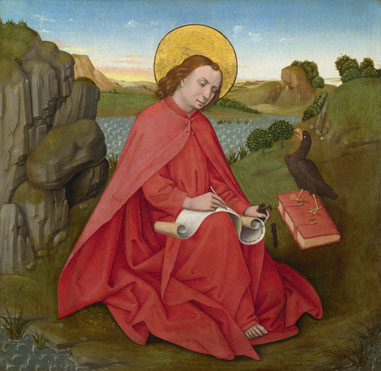
Saint John on Patmos, about 1460-70.
German, South. The National Gallery.
Our Lord had told His Apostles: “You shall receive the power of the Holy Ghost coming upon you, and you shall be witnesses unto me in Jerusalem, and in all Judea, and Samaria, and even to the uttermost part of the earth.” After the Ascension they returned to their room in Jerusalem to wait and pray. And then on the day of Pentecost: “Suddenly there came a sound from heaven, as of a mighty wind coming, and it filled the whole house where they were sitting. And there appeared to them parted tongues as it were of fire, and it sat upon every one of them: and they were all filled with the Holy Ghost.”
On that very day the Apostles, led by Peter, preached to the crowds in Jerusalem, and three thousand heard and were baptized. A few days later two thousand more were added as a result of the miracle of Peter and John before the Beautiful Gate, where they cured a man who had been lame from birth.
Between these two Apostles, Peter and John, who were favored by Our Lord above all the others, the one with authority and the other with love, there was a great and abiding friendship. When just before the Ascension Our Lord re-affirmed Peter’s position as head of His Church (“Feed my lambs. Feed my sheep.”), Peter showed his love for John when he asked Our Lord about him, “Lord and what shall this man do?” He asked because he sensed that John wanted to know what his mission should be and because he wanted to learn whether he and John should have to be parted. Jesus answered, “So I will have him to remain till I come, what is it to thee? Follow thou me.” This answer showed that deeply as Our Lord loved Peter, He could not love him as He did John, because John’s own love was so much more perfect than that of any of the other Apostles. In assigning symbols to the four Evangelists, the early Fathers of the Church were to call John the eagle. Carried on the wings of love he flew directly and surely to God. He had no need of the rules and commandments of those who must walk, just as a boy and girl who are in love have no need of an Emily Post code of etiquette to tell them how to behave towards each other.
After the martyrdom of Stephen, who was stoned to death by the Jews, the persecution which had been threatening the Church since Pentecost unleashed itself with violence. The Christians fled into the outlying districts of Judea and Samaria to hide from their persecutors. But the Apostles were not free to come and go as best suited their personal safety. They had to be guided by their commission from Our Lord: “Going therefore, teach ye all nations, baptizing them in the name of the Father, and of the Son, and of the Holy Ghost.” First they traveled over the lands of Palestine, converting the Jews, then into the countries of the heathens, preaching the Kingdom of God, and baptizing those who would listen and believe. Soon there were Christians in almost every part of the known world. Peter founded churches at Pontus, Galatia, Cappadocia, Asia Minor, Bithynia, Mesopotamia, and Rome. Paul, who before his conversion had been one of the most violent of the Church’s persecutors, travelled to Syria, across Asia Minor, into Macedonia, Greece, Crete, then over to Sicily and into Europe. The heavens shew forth the glory of God, and the firmament declareth thework of his hands. Day to day uttereth speech, and night to night sheweth knowledge. There are no speeches nor languages, where their voices are not heard. Their sound hath gone forth into all the earth: and their words unto the ends of the world.
But John did not go out to preach with the other Apostles. He remained in Jerusalem to care for the mother whom Christ had bequeathed to him on the Cross. When Our Lord ascended into heaven, Our Lady wanted to follow Him, but ever the handmaid of the Lord who had said, “Be it done unto me according to thy word,” she did as Our Lord asked her and remained on earth to comfort and console the Apostles and to inspire them in spreading the faith. In this was God’s great love for the world made manifest. But where her treasure was there was her heart also. And she used often to visit the places where her son had been while He was on earth. She, with John, went to see again the stable at Bethlehem, where many years before she had brought God into the world; and to the house at Nazareth, where she and Joseph had been alone with Him for thirty wonderful years; to the Garden of Gethsemani, where He had suffered; and to Mount Calvary, where He had died.
St. Bernard says that so intense was Mary’s love for God that it required a continued miracle to preserve her life in the midst of such flames. But now the work of establishing the Church was well under way and God was impatient to be with His daughter, His mother, His spouse. Arise, make haste, my love, my dove, my beautiful one, and come.
When Mary learned that she was at last going to be taken to her loved-one she told John, who sent word to the others, and they all came to Jerusalem, to the small house where she and John had lived since the Ascension. These men who had faced so much could not face this. They could not face the sadness and loneliness, the desolation of the world with its fairest flower gone. Our Lady called them to her, one by one, and told them not be to unhappy or afraid, that she would pray for them, that she would never forget them. And, they were consoled. And then of love she died. The one for whom the world was created, the single perfect and beautiful creature was gone; the voice of the turtle was heard no more in our land. St. John had completed that work which was his alone. Now the love and protection of the Mother of God was the charge of all the faithful.
John stayed on in Jerusalem a few more years, until he learned of the martyrdom of St. Peter and St. Paul. Then he went to Ephesus, a city in Asia Minor, on the coast of the Aegean Sea. With him were many of his disciples, including three who became Fathers of the Church, Ignatius of Antioch, Polycarp of Smyrna, and Papias of Hierapolis. As the last of those who had been with Our Lord during His life, the eyes of the whole Church looked to John. They expected that some great deed should be worked through him. Because of the words Our Lord spoke to Peter concerning him – “I will have him to remain till I come” – many thought that John would never die, though he himself denied this interpretation.
Soon after his arrival he was appointed head of the seven churches of Asia, Ephesus, Smyrna, Pergamus, Thyatira, Sardis, Philadelphia, and Laodicea. But he was not to finish out his life in this peaceful manner. The Emperor Domitian, who bitterly hated and feared the Christians, as do all whom the Church challenges, ordered that a tax be levied against all Jews and all “who lived as Jews.” By this phrase he meant to include the Christians, thinking that he could attack them more effectively in not calling them by name. But the Christians would not permit themselves to be considered Jews and so refused to pay the tax. This made Domitian even more angry and afraid, and he began his cruel and violent persecution.
Naturally he was anxious to be rid of John, and he had him brought in chains from Ephesus to Rome. There, before the Latin Gate, John was thrown into a cauldron of boiling oil. But god still had work for His beloved disciple to do. After suffering all the torments of actual martyrdom, John emerged from the cauldron unharmed. Domitian decided that he had best be content merely with getting John away from the people, so he had him banished to Patmos, a small island in the Aegean Sea.
With John gone from Ephesus many heretics seized upon the chance to spread their false doctrines and seduce the people from the truth. The most famous of the heresiarchs was Cerrinthus, who taught that Christ was not truly the Son of God, but a creature, the child of Joseph and Mary. News of this spreading heresy reached John at Patmos, and he grieved for his people, knowing that they were being drawn from the truth and that he was himself unable to go and fight these pernicious doctrines.
One day while he was in this dejected state John suddenly felt himself taken up by the Holy Spirit. Taking his pen, he began to write: “The Revelation of Jesus Christ, which God gave unto him, to make known to his servants the things which must shortly come to pass: and signified, sending by his angel to his servant John, who hath given testimony to the word of God, and the testimony of Jesus Christ, what things soever he hath seen.” So did John begin his great Apocalypse, the only book of prophecy in the New Testament, the only book of prophecy yet to be fulfilled.
After the death of Domitian his cruel ordinances were revoked and John was allowed to return to Ephesus. He was by now a very old man and many supposed his active life to be over. But there was still something to be done.
The bishops of Asia requested John to write an account of the life of Our Lord which could serve as a refutation of the rampant heresies. John agreed if they would all fast and pray that he might be inspired by the Holy Spirit. This being done, John began to write: “In the beginning was the Word, and the Word was with God, and the Word was God . . . And the Word was made flesh, and dwelt among us.” Here was the purest expression of doctrine ever composed, the doctrine of the eternal Son of God made man. This was the Eagle flying high above the earth and the stars and soaring straight to the Godhead.
The three Gospels that preceded John’s, those of Matthew, Mark, and Luke, are called the synoptic Gospels, because they present a general view of Our Lord’s life and are concerned for the most part with the same events. John tells many things not included in the synoptic Gospels, particularly those of the time preceding the news of the imprisonment of John the Baptist, and many important events of Our Lord’s life he omits, because he supposes them known from the synoptics. Without a thorough knowledge of the first three Gospels, much of John’s cannot be understood; it is a supplement to them. It was clearly written to be what it is, the fourth Gospel.
Besides his Apocalypse and Gospel, John wrote three Epistles, one to the Christians at large, one to the lady Elect and her children, and one to Gaius. Nowhere in the New Testament are writings to be found so filled with doctrine as in the writings of John. Heretics have been especially hard put to explain away his words, and this has naturally led to his dislike by them. How, for instance, shall they deny that there is but one true Church, founded by Christ for the salvation of all, in the face of these words: “And other sheep I have, that are not of this fold; them also must I bring, and they shall hear my voice, and there shall be one fold and one shepherd . . . Amen, amen I say to you: He that entereth not by the door into the sheepfold, but climbeth up another way, the same is a thief and a robber.” Or how shall they deny the Blessed Trinity in the face of these: “And there are three who give testimony in heaven, the Father, the Word, and the Holy Ghost. And these three are one.” Or the necessity of Baptism (of water): “Amen, amen I say to thee, unless a man be born again of water and the Holy Ghost, he cannot enter into the kingdom of God.” Or the power of absolution given by Christ to His priests: “Receive ye the Holy Ghost. Whose sins you shall forgive, they are forgiven them; and whose sins you shall retain, they are retained.” Or the Holy Eucharist: “If any man eat of this bread, he shall live for ever; and the bread that I will give, is my flesh, for the life of the world . . . Amen, amen I say unto you: Except you eat the flesh of the Son of man, and drink his blood, you shall not have life in you.”
Those few heretics willing to take John at all drain him of his blood and turn him into a mealy-mouthed milksop like themselves. But listen for yourself to the son of thunder roar: “Who is a liar, but he who denieth the Father, and the Son. Whosoever denieth the Son, the same hath not the Father. He that confesseth the Son, hath the Father also . . . This is the work of God, that you believe in Him Whom He hath sent . . . He that believeth in Him is not judged. But he that doth not believe, is already judged: because he believeth not in the name of the only begotten son of God. And this is the judgment: because the Light is come into the world, and men loved darkness rather than the Light: for their works were evil.”
When John said that we must love one another, he was not speaking to any Ladies’ Welfare League kind of love. Since God had come into the world love could mean but one thing: “My little children, let us not love in word, not in tongue, but in deed, and in truth.” Nor did he mean a love to be lavished upon all indiscriminately. This love was to be between those who belonged to the Church. As for the heretics, they should not even be greeted: “Look to yourselves, that you lose not the things which you have wrought: but that you may have a full reward. Whosoever revolteth, and continueth not in the doctrine of Christ, hath not God. He that continueth in the doctrine, the same hath both the Father and the Son. If any man come to you, and bring not this doctrine, receive him not into the house nor say to him, God speed you. For he that saith unto him, God speed you, communicateth with his wicked works.”
And as he wrote, so he lived. For the orthodox Christians his love was tender and warm, but when the honor of Christ was endangered the wrath of the son of thunder unleased itself, and he showed that his zeal had still the ardency it had when, as a young disciple, he asked for fire to come down from heaven and consume the village that refused to receive Jesus. With the heretic he would allow no reconcilement. It was he, and not the Christian lacking in virtue nor the pagan to whom the faith had not yet been brought, who was the enemy of truth. And he must be avoided as one with the plague. St. Polycarp tells how one day John went into the baths and found the heresiarch Cerinthus there. He ran into the street yelling, “Let us fly the baths lest they fall in, for Cerinthus the enemy of truth is within.”
Sometime after the year 98, in the reign of the Emperor Trajan, John died. After so many years of lonely exile upon earth, away from Our Lord and Our Lady and from Peter and the other Apostles, death was sweet and welcome. There was no bitterness in it, because he had seen death and the evils of the world subdued. He had written, “And this is the victory which overcometh the world, our faith.” And now he would enjoy the fruits of that victory. God’s last instrument of revelation to His people, the guardian of Our Lady, the disciple whom Jesus loved was gone. The Eagle had soared off into the heavens, out of the sight of men, to the place where those he knew and loved were waiting for him and where he should be with them in eternal happiness.
And I saw a new heaven and a new earth. For the first heaven and the first earth was gone, and the sea is now no more. And I John saw the holy city, the new Jerusalem, coming down out of heaven from God, prepared as a bride adorned for her husband. And I heard a great voice from the throne, saying: Behold the tabernacle of God with men, and he will dwell with them. And they shall be his people; and God himself shall be their God. And god shall wipe away all tears from their eyes: and death shall be no more, nor mourning, nor crying, nor sor- row shall be any more, for the former things are passed away.



