

As I write, my thoughts are directed to our October 9–10 Conference, which is for us the renewal of a beloved autumnal ritual. This year’s theme is “Oases of Sanity in the 21st Century,” and I have entitled my own presentation, “The Catholic Sacramental Economy: Oasis of Salvation.”
Just about every year that he has spoken at our Conference — over a quarter of a century now — Joe Doyle always thanks us for having him and reiterates his judgment that “Saint Benedict Center is an oasis of sanity.” It is not something we have ever asked him to say, but we are happy to hear it nonetheless. When I was pondering this year’s Conference at a time when insanity in both civil and ecclesiastical society seems to be at an all-time high, I thought of Joe’s remark and wove it into a theme. I put the operative word in the plural and asked our speakers to speak on the various oases of sanity our conference attendees might ponder.
My own contribution will not be to “toot our own horn” by expanding on Joe’s claim (Sister Marie Gabrielle will do that, with her talk, “Fortes in Fide: St. Benedict Center as an Oasis of Sanity in the Heart of Traditional Catholicism”). Instead, I have chosen to speak of the Catholic sacramental economy as such an oasis.
“Sanity” comes from the Latin word for “healthy”: sānus. Primarily referring to bodily health, the Latin word does also refer to mental health, which is the primary meaning the word has acquired in English.
The Church herself is a spiritual sanatorium — the word comes from the related Latin verb, “to heal,” as in, to restore health — where we are made spiritually healthy, like the inn to which the Good Samaritan brought the man who fell among robbers. The sacraments are the primary means by which our Divine Physician, Jesus Christ, imparts, restores, and increases our spiritual health. He has made His Church to be a sacramental reality. We enter her by Baptism, and her hierarchy is perpetuated by Holy Orders. At the heart of the Church’s life, of course, is the Eucharist, which is at once a Sacrament and a Sacrifice, as well as an adorable, abiding Presence, and a Holy Communion we are privileged to have with the Church’s Bridegroom.
We are not mixing metaphors when we note that this spiritual sanatorium is also an “oasis.” God seems to have a predilection for oases. In that exquisite love poem between Our Lord and the Church, the Canticle of Canticles, the Sulamitess (the Church) says of her lover, “My beloved is to me a cluster of henna blossoms in the vineyards of En-gedi.” That place, called Engaddi in the Douay Old Testament, was where David once hid out, and where he proved his fidelity to Saul, even when that deranged king was trying to kill him. It was there that Saul conceded that David would rule after him. The henna blossoms mentioned in that celebrated verse are very fragrant (perfumes have been made from them for thousands of years), and the plant that bears them, the Lawsonia inermis, is used as a hedge to protect crops. Both uses seem to be implied in the Canticle.
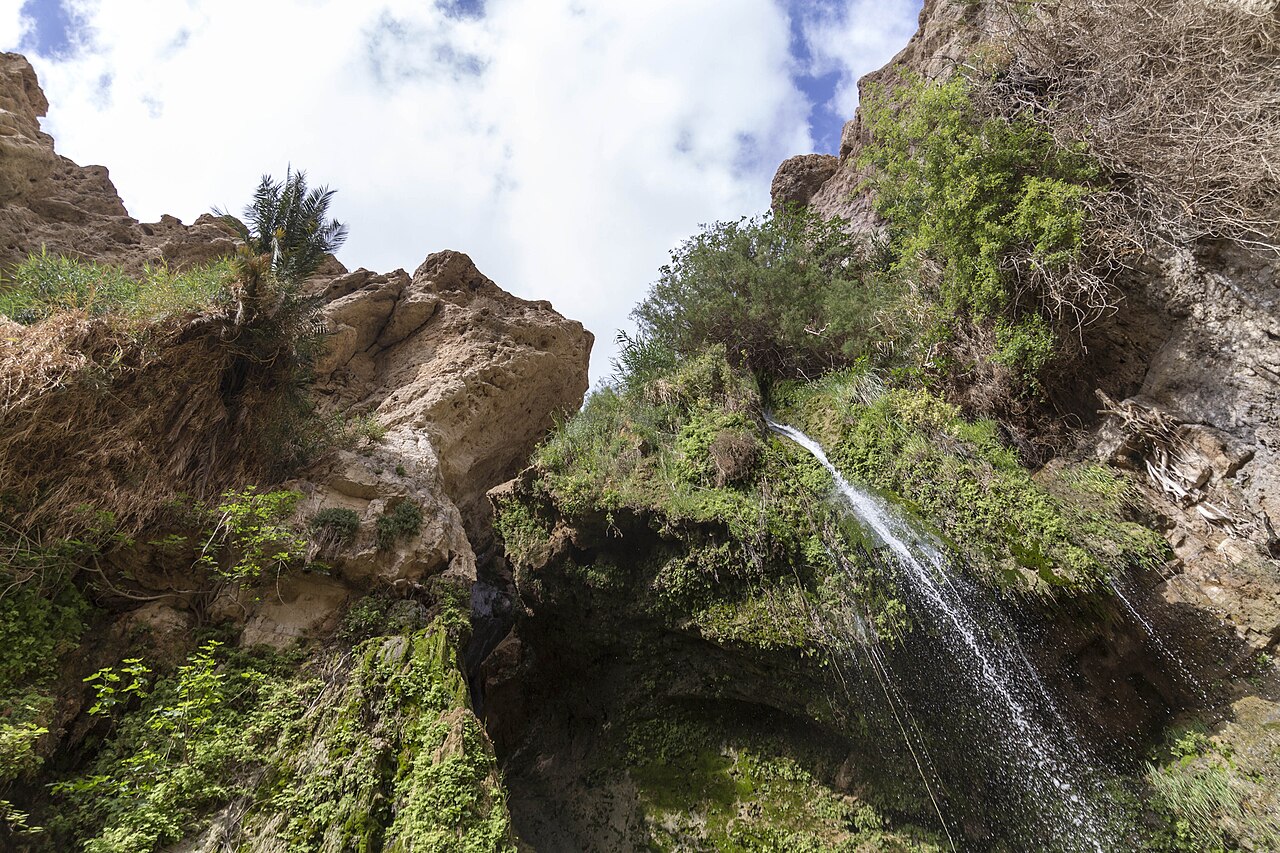
A waterfall in Ein Gedi. Photo by Ilariamolinelli, CC BY-SA 4.0, via Wikimedia Commons. The Hebrew description at Wikipedia reads, “Ein Gedi is the name of a spring, nature reserve, and ancient city situated on the western shore of the Dead Sea, within the Judean Desert, on Route 90, about one kilometer north of Kibbutz Ein Gedi. The reserve extends along the eastern edge of the Judean Desert, on the shore of the Dead Sea. The reserve is located in the Dead Sea Valley (Rift), which is part of the Syrian-African Rift” (translation by Claude Sonnet 5).
But what is an oasis? It is a place within a desert where there is a source of water, usually one or more underground springs, that allows for vegetation and provides a habitat for animals, too. Britannica tells us that they can be as small as two and a half acres but can also be “vast areas of naturally watered or irrigated land”: the Al-Ahsa Oasis in eastern Saudi Arabia is thirty-three square miles. The underground aquifers that supply an oasis can come from as far away as 500 miles. An oasis provides a microclimate — that is, “a local atmospheric zone where the climate differs from the surrounding area” (ucanr.edu). The oasis microclimate is produced by shade, decreased wind, and evaporation control thanks to its multi-layered vegetable life: taller trees (usually date palms) give shelter to a middle layer of smaller trees, many of them fruit-bearing, and these, in turn, provide conditions for grains like wheat and barley to grow. Some oases are so lush and fertile that jungle plants can grow there, brought from miles away by thirsty migrating birds who deposit the seeds in their droppings. If you were to take any of those delicate plants out of the oasis into the desert just outside their protected microclimate, they would quickly shrivel up and die. Some oases, like Engaddi, can even have waterfalls. For millennia, nomadic as well as sedentary people of West Asia and Africa have depended upon oases for their survival. The Israelites went from oasis to oasis in their Exodus from Egypt. The oasis of Elim was one of their earlier stops; it featured twelve water springs and seventy palm trees, very mystical numbers to the Old-Testament Rabbis and the Fathers of the Church alike.
In Psalm 106:35–36, God is said to make oases out of deserts: “He hath turned a wilderness into pools of waters, and a dry land into water springs. And hath placed there the hungry; and they made a city for their habitation.” The Prophet Isaias (41:18) says that God “will turn the desert into pools of waters, and the impassable land into streams of waters,” a passage that Cornelius à Lapide says was fulfilled by Jesus and the “rivers of living water” (John 7:38) that flow from Him.
Oases are maintained by human industry. By removing water-wasting invasive species, digging and maintaining canals, oasis-dwellers prevent the waste of precious water from their protected environment. The Wikipedia article, “Oasis,” informs us that,
People who live in an oasis must manage land and water use carefully. The most important plant in an oasis is the date palm…, which forms the upper layer. These palm trees provide shade for smaller understory trees like apricots, figs, olives, and peach trees, which form the middle layer. Market-garden vegetables, some cereals (such as sorghum, barley, millet, and wheat), and/or mixed animal fodder, are grown in the bottom layer where there is more moisture. The oasis is integrated into its desert environment through an often close association with nomadic transhumant livestock farming (very often pastoral and sedentary populations are clearly distinguished). The fertility of the oasis soil is restored by “cyclic organic inputs of animal origin.” In summary, an oasis palm grove is a highly anthropized and irrigated area that supports a traditionally intensive and polyculture-based agriculture.
How many parables are built into this geographical reality for our spiritual life, our sacramental life! This environment provides food, water, and shelter from the desert — in short, life — to those dependent upon it, but they must manage it well. Desert oases have been destroyed and their place filled with arid wasteland. It is a frail system that can be easily destroyed, but a rich, life-sustaining, and beautiful place when well used and maintained. In the Church, we get all we need for our spiritual flourishing, for our abundant life. Our Lord has entrusted to men the maintenance of this sacred environment. This is principally true of the clergy of differing ranks, but it also applies to all the baptized to some degree, each of whom can contribute to the life of the Church and to its thriving (cf. Rom. 12, esp., v. 4). There have been places in the history of the world where the Church once prospered but which are now mostly spiritual arid zones: Nicea, Constantinople, Ephesus, and Chalcedon come to mind right away, for these sites of the first four ecumenical councils are now mostly Mohammedan desert. But what about Paris, London, Rome, Edinburgh, Munich, Armagh, Kiev, etc.? What used to be the interconnected oases of European Christendom are now largely wastes because the delicate channels of grace have been vandalized. Modernist engineers with all the decorum of robber barons have depleted the waters of grace, reminiscent of a dreadful image from Jeremias the Prophet: “For my people have done two evils. They have forsaken me, the fountain of living water, and have digged to themselves cisterns, broken cisterns, that can hold no water” (Jer. 2:13).
All is not lost, though, not by a long shot. Both kinds of oasis can be rebuilt.
In the American Southwest, scientists and highly motivated ordinary people have actually reclaimed oases which were lost to the desert by wasteful practices. They have turned desert patches into fertile land that provides fresh produce, bringing birds and other wildlife, including fish, back to where they once flourished. Besides hard work, their success has depended upon studying the way that land was managed before. Similar projects have succeeded in China, India, Egypt, and Morocco.
My message here is not an environmentalist one (though I am all for the conservation of God’s good earth), but a Catholic one. The water of heavenly grace is not now wanting; it is abundant, for the merits of Christ’s Passion are infinite. Proper spiritual husbandry — prayer, fasting, almsgiving, and fidelity to tradition in its various embodiments — will rebuild the channels that provide the waters of life to those dying of thirst in the deserts created by Modernism. Those seeking eternal life will find it in these oases, and not in the mirages of heresy, schism, and false religion. Our Catholic sacramental economy, thus preserved and spread, will also build new oases: parishes, monasteries, convents, oratories, chapels; Christian homes, villages, and towns; Catholic schools, universities, and all manner of associations of Christian faithful that can bring vigorous vitality where death once reigned.
When we say that there is “no salvation outside the Church,” an unassailable dogma of our faith, we are also saying that there is salvation inside the Church, and plenty of it. The Catholic Church is the great oasis of salvation, and it is ours to spread.



