
Back in April I posted an article on the “Holy Forties.” Now I would like to post a short piece on the “Holy Twelves.”
We begin, of course, with the twelve Apostles: Peter, Andrew, James (the Greater), John, Simon, James (the Less), Jude, Philip, Bartholomew, Matthew, Thomas, and Matthias.
Here are other “Twelves”.
There were twelve tribes of Israel (or Jacob). They are: Reuben, Simeon, Levi, Juda, Dan, Naphtali, Gad, Aser, Issachar, Zebulon, Joseph, and Benjamin. Jesus told His Apostles: “Amen, I say to you, that you, who have followed me, in the regeneration, when the Son of man shall sit on the seat of his majesty, you also shall sit on twelve seats judging the twelve tribes of Israel” (Matthew 19:28).
Jesus was twelve years old when He was “lost” in the temple. “And his parents went every year to Jerusalem, at the solemn day of the pasch, And when he was twelve years old, they going up into Jerusalem, according to the custom of the feast, And having fulfilled the days, when they returned, the child Jesus remained in Jerusalem; and his parents knew it not” (Luke 2:41-2).
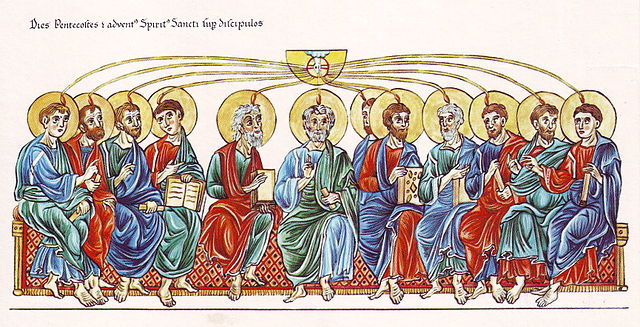
Medieval illustration of Pentecost from the 12th-century Hortus deliciarum of Herrad of Landsberg (details)
There were twelve loaves of Proposition, which only the priests could eat, in the “holy place” in the temple of Jerusalem. They were of the finest flour and unleavened. Every Sabbath the new priests, replacing those in the cycle before them, ate these loaves and prepared new ones. These loaves were placed along side the altar of incense on a table laden with gold before the veil of the tabernacle. Also here in the “Holy Place” was a seven branch candlestick always lighted. We see here a figure of the liturgy of the Holy Mass, bread, candles, and incense. In the Holy of Holies, behind the veil, was another figure of the Holy Eucharist and the priesthood within the Ark of the Covenant: the Manna (Bread) from heaven, the rod of Aaron the priest, and the tablets of the Law of Moses (the Ten Commandments).
When Our Lord feed the five thousand with five loaves and two fishes there were twelve baskets of fragments left over: “And they did all eat, and were filled. And they took up what remained, twelve full baskets of fragments” (Matthew 14:20). This miracle, and the twelve baskets left over after it, was recorded by all four evangelists. I have wondered, what happened to the leftovers? One simple answer is that whoever donated the baskets took the leftovers for their journey back home.
The woman who had an issue of blood for twelve years was cured simply by the passing by of Our Lord. She only needed to touch the hem of His garment. “Who touched me?” Jesus asked. (Matthew 9:20) The Sacred Heart longs to be longed for.
In the Garden of Gethsemane, Jesus assured His Apostles that He had more than twelve legions of angels at His disposal, if He should choose to call upon them. (Matthew 26:53) This was meant simply for their understanding, as they knew, being well-educated Jews, that only one angel slew 185,000 soldiers of the Syrian king Sennacherib. The Apostles were by no means ignorant men. (This is a pet peeve of mine, which I will not elaborate on here.) For goodness sake, Saint John the Apostle was known to the high priest. (Matthew 18:16).
In the Book of the Apocalypse, Our Lady, the Woman “clothed with the sun” has a crown of twelve stars around her head: “And a great sign appeared in heaven: A woman clothed with the sun, and the moon under her feet, and on her head a crown of twelve stars” (Apoc 12:1).
And the walls of the heavenly Jerusalem, described by Saint John in his vision, had twelve gates, and twelve angels at the gates, and twelve pillars for a foundation. “And it had a wall great and high, having twelve gates, and in the gates twelve angels, and names written thereon, which are the names of the twelve tribes of the children of Israel” (Apoc. 21:12). “And the wall of the city had twelve foundations, and in them, the twelve names of the twelve apostles of the Lamb” (Apoc, 21:14).
The Tree of Life, described in the Apocalypse bears twelve fruits: “In the midst of the street thereof, and on both sides of the river, was the tree of life, bearing twelve fruits, yielding its fruits every month, and the leaves of the tree were for the healing of the nations” (22:2).
This verse brings us to the “substance” of the type presented to us by the “fruits” of the Tree of Life, of which there are two. The first is preeminently the Holy Eucharist, the Bread of Life. The second is the twelve fruits of the Holy Ghost. What are the twelve fruits of the Holy Ghost? Saint Paul gives them: charity, joy, peace, patience, benignity, goodness, longanimity, mildness, faith, modesty, continency, and chastity. (Galatians 5:22). These fruits, given by God to those who cooperate with grace, are necessary for salvation.
Lastly, although it is not a scriptural citation, there are twelve months of the year.
Does anyone know any other “holy twelves”?



