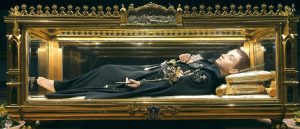
At Mass this morning, the chaplain for Saint Benedict Center gave an inspiring sketch of the major events in the life of the Passionist Saint Gabriel of the Sorrowful Virgin (1838-1862), whose feast day is today, February 27. What caught my attention most was the saint’s inordinate zeal for extreme penances. In this, he had to be disciplined by a prudent and fatherly spiritual director. When the young Passionist asked permission to wear a studded chain around his waist (which was a step beyond a hair shirt, but permitted, in those days, to some religious who lived the monastic life), his director granted the permission — with one condition — that the holy monk wear the chain on the outside of his habit. So, Brother Gabriel complied. What blossomed was a far more rigorous penance, the abnegation of pride. This fruit was nourished by the fiery darts of mockery hurled at him by his religious brethren as he walked among them girded with his studded chain.
The reason why Gabriel is a saint is not only because of his eight-year penitential life of solitude, prayer, self-denial, mortification of the senses, and ardent love for God and His holy Mother, but mostly because of his humble acceptance of derision. Not from his enemies, mind you, but rather from those he loved, those “of his own household” so to speak.
Father ended his sermon by comparing Saint Gabriel’s sufferings to those of the Man of Sorrows, who, for our salvation, endured the most cruel humiliations in His passion at the hands of wicked men.
Our Lord was first mocked by the simple folk, the wailers (Jews often hired professional grievers to mourn the dead) outside the house of Jairus, a ruler of the synagogue, who believed in Jesus. Jairus had asked Our Lord for a miracle, to cure his dying daughter, but before Jesus arrived, the maiden had died. Knowing this, He who, in His divinity, had received the soul of the young girl, said to the crowd of wailers:
Give place, for the girl is not dead, but sleepeth. And they laughed him to scorn (Matt. (9:24).
Several times Our Lord told His Apostles that the Son of Man must suffer, be crucified, die, and then rise anew. He even provided for them the details of the mockery that He must endure:
For he shall be delivered to the Gentiles, and shall be mocked, and scourged, and spit upon (Luke 18:32).
The mockery began with Herod Agrippa, unto whose authority Pilate had sought to release Jesus, as this Herod was the tetrarch of Judea and ruler of the Judean Jews:
And Herod with his army set him at nought, and mocked him, putting on him a white garment, and sent him back to Pilate (Luke 23:11).
Then, the demons seized upon the dark souls of the pagan gentile soldiers who ratcheted up the intensity of the mockery:
And platting a crown of thorns, they put it upon his head, and a reed in his right hand. And bowing the knee before him, they mocked him, saying: Hail, king of the Jews. And spitting upon him, they took the reed, and struck his head (Matt. 27:29).
Finally, the priests, and servants, who had mocked him in the court of the high priest Caiaphas, continued their assault on Calvary:
And they that passed by, blasphemed him, wagging their heads (Matt. 27:39).
In like manner also the chief priests, with the scribes and ancients, mocking, said: He saved others; himself he cannot save (Matt. 27:41).
The wagging of the head was a particularly hateful and arrogant insult, leveled by one who seemingly has the upper hand, upon another who would seem to be in the agony of defeat.
Saint Gabriel endured his humiliation meekly in imitation of the derision cast upon the Omnipotent Son of God Himself in His payment of the price for our sins of pride.
Behold, he cometh with the clouds, and every eye shall see him, and they also that pierced him. And all the tribes of the earth shall bewail themselves because of him. Even so. Amen (Apoc. 1:7).