
Often confused by Americans with Slovenia, Slovakia shares with that country a relatively brief period of political independence — 1939 to 1945, and 1993 to the present in the case of Slovakia. From 1920 to 1939 and from 1945 to 1993 it was very much the junior partner in Czechoslovakia. But for several centuries up until 1920, it was part of the Apostolic Kingdom of Hungary — indeed, the area that is now Slovakia was called “Upper Hungary,” and thanks to the Turks occupying most of Hungary the capital of that country was moved to what is now Bratislava. It would not move to Budapest until the 19th century. The relationship between the Slovaks and Magyars is very reminiscent of that between English and Irish.
Long before either arrived in what is Slovakia, the Celts came from the West around 400 BC, colonising the lowlands along the Danube and its tributaries. These were conquered by Burebista, King of the Dacians around 60 BC. His empire collapsed after he died, 16 years later. The Romans and the Germanic tribes launched their first invasions along the Middle Danube after 10 BC. The Danube formed the frontier between the Roman Empire and Barbaricum. Nevertheless, the Romans built small outposts along the left bank of the Danube. They crossed the Danube several times during the Marcomannic Wars between 160 and 180. Marcus Aurelius wrote the first chapter of his Meditations during a campaign in the region of the Hron River in 172. The “Miracle of the Rain” — a sudden and unexpected storm which saved an exhausted Roman army — occurred in the land north of the Danube in 173; the rain came in answer to a Christian soldier’s prayer. Roman troops crossed the Danube for the last time in 374.
The empire’s frontier started to collapse along the Danube in the 370s. The depredations of the Huns forced large groups of Germanic peoples, including the Quadi and the Vandals, to leave their homelands by the Middle Danube and along the upper course of the river Tisza in the early 5th century. Their lands were occupied by other Germanic peoples. But the Carpathian Basin was dominated by the nomadic Huns from the early 5th century and the Germanic peoples became subjects to Attila the Hun. After his Empire imploded after his death in 453, the Germanic peoples either regained their independence or left the Carpathian Basin.
Slavs began entering the region in the 6th century. At the same time the Lombards passed through enroute to Italy. But in 568 the Avars arrived from the east and conquered the local Slavs. But in 623 the Slavs rose up against their Avar masters and declared a Frankish merchant, Samo, to be their King. His realm lasted all of 35 years. Charlemagne’s wars with the Avars (788-803) ended them as a power. This opened the way for the local Slavs to organise a state — thus Great Moravia arose in 830, although initially under Carolingian overlordship. Frankish priests and then Ss. Cyril and Methodius arrived to evangelise, and St. Methodius was made Bishop of the country in 880.
But about 896 the Magyars rode in from the East, successors of the Huns and Avars. Although they conquered Great Moravia within a decade, the defeated realm left an important legacy for all the Eastern Slavs: Glagolitic script and its successor Cyrillic spread to many other Slavic countries, charting a new path in their cultural development. Despite that, what is now Slovakia and its Slavic inhabitants were now part of Hungary and would share its fate until 1920. St. Stephen received a crown from Pope Silvester II being crowned as the first King of Hungary in 1000 or 1001.
In 1526, at the Battle of Mohacs the Hungarians were decisively defeated by the Turks who occupied the central part of the country. What was left — basically the northern fringe — was inherited by the last King’s heirs in the female line, the House of Habsburg. This “Royal Hungary” included much of the present-day territory of Slovakia (except for the southern central regions), northwestern present-day Hungary, and present-day Burgenland in Austria. As noted, Bratislava (Poszon for the Magyars, Pressburg for the Austrians) became, between 1536 and 1784/1848, the capital and coronation city of the Kingdom of Hungary. From 1526 to 1830, nineteen Habsburg sovereigns went through coronation ceremonies as Kings and Queens of the Kingdom of Hungary in St. Martin’s Cathedral. Eventually, the Habsburgs would push the Turks back out if Hungary, taking Budapest in in 1686.
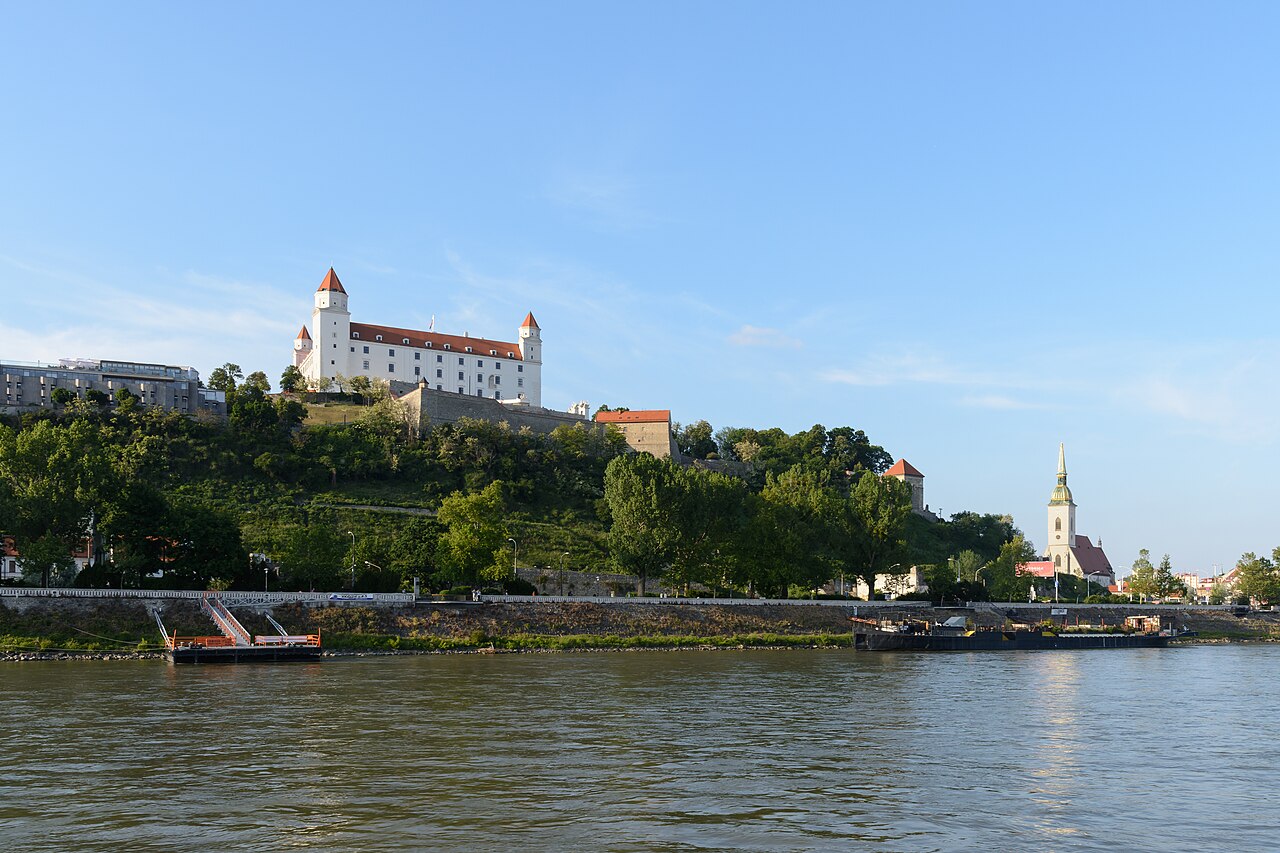
Bratislava Castle and St. Martin’s Cathedral, from the Danube. Photo by Uoaei1, CC BY-SA 4.0, via Wikimedia Commons.
In the meantime, the Slavic population of northern Hungary retained their unique language and customs, although divided between Byzantine and Latin Rites religiously. With the 18th century, a Slovak National Movement emerged. Both Protestants and Catholics came up with alternative methods of writing Slovak. Ľudovít Štúr’s version was approved by both Catholics and Lutherans in 1847; after several reforms, it remains standard Slovak.
When the Hungarian Revolution broke out the following year, the Slovaks, in common with the other minorities and a large chunk of the Magyars, stayed loyal to the Habsburgs, and took up arms to defend the Holy Crown. As a result, the so-called “Period of Absolutism” saw the Slovak National Movement flourish with the foundation of the cultural association Matica slovenská (1863), the Slovak National Museum, and the Slovak National Party. But the creation of the governmentally separate Kingdom of Hungary in 1867 had the effect of placing the minorities once more under Magyar rule. Had the Catholic Party been dominant, things might have resulted differently. But the Liberal Party determined upon a policy of Magyarisation of said minorities, to include the Slovaks. The result was an ever escalating series of campaigns and incidents. Before World War I, the idea of Slovak autonomy became part of Archduke Franz Ferdinand’s plan to federalise of the monarchy, developed with help of Slovak journalist and politician Milan Hodža. This plan did not die with the Archduke, but was passed on to his nephew, Archduke Karl — the future Bl. Emperor Karl.
While a prominent circle of exiled intellectuals (such as Milan Rastislav Štefánik) worked abroad with Czech leaders to establish the Entente-aligned Czechoslovak Legions to dismantle the empire, this anti-Habsburg movement was not the reality for most Slovaks on the ground. Slovaks in the United States of America, an especially numerous group, formed a sizable organization. These, and other organizations in Russia and in neutral countries, backed the idea of a Czecho-Slovak republic. Despite all of this, on July 16, 1918, Bl. Karl and SG Zita were overwhelmed by the loyalty of the crowds who greeted them. It woud be their last official visit outside Vienna before the end of the war and the Monarchy.
Thanks to Woodrow Wilson’s insistence on the Habsburg deposition, the First Czechoslovak Republic came into existence in November of 1918. Now even attempting to fuse Czechs and Slovaks into one nationality, there were large minorities of Sudeten Germans, Magyars, Poles, and Ruthenians — and the Czechs were definitely the senior partners. This led in time to a renewed Slovak National Movement under the priest Fr. Andrej Hlinka, who had been a Slovak Nationalist before the war. After his death, he was succeeded by another Priest, Msgr. Jozef Tiso.
The rise of Hitler intensified the country’s internal issues. In the end, the 1938 Munich treaty gave the German-inhabited parts of Bohemia and Moravia to Germany, the Magyar sections of southern Slovakia to Hungary, and Teschen to Poland. March of 1939 saw Germany occupy what was left of Bohemia and Moravia as a “protectorate,” with Slovakia and Ruthenia independent republics (the latter very briefly, because Hungary quickly snapped it up). But Msgr. Tiso tried to run as independent a government as he could; he refused to declare war on the United States in 1941. When American troops captured him at the end of World War II, they terribly abused him and then turned him over to the Communists for prison and death. His legacy remains controversial in Slovakia to-day.
Thanks to Yalta the newly recreated Czechoslovakia (same shape as the old one, save with Ruthenia annexed to the Ukrainian Soviet Socialist Republic) was firmly under Soviet control after 1948. Twenty years later was the famous Prague Spring, which was summarily crushed. Finally, the Soviet Bloc collapsed, and Slovakia and Czechia separated in 1993.
Since then, Slovakia has joined NATO and the EU and adopted the Euro. As with the rest of Central Europe, there is a division between Catholic Conservatives and secularising leftists. The latter have the aid of George Soros, the former have nothing on their side but the truth. All of the standard issues agitating their neighbours agitate Slovakia.
The Slovaks, like the other inhabitants of what was Austria-Hungary, have had over a century of promises that national independence would bring national happiness. Instead, the period since Bl. Karl withdrew from governing his peoples has been for the most part a nightmare for them all. One cannot help but wish they would figure this out on their own someday.



