

One of the things moving from Los Angeles to Austria has taught me is the preciousness of Spring. That may sound a bit odd, but the truth is that in Southern California the lack of a snowy winter and the year-round presence of blossoming flowers reduces spring to a cool period before the onset of summer’s blazing heat (in the desert, however, the rains bring an explosion of California poppies and other wildflowers that can be utterly mesmerising). It is very different, indeed, in a certified four seasons realm such as I now live in. Here, as the snow recedes the flowers arrive in a succession common to most temperate climes. First, the white snowdrops make their appearance. These harbingers of spring often blend in with the lingering snow.
But there can be no mistaking the yellow daffodils that follow them. In garden, meadow, and woods, they make a tremendous display. As the national flower of Wales (alongside the leek!) they are omnipresent among the Welsh at home and in the diaspora. Following them come the tulips in all their different colours. These are particularly associated with the Dutch – and certainly are enchanting in the Hudson Valley, where the doughty burghers settled. As with the poppies in the California desert, the sheer profusion of them around places such as FDR’s home at Hyde Park, the Old Dutch Church in Kingston, and Washington Irving’s mansion, Sunnyside in Irvington, is so colourful as to be hypnotic. Trees and shrubs blossom in pink and purple, and at last the roses begin to emerge. Spring flowers can exercise the same magical influence on the imagination as do autumn leaves. But where the latter magic is replete with the idea of harvest and ingathering, the vernal variety is all about growth and birth and fertility – promise rather than fullness.
This atmosphere provides the perfect backdrop for the liturgical seasons of Carnival, Lent and Easter and the feasts therein. The celebrations of the first give way for the penance of the second; but there are bright lights in the violet pall. Given that the daffodil is the national flower of Wales, it is fitting that the country’s patron Saint, St. David, has his day on March 1. The Cornish cousins of the Welsh celebrate their patron, St. Piran, five days later. In this truly Celtic month, St. Patrick’s Day makes us all Hibernian for a day – and in truth, there is much in the heritage of the Emerald Isle to celebrate, if not since the two referenda that reduced the Irish to the same standard of murderous perversity that prevails in most countries. But the Hill of Tara retains its mystery, and the various shrines to the country’s patron saint scattered around Ireland remind us of his holiness, even if many of the current population do not. Shamrocks are everywhere, even as the green is universally worn.
On the same day is the feast of St. Joseph pf Arimathea. Far less famous than the Apostle of Ireland, St. Joseph of Arimathea appears in the Bible, when he provides his own tomb for Jesus after the Crucifixion. The earliest legends have him bringing relics of the Precious Blood and the water that flowed from Christ’s side to Glastonbury. Later on, it was held to have been the Holy Grail. What is certain is that when he leaned on his staff, having arrived at the area’s Wearyall Hill, it took root and blossomed. To this day descendants of the original thorn bush bloom at Christmas time. Several blossoms are ceremonially cut and sent to the King.
Two days later is the feast of St. Joseph, foster father of Our Lord, spouse of Our Lady, and Patron of the Universal Church. While all Catholics are counselled to “go to Joseph,” he is particularly loved by the Italians. The creation and enjoyment of “St. Joseph’s Table” is an enduring feature of any American Catholic parish with a sizeable Italian membership. In New Orleans, due to the large numbers of both Italians and Irish, these two days make an odd sort of double festival – and Catholic blacks there enthusiastically have adopted the St. Joseph’s Table custom.
On March 25 is the feast of the Annunciation, which is an extremely important feast for a number of reasons. The event it commemorates is of course the beginning of the Incarnation – that is to say, that eruption of the Second Person of the Holy Trinity into our human world, at last ending the reign of Satan that had begun with the Fall. Not surprisingly, it was perhaps the very earliest feast observed by Christians – at least as early as the 2ndcentury AD, at a time when Apostolic tradition was still fresh in the ears of those who had hear it from the first generation of disciples. Always celebrated on this day in all Rites of the Church, it is not hard to track the course of Our Lady’s pregnancy – thus establishing December 25thas the date of Our Lord’s birth, despite the Christmas-debunking industry which has grown up in the past couple of centuries.
Thinking of Christmas in Spring of course underlines the resemblances between Lent and Advent – both periods of penance preceding the two major feasts of Our Lord. Purple vestments remind us of the nature of the time, as does the silent organ. But they also boast two islands of joy in the midst of the liturgical penance: Gaudete and Laetare Sundays. These are the only two days of the year upon which a priest may wear Old Rose (NOT pink!) vestments. Both look forward to either the Nativity or the Resurrection of Jesus, the thoughtof which should help us keep going, not merely through the respective penitential seasons, but through the stresses and strains of modern life in general.
The Stations of the Cross that so many parishes undertake on Friday bring the mysteries of Good Friday ever closer, as Lenten soup suppers and the inevitable Knights of Columbus fish fries remind us of the Last Supper. Nevertheless, as Passion week goes on, we cannot help but think of Easter plans. The dying of eggs, the buying of lilies and other flowers, and of lamb or ham for the great feast loom ever greater. But first is Holy Week to be gone through; if we have kept a good Lent, there is a sort of emotional buildup which culminates on Good Friday.
Between Easter’s Resurrection and Pentecost’s Descent of the Holy Ghost, Christ rises, completes the formation of the Church and her Sacraments begun with Maundy Thursday and Good Friday, ascend, and finally sets the Church a-sail, guided by the Holy Ghost. She and her members will now have all the spiritual weapons they need to tackle the time after Pentecost, which in addition to other things can symbolise the life of the Church in the World between her Founder’s departure and her own completion at the End of time.
What is both commemorated and foreshadowed of the Church in the Liturgical Year, and demonstrated in nature in the turning of the seasons, is true for each of us as well. Our own Springtime happens early on to each of us. We are born into a family, raised (presuming our parents and relations to be decent people) in the best way our family knows how, similarly educated, and then set off into the World. As with Lent, we are in a hurry to be over with childhood; yet when we are finished with it, and are hard at work in the summer of our lives, we wish we could go back.
The golden days of childhood and youth are gilded with nostalgia – the days when we had more to-morrows than yesterdays, when everything was new and exciting. Our beloved parents, relatives, mentors, and friends now long gone arise again, as do our school days — when we were tested, and tested ourselves. The Scouts and camping in the woods and fields of long ago, the people of the Old Neighbourhood just as we remember them – and all of them in our memories perhaps better than they really were.
All of it passes, and for many of us has passed; but just as we know we must face our final illness and death, so too with Christ. The pleasant years He passed with his apostles in the meadows and byways of Palestine passed quickly, as with own childhoods and youths. The spectre of His end came closer and closer, as it does with each of us. The gradual loss of our friends and loved ones was prefigured by His loss of St. Lazarus; even though He knew He would raise him from the dead, He still wept for His loss – so may we for ours, quite legitimately. But we also know that He shall raise them up again, as He did His own dear friend. Wherever we are now in the Year that is our own life span – the heat of summer when we are doing our life’s work, the cool of autumn when we have accomplished most of what we shall accomplish, or the cold of winter awaiting our removal from the scene – if we are faithful, we shall be born again, into that spring that has no end, in the Kingdom of Heaven.
But as part of our achieving that blessed goal, we must give what aid we can to those who are now in the springtime of their lives. Through our example and our word, though the passing on of whatever good was given to us, we must do our best to make this part of their time on earth joyful and productive, according to our own positions, abilities, and temperaments. Once, not too long ago, we stood where they stand; all too soon, they shall be in our place. If we remain Faithful to God and His Church, we shall resurrect in glory one day; if we keep faith with the young, all that we love and believe in shall also have a temporal resurrection one day. May we all one day share the eternal springtime.
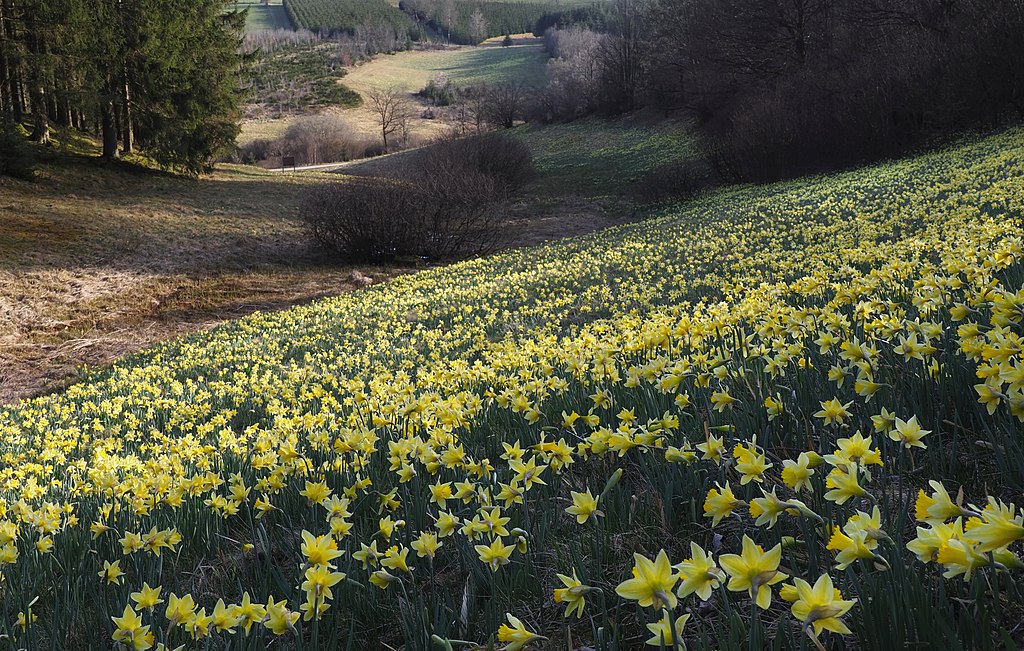
Narcissus flower (Narcissus pseudonarcissus) in the Holzwarchetal near Mürringen, East Belgium. Frank Vassen from Brussels, Belgium, CC BY 2.0, via Wikimedia Commons.



