

Parishioners at the FSSP’s North American Martyrs Parish in the Seattle area have friends in high places—in more than one sense. To be sure, St. Isaac Jogues and his seven missionary brothers intercede for the souls in their namesake’s parish, which honored them with newly-commissioned wood carvings in the church’s sanctuary.
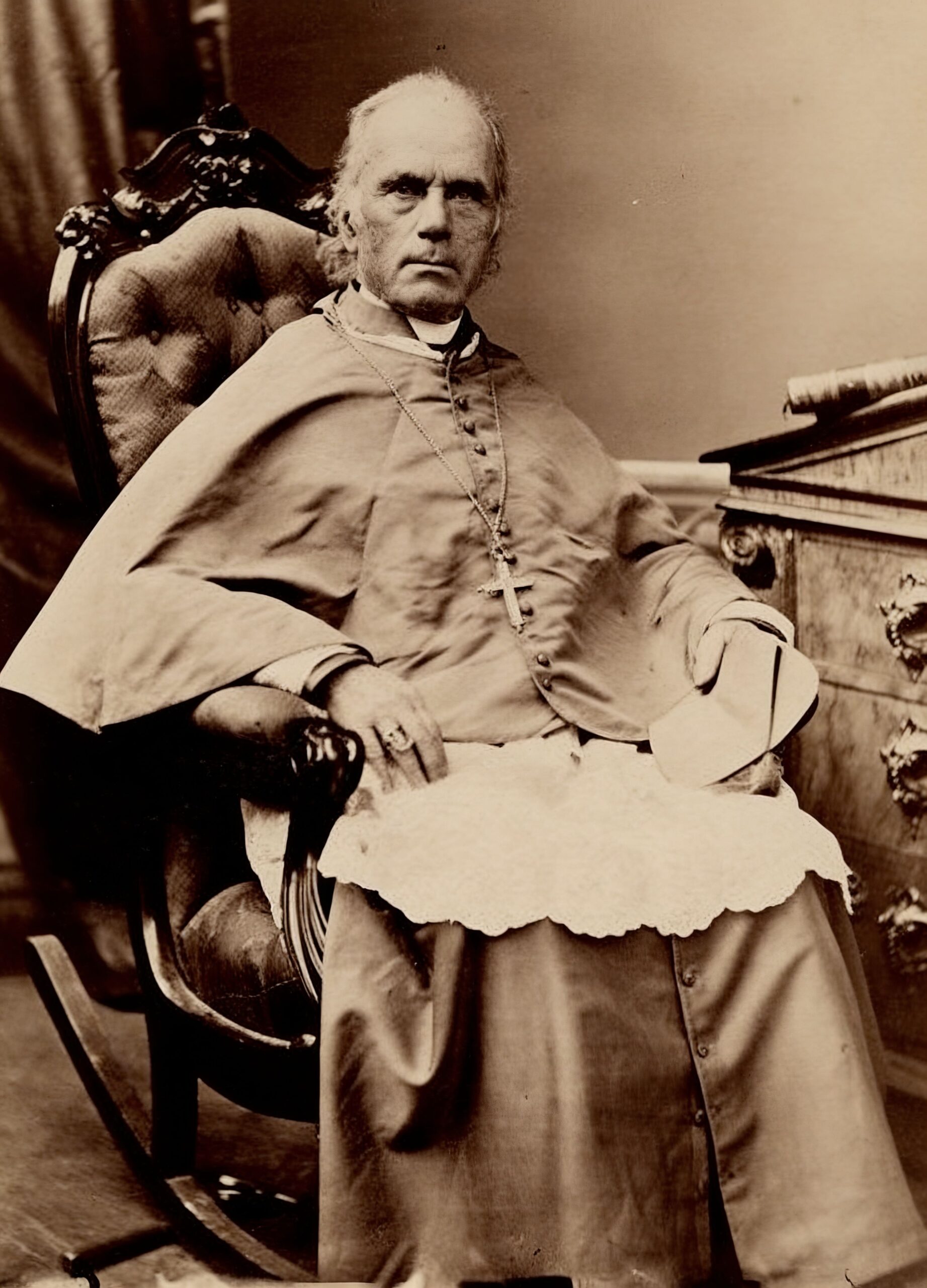
This particular church has been in use by the parish since 2019, but for several years before that, parishioners who attended the 8:00 am Mass at the nearby Holyrood Cemetery’s mausoleum had an additional friend likely in Heaven, whose bodily remains are also in a high place: French-Canadian-born missionary, Bishop Augustin Blanchet.
This mysterious situation needs a little historical background in order to be understood…
The late Father Joseph Doogan wrote an account of an extraordinary event in 1955, but that report was buried and almost never saw the light. It was June 1955, and he had just completed a mission entrusted to him by Seattle’s Archbishop Thomas Connolly. The archbishop wanted the remains of his predecessors uncovered and moved to a new mausoleum in north Seattle. They were to be placed in shelf-crypts inside the new structure, with the first bishop of Western Washington, Augustin Blanchet, on the top row to the left of the altar. Despite the relative unfamiliarity of Americans with exhumation, it was supposed to be a simple assignment. Yet it turned out to be similar to Bishop Blanchet’s life: unusual and adventurous.
Augustin Blanchet was born on August 22, 1797 in the village of St. Pierre de la Rivière du Sud in what is now the province of Québec, Canada. He was ordained to the priesthood on June 3, 1821 and served the faithful in various ways around Montréal, including as the chaplain for the Sisters of Providence, founded in 1843 by Blessed Émilie Gamelin.
Blanchet’s older brother, François, also a priest, was sent to the Pacific Northwest by his bishop in 1838. This was done in response to the request of John McLoughlin (“the Father of Oregon”) for priests to minister to employees of the Hudson’s Bay Company, of which he was the Columbia district head.
Father François Blanchet was notified in 1844 that he would be elevated to the episcopacy. There were no bishops in the Pacific Northwest to consecrate him, so he made the journey back to Québec—taking a very long route to Honolulu, Hawaii; Cape Horn, Chile; and Dover, England by boat. Then to Liverpool, England by train, Boston by boat, and finally to Montréal by train.
After his voyage of over 20,000 miles and subsequent consecration on July 25, 1845, Bishop François Blanchet travelled back to Oregon—taking an even longer route, which this time included fundraising journeys through France and Italy. All told, the first ordinary of what is now the Archdiocese of Portland, Oregon, spent over two-and-a-half years doing something (traveling from Oregon to Québec for a big event and then back to Oregon) that now might take two-and-a-half days.
On September 27, 1846, his younger brother, Father Augustin Blanchet, was elevated to the episcopacy in Montréal. He was then sent to be the first head of the Diocese of Walla Walla, Washington, which had been created out of the much larger Vicariate Apostolic of Oregon Territory, which became the Diocese of Oregon City, and later, the Archdiocese of Portland.
Amid frequently-changing territorial distinctions, Bishop Blanchet was named the first bishop of the newly-designated Diocese of Nesqually, which encompassed the entire state of Washington, on May 31, 1850. It would later lose land size, but gain tens of thousands of souls, eventually becoming the Archdiocese of Seattle.
No Good Deed Goes Unpunished
Not all went smoothly for the brother bishops. Less than three months after Bishop Augustin Blanchet arrived in Walla Walla, Protestant missionary Dr. Marcus Whitman, his wife, and eleven others were murdered by Cayuse and Umatilla Indians. They believed that Dr. Whitman, who was unable to stop the spread of measles in the native population, had actually poisoned the natives.
The massacre prompted Bishop Blanchet to move out of Walla Walla. While away, he was notified by governmental officials that he would no longer be allowed to continue his missions. On April 29, 1848, he wrote to George Abernethy, governor of the Provisional Government of Oregon. This letter and several others are in the book, Selected Letters of A.M.A. Blanchet, translated by Roberta Stringham Brown and edited by her and Patricia O’Connell Killen; published by the University of Washington Press:
On coming to this country which was to be my adoptive land, I foresaw that I had two important duties to discharge; the one towards God, whose unworthy minister and ambassador I am, the other towards this country…
For why have we been sent forth by the head of the Church? Was it not to Christianize our poor infidel Indians, and to make them servants of God? But to Christianize these unbelievers is nothing else than to first teach them the duties which they owe to God and to mankind; that is to say, to teach them to love God with their whole hearts, and their neighbors as themselves; and then to confer Baptism. Why are these Indians so miserable, unless because either they have no knowledge of this law of the Creator, or do not sufficiently comprehend it?…
Let us teach them how, according to the words of Our Savior, all the commandments are contained in these two—namely, the love of God and the love of our neighbor. As soon as they shall be well acquainted with this, they will no longer be addicted to revenge, murder and numerous other crimes, which habit has rendered almost natural to them (page 46).
Despite the life-threating situation, the zealous bishop was determined to complete his missionary work, expressing this desire in the same letter to the governor:
…I am anxious to continue the work we have so successfully commenced. Yes, I am desirous that circumstances permit us to return among these Indians, who wish to know God as we do, in order to adore Him and to love Him with all their hearts, and it is my intention to do so as soon as possible (Ibid., page 46).
If troubles with Indian misconceptions were not enough, missionaries of other beliefs had been able to convince officials that Bishop Blanchet and his cohorts were not fit for the area. He referred in a subsequent letter to “blind hatred of Catholicism” but also how those who purveyed it “fell into the very ditch they had been digging for us.” He said that they had gone so far that “every person of common sense condemned them.” (This was highlighted by the leader of the anti-Catholic pack running for Congress, yet only receiving three votes in his own county.)
Later that year, U.S. President James K. Polk appointed Joseph Lane the first governor of the Oregon Territory. The following year, Bishop Blanchet wrote of his relief to the Society for the Propagation of the Faith in Paris and Lyon, France:
Religious persecution has ceased. Last year’s restriction on our establishing Indian missions quickly vanished; and on several occasions, the governor [Lane] expressed chagrin in learning that there were persons so very narrow-minded and imbued with prejudice that they had forbidden us to bring the light of civilization to the poor Indians (Ibid., page 61).
…
If the truth were to be told, several public officials do not hesitate to say that Catholics alone know how to work successfully with Indians, that experience has shown this to be so. I need not tell you that these officials were not Catholic (Ibid., page 63).
Bishop Blanchet then stated how he “was pleased to be recognized by the government, gladdened at long last to be able to evangelize the Indians of my diocese without fear of further harassment.” His gladness, however, was not to last, as he soon learned that the Society for the Propagation of the Faith had stopped funding his missionary work.
Seemingly never at a loss for a cross, Blanchet’s 33-year term as bishop displayed a concern for souls at the expense of personal comfort. He concludes an 1875 letter to Bishop Ignace Bourget of Montréal with the request that:
in your fervent prayers, please think about him who, like Your Lordship, cannot expect to live much longer: Ut moriatur anima mea morte justorum, et fiant novissima mea horum similia. [“May my soul die the death of the just, and may my last end be like theirs.”] (Ibid., page 232).
The following year, a report on the diocese of Nesqually, which encompassed the entire state of Washington, stated that the number of non-indigenous Catholics had not increased much, there was no seminary, the 60-foot by 36-foot cathedral was made of wood, and the bishop had no personal revenue.
However, the report also indicated the presence of approximately 10,000 Catholics, including more than 600 in Vancouver, nearly 300 in Seattle and 700 in Walla Walla. There was also the prayerful presence of the Sisters of Charity of the House of Providence, who, with forty professed members, maintained a convent, boarding school, day school, two orphanages and a hospital.
This was at the time when the diocesan see was located in Vancouver, a city in the southwestern part of Washington. By 1885, a more suitable brick cathedral built in Gothic Revival style and named after Saint James the Greater, had opened. A crypt under its sanctuary was where the remains of Bishop Blanchet were placed after his death in 1887.
Cryptic References
The Diocese of Nesqually was renamed the Diocese of Seattle in 1907 and the Archdiocese of Seattle in 1951. Four years later, Seattle’s Archbishop Connolly instructed Father Joseph Doogan, the head of Catholic Cemeteries in Seattle, to transfer the remains of the archbishop’s four predecessors to a new mausoleum at Holyrood Cemetery in north Seattle (now the city of Shoreline). It was supposed to be an ordinary event, yet it turned out to be quite noteworthy.
The remains of the first two bishops of Nesqually were still in Vancouver, in the crypt at St. James Church. It seemed that is where almost everyone in Vancouver wanted them to remain, including the pastor of St. James at the time, Father Robert Dillon. According to Father Doogan, neither Father Dillon nor the people who had gathered across the street from the church were in favor of the transfer.
Despite the crowd that witnessed the caskets being taken from the church, a tale even got out that the bodies were stolen in the middle of the night. Yet Father Doogan described a far different story. He wrote that he, Jerome Healy (superintendent of Holyrood Cemetery), and George Hoffner (owner of a funeral home in Seattle) were able to get into a hidden crypt area beneath the sanctuary, via trap-door. Two of the four available crypts were occupied: one by Bishop Aegidius Junger, the other by his immediate predecessor, Bishop Augustin Blanchet.
In full view of uneasy onlookers, the team of three men from Seattle loaded two caskets into a hearse parked at the side of the church. Then they traveled to Holyrood Cemetery in north Seattle, leaving the remains of the first two bishops of Nesqually in the sacristy of the mausoleum. The next day, Father Doogan and Mr. Healy returned to the mausoleum. They were accompanied by Father Doogan’s brother, John, also a priest and later named a Monsignor, who was then the principal of the recently-opened Bishop Blanchet High School in Seattle. The men wanted to ensure that the remains were correctly identified so that they would be putting them in their proper places. Bishop Blanchet’s body was to be on the very top of a section of crypts to the left of the mausoleum altar, with his successors following beneath him.
Upon opening the top of the first casket, the three men discovered a large sheet of tin fastened to the sides. There was an oval-shaped piece of glass and a matching oval-shaped section of tin at the top where the head should be situated. The men surmised that this arrangement could be explained as follows: the sheet of tin was spread out over the bishop’s body, with a section cut out at the top and glass placed in it. This was so people attending the funeral could view the face, but not touch the body, of the deceased bishop. When the funeral was over, they thought, the piece of glass was removed and the section of tin it had filled was replaced.
When the oval-shaped piece of tin was peeled back, the Doogan brothers and Jerome Healy were astonished at what they saw before them. It was Bishop Augustin Blanchet’s face, completely intact! They recognized him from photos. There was no mistaking: This was indeed the casket of first bishop of Western Washington. They felt that they were in the presence of a pioneer in faith.
Whether the deceased bishop’s body was incorrupt due to the tin seal, some other aspect of burial, or to sainthood, remains unknown. In her enormously popular book The Incorruptibles, Joan Carroll Cruz recounts the lives of numerous saints whose bodies have not decayed, despite the passage of decades and even centuries. Examples include St. Catherine of Bologna, St. John Vianney, and St. Bernadette Soubirous.
While incorruption is not a requirement for sainthood, it can be an indication of it. Whether Bishop Blanchet’s perfectly-preserved remains are indicative of sanctity will take a long time to determine, since the Archdiocese of Seattle has no current plans for pursuing his cause for canonization.
Apart from the actual events of 1955, the strange story behind a written report on those events made things even more intriguing. An account describing the transfer of the bishops’ bodies was written by Father Doogan in 1955. A copy was sent to the office at Holyrood Cemetery and to the Chancery in downtown Seattle for filing. Years later, however, neither copy could be found. In 1993 Father Doogan wrote up another report describing the events of 1955, and it is from this account that we learned the story from 1955.
Whether we have here the first Saint Augustin(e) of North America is not yet known. What is known is that a pioneering bishop continued his mission for more than three decades, despite cultural, financial, governmental, and ecclesiastical challenges. Like his life itself, the general knowledge of his afterlife has already seen many setbacks. His remains, after having been covered for decades, were uncovered and shelved, and then a report on him was shelved and decades later uncovered.
At the Last Judgment, all things will be uncovered, but may God grant that long before then, Bishop Blanchet, according to his own prayer, be publicly counted among the just.
Trent Beattie is the author of Scruples and Sainthood (Loreto Publications) and Fit for Heaven (Dynamic Catholic). He is also the editor of Saint Alphonsus Liguori for Every Day (Mediatrix Press), Finding True Happiness (Dynamic Catholic) and Apostolic Athletes (Marian Press).



