

The world is sliding towards confusion. It clings to the slippery slope, but is unable to stay in place — I have a presentiment of impending upheavals, I probe the imminent days with my nerves and I absorb all their venom. Both sides will rage; Muscovy and the red republics will chase each other, beget each other, and kill each other off. The very heavenly powers will be shaken, as Christ prophesied. What are they within every one of us? The heavenly powers within us are the belief in the providential rule of God; they are the love of one’s neighbor, homeland, and humanity; they are decency, virtue, courage, and piety! Now it will come to pass that these angels of the human conscience will suddenly flee from many consciences, or if they stay, they will stagger as if drunk from pain and the horrible impressions from without. There will be many who will doubt God, many who will doubt the ir own immortality, many who will doubt their nation and country, many who will doubt love, many who will doubt the harmony of human fate, many who will despair of virtue, as once did the most tenacious patrician of the unraveling days of antiquity, adored by all modern demagogues, the hapless Brutus, who took his own life at Philippi after having committed patricide! Yes, the heavenly powers will be shaken in every man, and he who does not stand his ground, he who submits to the seduction of this brief fainting of the eternal conscience, will perpetrate crimes and violence, having proved to himself logically or mystically that the era of crime has come and evil has changed places with good, and he will be damned for eternity or for many centuries, but perhaps he will enjoy a few days of power over his dissolute comrades, he will sell his soul to the devil in exchange for might — this ecstasy of arrogance!
—Zygmunt Count Krasinski, “Poland Facing the Storm.”
THE First Partition of Poland was a dreadful blow, not just to Polish morale, but that of the Lithuanians, Belarusians, and Ukrainians with whom they shared the Commonwealth. The Allied Powers — Russia, Prussia, and Austria — that had undertaken the First Partition were watchful over any signs of independence that the Polish King and government might exert. Russia in particular supervised both the meeting of the Sejm and the Permanent Council made up of pro-Russian nobles and now deputed to carry on most of the business of governing. Stanislaus’ royal prerogative was restricted, so that he lost the right to confer noble titles, and military promotions and to appoint ministers and senators. Provincial Governorships, and Crown lands would be auctioned off. With the King reduced to seeming impotence, and the government firmly in pro-Russian hands, it seemed that the Commonwealth was now a complete puppet.
But King Stanislaus was a wily man. There was strong Conservative opposition to the Council, made up of nobility who feared loss of their own powers to a resurgent central government. The King became adept at playing the two sides off against each other and creating his own King’s party. Moreover, although his own powers had been severely clipped, his ability to influence and cajole became if anything ever stronger. He became very adept at mitigating or frustrating the worst of legislation that the Russians favoured. In secret, with trusted advisers, he created a reform programme. But while the King was able to slow the rate of decay, his opponents in the Sejm were able to block his reforms.
This standoff would continue for almost two decades. But on the wider world, things were happening. In 1781, Austria and Russia allied as a means of countering — and, they hoped, eventually conquering — the Ottomans (Catherine the Great had one of her grandsons named Constantine, in hopes that he would reign over a new Byzantine Empire). Stanislaus attempted to join this alliance, reasoning that it would strengthen Poland-Lithuania, and buy the country some independence. They were unable to agree on terms, but in 1787, the two Christian Empires went to war with the Muslim one. In response, Stanislaus convoked the “Great Sejm” the following year, which would sit for four years. Then in 1789, the revolution in France began, and that country created a constitution.
These events had a huge effect in Warsaw. With Austria and Russia busy fighting the Ottomans, Stanislaus and the Sejm seized the opportunity to draught a constitution of their own. The King joined the Patriotic Party of Stanisław Małachowski, Ignacy Potocki, and Hugo Kołłątaj, co-authoring the Constitution of May 3, 1791. Stanislaus described it, as “founded principally on those of England and the United States of America, but avoiding the faults and errors of both, and adapted as much as possible to the local and particular circumstances of the country.” Reaction at home and abroad was swift — the more so because the Polish Reform Party had been in touch with the revolutionaries in Paris, where the revolution was becoming ever more radical.
The Ottoman War ended, leaving Russia free to deal with the Commonwealth, and Catherine angry to find Stanislaus had regained his Sovereignty. Prussia too was outraged, although Austria had no objections. Fearful of what was beginning to happen to their peers in France, a group of conservative Polish nobility formed the Targowica Confederation to overthrow the Constitution, seeing in it as threatening their traditional freedoms and privileges. These new confederates aligned with the Russian army entering the Commonweal. Thus began the Polish–Russian War of 1792. In response, the King could only gather a 37,000-man army, many of them raw recruits. Under the command of the King’s nephew Józef Poniatowski and Tadeusz Kościuszko (famous for his exploits in the American Revolution), managed to defeat the Russians or fight them to a draw on several occasions. Following the victory at Zieleńce, in which Polish forces were commanded by his nephew, the King founded the Order of Virtuti Militari for exceptional military leadership and courage in combat.
But in the end, the numerical superiority of the Russians was too great; defeat appeared inevitable. Catherine refused to negotiate with Stanislaus, and by July 1792, as the Russians closed in on Warsaw, the King came to believe that surrender was the only alternative to total defeat. The Russian envoy having promised that there would be no territorial losses, the Cabinet voted eight to four to surrender. On July 24, 1792, the King himself joined the Targowica Confederation, and his army disintegrated. Many of its officers fled overseas, hoping against hope that the King could somehow rescue the situation. But his credibility with the Russians was gone, and the Targowica Confederates found that their treason had been in vain.
Russia was now prepared to seize a huge chunk of the Commonwealth’s remaining lands. But then Frederick William II of Prussia approached Catherine with demands of his own. He insisted that she was obligated to compensate Prussia with Polish territory, because he had joined the War of the First Coalition against revolutionary France at her urging, and as a result Prussia suffered a huge defeat at the Battle of Valmy. Catherine agreed.
On January 23, 1793, Prussia signed a treaty with Russia, agreeing that the Constitution would be revoked and they would both would receive huge chunks of Commonwealth territory. Russian and Prussian troops took control of the territories they claimed, with Russian troops already present, and Prussian troops meeting only limited resistance. In 1793, deputies to the Grodno Sejm, the last Sejm of the Commonwealth, in the presence of Russian forces, agreed to the Russian and Prussian territorial demands. The two countries insisted on legal sanction from the Commonwealth. Russia seized 97,000 square miles, while Prussia took 22,000 square miles. The Commonwealth was reduced to 83,011.96 square miles.
The King considered abdication. But it was pointed out to him that if he did so there would be no remnant of Polish-Lithuanian Sovereignty left. But he had lost all credibility with Russians, and the confidence of a great many of his countrymen. As things stood, only Austria seemed at all interested in preserving Polish-Lithuanian independence, and in 1790 had offered to return Galicia if Prussia would do the same with portions — an offer the Prussians refused. But by this time, Austria was completely engaged in the war with France.
Both King and country were defeated, despondent, and isolated. Perhaps, if time permitted, something could be restored internally. Alas, all Stanislaus and his remaining countrymen could do was try to lick their wounds and recover. Western Europe was ablaze, and what was left of Poland was pictured by both Prussians and Russians as a possible hotbed of revolutionaries in the heart of Central Europe. The future for the rump of Poland-Lithuania did not look bright, and as we shall see in the next instalment, it wasn’t. But neither the King nor his countrymen were prepared to go down without a fight.
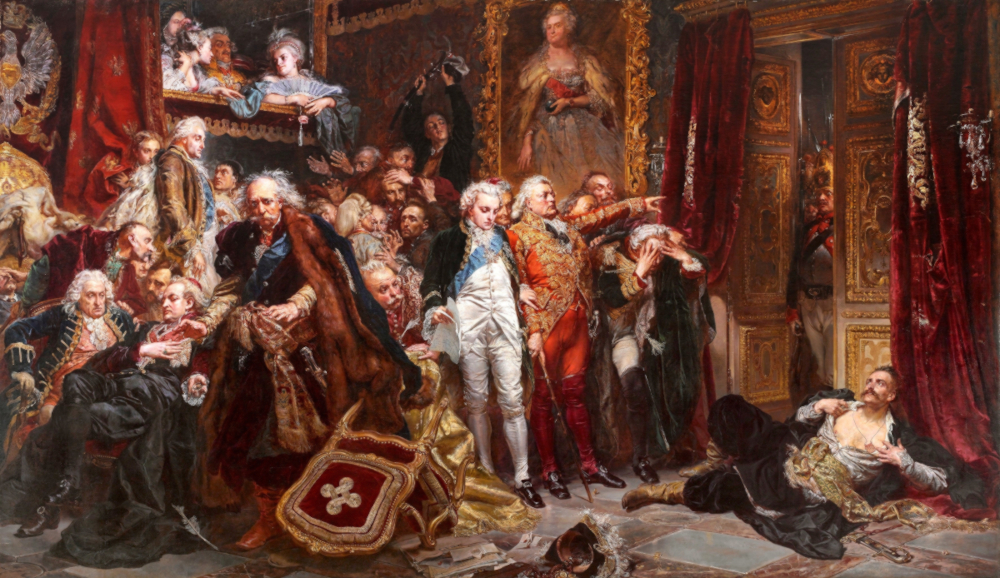
Rejtan, The Fall of Poland, by Jan Matejko, 1866. Royal Castle, Warsaw – Oil on canvas, 282 x 487 cm. The image is in the Public Domain and is courtesy of Obelisk.



