
From the mail bag:
Good evening, Brother André Marie, I recently found a video where you talk about “Christian Zionism.” It has been a great eye opener for me. Thanks so much. In that lecture you explain that for Catholics it is wrong to celebrate a “Seder Meal.” I just saw a post on Facebook from my local parish where the main priest was celebrating that ritual with several parishioners. I’m all confused; I don’t even know what it is that all about. Can you explain more what is it? I read a little bit and I know it has to do with the Jewish exodus from Egypt. Thanks.
The Seder Meal, or Passover Seder, is the Old-Testament observance commemorating the Exodus of the Israelites from Egypt. It was a good and holy thing that was commanded by God to be kept as a memorial for future generations. Along with the other parts of the Old-Testament ceremonial law, it ceased, and was replaced by the sacraments of the New Testament. The sacred Triduum and the Resurrection, historical events in the life of Jesus Christ, took place around the Passover, which was itself a beautiful type of the Passion, Death, and Resurrection of Our Lord.
In other words, the Jewish Passover and the rituals that surrounded it pointed to Jesus Christ, and — since His merciful coming — these ceremonies have been replaced by the Christian Pasch (Easter), the Christian Sacraments, and the Holy Sacrifice of the Mass.
Saint Paul explained, “Therefore, my brethren, you also are become dead to the law, by the body of Christ; that you may belong to another, who is risen again from the dead, that we may bring forth fruit to God” (Rom. 7:4).
While the Seder Meal was by Jesus and the Disciples on Holy Thursday, after this ritual was finished, a completely new rite — the Holy Sacrifice of the Mass — was instituted by Our Lord. We must put away the “shadow of the good things to come,” since we now have “the very image of the things” (Heb 10:1): Christ, who is the image of the invisible God.
Here is the teaching of the Church’s seventeenth ecumenical council, the Council of Florence, on the matter:
[The Catholic Church] firmly believes, professes, and teaches that the matter pertaining to the law of the Old Testament, of the Mosaic law, which are divided into ceremonies, sacred rites, sacrifices, and sacraments, because they were established to signify something in the future, although they were suited to the divine worship at that time, after our Lord’s coming had been signified by them, ceased, and the sacraments of the New Testament began; and that whoever, even after the passion, placed hope in these matters of the law and submitted himself to them as necessary for salvation, as if faith in Christ could not save without them, sinned mortally. Yet it does not deny that after the passion of Christ up to the promulgation of the Gospel they could have been observed until they were believed to be in no way necessary for salvation; but after the promulgation of the Gospel it asserts that they cannot be observed without the loss of eternal salvation. All, therefore, who after that time observe circumcision and the Sabbath and the other requirements of the law, it declares alien to the Christian faith and not in the least fit to participate in eternal salvation, unless someday they recover from these errors. (Denz. 712)
According to the Council of Florence, the Old Law “ceased” (cessasse) when the New Law of Christ was instituted. This passage from the council relies heavily on Saint Thomas Aquinas — some passages are close paraphrases — who divided the Old Law into the moral, ceremonial, and judicial precepts. The moral law, which is continued in the New Testament, is nothing other than the natural law. The ceremonial and juridical precepts both ceased with the Passion of Christ. Here is Saint Thomas Aquinas on the ending of the ceremonial law (which includes the Passover Seder):
Consequently, just as it would be a mortal sin now for anyone, in making a profession of faith, to say that Christ is yet to be born, which the fathers of old said devoutly and truthfully; so too it would be a mortal sin now to observe those ceremonies which the fathers of old fulfilled with devotion and fidelity. Such is the teaching Augustine (Contra Faust. xix, 16), who says: “It is no longer promised that He shall be born, shall suffer and rise again, truths of which their sacraments were a kind of image: but it is declared that He is already born, has suffered and risen again; of which our sacraments, in which Christians share, are the actual representation.” (ST Ia IIae, Q. 103, A. 4; cf. Ia IIae Q 104, A. 3 for the judicial precepts).
To Saint Thomas and Saint Augustine, the observance of the Old Law’s ceremonies was “neither dead nor deadly” before the Passion of Christ, “dead but not deadly” during the time in between the Passion and the promulgation of the Gospel, and finally, “dead and deadly” after the promulgation of the Gospel. The Mosaic Law of the Old Israel has been replaced and superseded by the Catholic Church (the New Israel), with its Christian Sacraments and the Holy Sacrifice of the Mass. For this reason, it has always been regarded as objectively mortally sinful for Catholics to practice any of the ceremonial rites of the Old Law. I cannot and will not cast a judgment on your priest’s subjective state of soul for observing a Seder, but the act itself is objectively wrong for a Christian to perform, and has always been regarded as wrong by Christians.
For further reading, I recommend Our Patriarch Abraham and the Continuity of Religion. Also, scroll past the image below for an embedded YouTube video of a great sermon on the matter by a Catholic priest.
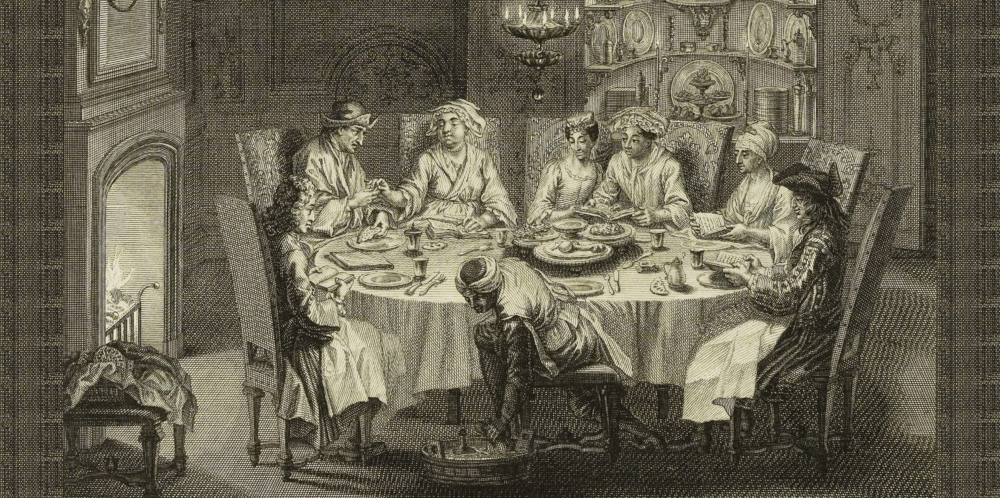
The featured image for this posting was derived from a Public Domain image of the engraving, Passover Meal Among Portuguese Jews, by the French engraver, Bernard Picart.



