

Our Savior’s triumphal entry into Jerusalem the first day of the week of His Passion was so momentous that it is recorded in all four Gospels. It was also recorded in prophecy around five hundred years before it happened by the prophet Zacharias.
Rejoice greatly, O daughter of Sion, shout for joy, O daughter of Jerusalem: BEHOLD THY KING will come to thee, the just and saviour: he is poor, and riding upon an ass, and upon a colt the foal of an ass (Zacharias 9:9).
And the multitudes that went before and that followed, cried, saying: Hosanna to the son of David: Blessed is he that cometh in the name of the Lord: Hosanna in the highest (Matt. 21:9).
Blessed be the king who cometh in the Name of the Lord (Luke 19:38).
[They]took branches of palm trees, and went forth to meet him, and cried: Hosanna, blessed is he that cometh in the name of the Lord, the king of Israel (John 12:13).
O Daughter of Sion:
This is the Church, the Bride of Christ, which was born on Mount Sion at Pentecost, and Sion is where the Food of the Mystical Body was given at the Last Supper. This is where King David built his fortress and it was revered by the Jews as a memorial to Israel’s days of glory and earthly power, the royal residence.
O Daughter of Jerusalem:
This was another Old Testament phrase, meaning the same as Daughter of Sion. Jesus would honorably address the faithful women with this title on the way to Calvary as they wept and lamented. He knew these women from all eternity. He nodded to them as they laid garments and branches before Him as He passed them by on a different day when there was jubilation in their eyes and a song on their lips.
Behold thy King will come to thee:
Palms were used in the East as a symbol of victory. But what a contrast to the glorious entries of worldly kings who return victorious from battle! For a stallion, Christ Jesus Victor prefers a donkey. For laurels and trumpets, He prefers branches of palm and the Hosannas of the poor, the simple, and the innocent.
The Just and Savior:
Jesus means “Savior.” To Saint Joseph, the angel said: “Thou shalt call His Name, Jesus.” He is to be called that which He is, “for he shall save his people from their sins” (Matt. 1:21). Hosanna, as it was uttered by the Jews on Palm Sunday, was both a petition and a praise. It was from the Hebrew prayers of supplication used in the synagogue services, and not confined to the liturgy of the temple. Scholars generally agree that as it was then used it meant “save us, we pray,” or “be our Savior.”
Hosanna to the son of David:
“And the Lord God shall give unto him the throne of David his father; and he shall reign in the house of Jacob for ever” (Luke 1:32).
He comes in the Name of the Lord:
“O Lord, save me: O Lord, give good success. Blessed be he that cometh in the name of the Lord” (Psalm 117:25-26).
In the Name of the Lord was the Hebrew way of saying in the “Person” of the Lord. The Holy Name of God could only be uttered by the High Priest and that once a year, in the Holy of Holies, on the feast of the Atonement, Yom Kippur. It was this attribution, more than the Hosannas, more than even Son of David, and King, which most disturbed the Pharisees and the priests. For they knew that He who was to come “in the Name of the Lord” would be not only Christ, the Son of David, but the Son of God.
King of Israel:
“He shall be great, and shall be called the Son of the most High; and the Lord God shall give unto him the throne of David his father; and he shall reign in the house of Jacob [Israel] for ever” (Luke 1:32).
The city was abuzz. Will He come to Jerusalem for the festival days, the people wondered? News had spread about the raising of Lazarus, who lived in Bethany just outside the city. Crowds must have come to see the man who had been buried four days and now walked and talked again. Saint John tells us that among those who witnessed the miracle some went and reported it to the scribes and Pharisees, who went themselves to the chief priests and they held a council together. Their enmity to each other would be suspended in their common quest to undo the Just One. Henceforth, not only did they have a mind to put Our Lord to death, but Lazarus as well. Of these Jesus said that they would not believe “even if one were to rise again from the dead” (Luke 16:31).
In Our Lord’s time Jerusalem was home to about 80,000 people. During the festival days of the Pasch, Atonement, and Pentecost the population grew, according to some historians, to three times that. When Jesus entered the city the Sunday before His Passion the multitudes that came out to welcome Him, even before He reached the Gate, were those who believed that He was the Messiah, the Son of David, and their King. They had come to Jerusalem from all over Palestine, and from Galilee, and laying palm branches before Him as He descended from Mount Olivet upon the colt of an ass, their joy and exuberance, increased, and they sang, and the children sang, and they shouted, proclaiming Him King with the Messianic title, Son of David. The Pharisees were scandalized and told His disciples to rebuke the crowd, to which Jesus said: “I say to you, that if these shall hold their peace, the stones will cry out” (Luke 19:40).
“And when he drew near, seeing the city, he wept over it, saying: If thou also hadst known, and that in this thy day, the things that are to thy peace; but now they are hidden from thy eyes. For the days shall come upon thee, and thy enemies shall cast a trench about thee, and compass thee round, and straiten thee on every side, And beat thee flat to the ground, and thy children who are in thee: and they shall not leave in thee a stone upon a stone: because thou hast not known the time of thy visitation. And entering into the temple, he began to cast out them that sold therein, and them that bought” (Luke 19:43-44).
What a contrast this day was to that which would come five days hence. The crowd wanted to proclaim Him King. Now He eluded them. Where did He go? Although Our Lord had told His disciples that He was going to be handed over to the chief priests, mocked, scourged, and crucified, and then on the third day rise again, it did not register with them. Palm Sunday ended quite quickly. It was a moment of glory from the hearts of the innocent, for the Incarnate God must have some honor in His mortal life, even as He did from the shepherds and the Wise Men.
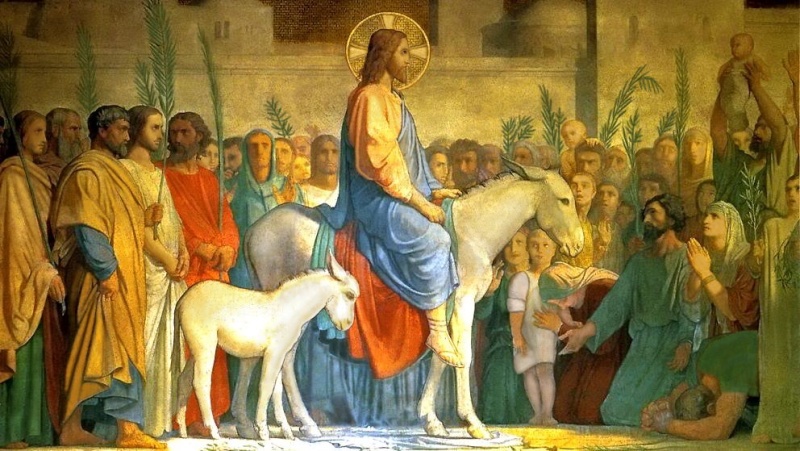
Christ’s Entry into Jerusalem (1846), by Jean-Hippolyte Flandrin, in the Church of Saint-Germain-des-Prés, Paris



