
Brief intro: Brother Thomas Mary wrote this gem of a tribute to the Angelic Doctor in 1948 for an early issue of From the Housetops. The quote from the Preface alone, which Saint Thomas wrote for his work, is worth savoring. Even if you’ve never read the Summa you will, I am sure, appreciate our late Brother’s tribute.
IT is usually forgotten that Saint Thomas Aquinas is both a child and a saint.
One day Saint Thomas was reluctantly dragged to the court of King Louis the Ninth of France to attend a banquet. When they entered Paris someone showed him from a hill the magnificence of the city, saying: “How wonderful it must be to own all this.” Saint Thomas only muttered: “I would rather have that Chrysostom manuscript I can’t get a hold of.”
They finally got Saint Thomas seated at his place in the royal banquet hall. It was the apex of the age of chivalry, and the great hall was jammed with knights. The worn black and white garments of the mendicant friar must have looked out of place amid the colorful shields and pennants of these crusaders. Saint Thomas spoke politely to his neighbors but said very little. An hour later the banquet was in full swing and everyone had completely forgotten the big Italian friar, who sat as if he was carved out of stone. Suddenly there was a pause in the uproar of French conversation. And in that instant, all the plates and cups jumped into the air, as Saint Thomas brought his big fist down on the table with a crash, and yelled as if he were in a trance: “And that will settle the Manichees.”
Every royal court has its conventions, even if it is the court of a saint, and everyone was stunned; all eyes turned to the King to see what would happen. It was as if Saint Thomas had thrown a pie at Saint Louis, and many of the knights were prepared to toss the begging friar out the window. Saint Louis merely turned and speaking to his secretaries in a low voice, told them to take their tablets down to the absent minded friar and to copy the argument that had just occurred to him, because it must be a good one, and he might forget it.
When Saint Thomas was not sitting still reading a book, he would walk around the cloisters at top speed, fighting noisy and furious battles in his mind. If he was interrupted, he was very polite and more apologetic than the apologizer. But there was no trace of unhealthy introspection in his absent-mindedness. He was not always concerned with self, but like a child was interested in things outside himself, not his personal reactions to those things.
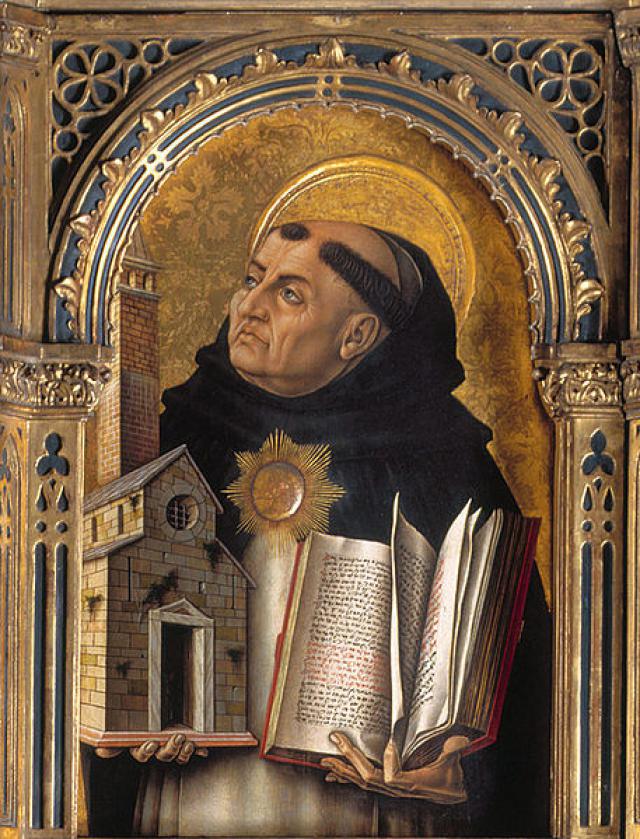 Saint Thomas was the most learned man the world has ever known. He always received a great many letters, many of them from simple people asking him questions. For example, someone asked him whether all the names of the blessed were written on a scroll in Heaven. He replied, “So far as I can see, this is not the case; but there is no harm in saying so.” In spite of his great learning Saint Thomas was not far removed from these simple people, because he was not an intellectual snob, but a man of intelligence, who had all his real values in common with them.
Our Lord said, “Unless you be converted and become as little children you shall not enter into the kingdom of heaven” (Matt. 18:3). If Saint Thomas is a child, his greatest work, the Summa Theologica, cannot be some intellectual labyrinth that only a few intellectuals can find their way around in. Far from it, it is a simple child’s vision of God. The whole work merely divides into three parts: God; the movement of the rational creature to God; and Christ, who as man is our way to God. The whole Summa is in three parts and contains twenty-seven questions. The first part, the Prima Pars, is on God and what proceeds from Him: the Oneness of the Divine substance, the Trinity of Divine Persons, Creation in general, the Work of the Six Days, Man, First Man, and the Divine Government. The second part, on the movement of the rational creature to God, divides into the Prima Secundae which treats of: the Last end of Man, Human Acts, Habits, Law, and Grace; and the Secunda Secundae, which treats of: Faith, Hope, Charity, Prudence, Justice, Fortitude, Temperance, gratuitous Graces, the Active and Contemplative life, and the States of Life. The third part, the Tertia Pars, on Christ who as man is our way to God, treats of the Incarnation, Christology, the Sacraments, and the Last Things.
To destroy the unity of the Summa, by issuing truncated versions of it (which carefully delete all the challenging Incarnational passages, as did Pegis), is to destroy the unity of the child’s vision. Nor does Saint Thomas need any proud, self appointed commentators, like Maritain, who say in effect, “I am the one who understands Aquinas, instead of reading him, read me.” Saint Thomas, himself, is the best teacher of Saint Thomas. He says as a Prologue to the Summa:
“The doctor of Catholic truth ought not only to instruct the proficient, but also to teach beginners. As Saint Paul says, ‘As unto little ones in Christ, I gave you milk to drink, not meat’ (1 Cor. 3:2). For this reason it is our purpose in the present work to treat of the things that belong to the Christian religion in such a way as befits the instruction of beginners.
“For we have observed that beginners in this doctrine have been considerably hampered by what various authors have written. They have been hampered because these things that are needful for them to know are not taught according to the order of the subject matter, but rather according as the order of exposition in books demands, or according as the occasion for disputation arises; and partly they have been hampered because frequent repetition brought about weariness and confusion in the minds of the readers.
“It will be our endeavor to avoid these and other like faults. With confidence in God’s help, we shall try, following the needs of the subject matter, to set forth briefly and clearly the things which pertain to sacred doctrine.”
If it is forgotten that Saint Thomas is a child it is also forgotten that he is a great saint whom we can love and pray to. Saint Thomas was not a cold intellect but a great lover of Our Lord and Our Lady, and he was many times seen floating in ecstasy. He performed many miracles, duplicating one of Our Lord’s, when a poor woman was healed of an issue of blood by touching the fringe of his habit. When he lay dying, he asked that the Song of Solomon be read through to him from beginning to end. And on receiving the Blessed Sacrament, he said, “I receive Thee the price of my soul’s redemption; for Thy love I have studied, watched, and labored.”
This great lover of Our Lord and Our Lady fearlessly fought their enemies, both within the Church and without. As in our day, so then, the enemies of Our Lord and Our Lady were the heretics on the outside and the liberals within. Saint Albertus Magnus said of Saint Thomas, “You call him a Dumb Ox; I tell you this Dumb Ox shall bellow so loud that his bellowings will fill the world.”
Chesterton says of the times of Saint Thomas: “First it must be remembered that the Greek influence continued to flow from the Greek Empire; or at least from the center of the Roman Empire, which was in the Greek city of Byzantium and no longer in Rome. That influence was Byzantine in every good and bad sense; like Byzantine art, it was severe and mathematical and a little terrible; like Byzantine etiquette, it was Oriental and faintly decadent. Byzantium slowly stiffened into a sort of Asiatic theocracy, more like that which served the Sacred Emperor (sic) in China. Eastern Christianity flattened everything, as it flattened the faces of the images into icons. It became a thing of patterns rather than pictures; and it made definite and destructive war upon statues. Thus we see, strangely enough, that the East was the land of the Cross and the West was the land of the Crucifix. The Greeks were being dehumanized by a radiant symbol, while the Goths were being humanized by an instrument of torture. Only the West made realistic pictures of the greatest of all the tales out of the East. Hence the Greek element in Christian theology tended more and more to be a sort of dried up Platonism; and a thing of diagrams and abstractions; to the last indeed noble abstractions, but not sufficiently touched by that great thing that is by definition almost the opposite of abstraction: Incarnation. Their Logos was the Word; but not the Word made Flesh. In a thousand very subtle ways, often escaping doctrinal definition, this spirit spread over the world of Christendom from the place where the Sacred Emperor sat under his golden mosaics; and the fiat pavement of the Roman Empire was at last a sort of smooth pathway for Mahomet. For Islam was the ultimate fulfillment of the Iconoclasts.”
All these subtle attacks on Our Lord and Our Lady were crystallized in one Siger of Brabant, a liberal of his day, who said: “The Church must be right theologically, but she can be wrong scientifically. There are two truths: the truth of the supernatural world, and the truth of the natural world, which contradicts the supernatural world. While we are being naturalists we can suppose that Christianity is all nonsense; but when we remember that we are Christians, we must admit that Christianity is true even if it is nonsense.” This is almost exactly the way liberals sound today when they talk about how far we can go along with science. Siger even had an ingenious theory of how an Arabian agnostic could be a Christian, just as the liberals today have many devices whereby heretics are Christians: the Gift of Faith, the Soul of the Church, the Baptism of Desire.
Saint Thomas was enraged at this enemy of Our Lord and Our Lady. The Dumb Ox bellowed: “Behold our refutation of the error. It is not based on the documents of faith, but on the reasons and statements of the philosophers themselves. If then anyone there be who, boastfully taking pride in his supposed wisdom, wishes to challenge what we have written, let him not do it in some corner or before children who are powerless to decide on such difficult matters. Let him reply openly if he dare. He shall find me there confronting him, and not only my negligible self, but many another whose study is truth. We shall do battle with his errors or bring a cure to his ignorance.” Saint Thomas won his battle, Siger was condemned.
Saint Thomas once confided to his friend Saint Bonaventure, that whatever he knew, he had for the most part learned from the Book of the Crucifix. One day while he was in prayer, Jesus spoke to him from the crucifix saying, “Well hast thou written of Me, Thomas: what reward wouldst thou have?” Chesterton, commenting on this, says:
“Nobody supposes that Thomas Aquinas, when offered by God his choice among all the gifts of God, would ask for a thousand pounds, or the crown of Sicily, or a present of rare Greek wine. But he might have asked for things that he really wanted; and he was a man who could want things; as he wanted the lost manuscript of Saint Chrysostom. He might have asked for the solution of an old difficulty; or the secret of a new science; or a flash of the inconceivable intuitive mind of the angels; or any one of a thousand things that really would have satisfied his broad and virile appetite for the very vastness and variety of the universe. The point is that for him, when the voice spoke from between the outstretched arms of the Crucified, those arms were truly opened wide, and opening most gloriously the gates of all the worlds; they were arms pointing to the east and to the west, to the ends of the earth and the very extremes of existence. They were truly spread out with a gesture of omnipotent generosity; the Creator Himself offering Creation itself; with all its million-fold mystery of separate beings, and the triumphal chorus of the creatures. Saint Thomas, when he at last lifted his head, spoke with that almost blasphemous audacity, which is one with humility: ‘I will have Thyself.’”
Although Brother Thomas Mary argues strongly that we should read Saint Thomas’ Summa rather than some other writer’s commentary, this shorter version of the Summa is Saint Thomas’ own more concise version. He composed this just before he died at the behest of his close disciple, Brother Reginald. Order from our website.



