

We continue our series on the Catholic economy of salvation.
The three theological virtues, along with sanctifying grace, are infused into the soul directly by God. The sacraments are all the works of Jesus Christ, who is the heavenly High Priest who works each one through the service of the ministerial priest — a man in Holy Orders. The Church is also God’s work inasmuch as it was founded by Jesus Christ Himself, the Man-God. What we are considering here, keeping the moral law and doing good works, are our works in God’s economy of salvation. That said, we should hasten to add that even though they are “our works,” they are also God’s works as He gives us the grace to do them — what we call “actual grace.” We have stressed it before, but it bears repeating: It is a truth of Catholic dogma that for us to do good works that merit a heavenly reward, we must have God’s help to do them. Men are radically dependent upon God at every stage of the spiritual life, including doing good works while in the state of sanctifying grace or justification. Anyone who says that the Church teaches otherwise is either just ignorant of the facts or is attempting to deceive.
Jesus Himself makes it clear that keeping the moral law is not optional:
- Matthew 19:16–17 — “And behold, one came up to him, saying, ‘Teacher, what good deed must I do, to have eternal life?’ And he said to him, ‘Why do you ask me about what is good? One there is who is good. If you would enter life, keep the commandments.'”
Comment: If Jesus were the teacher of a sola fides (faith alone) doctrine, He would have noted that keeping the commandments is not necessary.
There is a whole article on our site on the subject of Faith and Good Works. Here are some key passages showing their necessity:
- Matthew 25:31–46 — This is the final judgment scene, in which the sole criterion for salvation is whether one does or refuses to do good works (it simply does not address the necessity of faith, which is clearly taught elsewhere). The sheep at the Judge’s right did good works and, in doing this, they fed, clothed, visited, etc., Jesus by doing so to the least of His brethren. The goats at the Judge’s left refused Jesus those services. The former are saved; the latter, damned.
- Matthew 7:24–27 — “Every one then who hears these words of mine and does them will be like a wise man who built his house upon the rock; and the rain fell, and the floods came, and the winds blew and beat upon that house, but it did not fall, because it had been founded on the rock. And every one who hears these words of mine and does not do them will be like a foolish man who built his house upon the sand; and the rain fell, and the floods came, and the winds blew and beat against that house, and it fell; and great was the fall of it.”
Comment: These are Our Lord’s last words in the Sermon on the Mount, in which many commandments were given on how to live a life pleasing to God. Indeed, the pith and marrow of the Gospel is contained in this greatest of all sermons ever given. The wise and the foolish — distinguished from one another by doing or not doing what Jesus says — are clearly the saved and the damned. - Revelation 20:12–13 — “And I saw the dead, great and small, standing before the throne, and books were opened. Also another book was opened, which is the book of life. And the dead were judged by what was written in the books, by what they had done.”
- Romans 2:5–11 — “But by your hard and impenitent heart you are storing up wrath for yourself on the day of wrath when God’s righteous judgment will be revealed. For he will render to every man according to his works: to those who by patience in well-doing seek for glory and honor and immortality, he will give eternal life; but for those who are factious and do not obey the truth, but obey wickedness, there will be wrath and fury. There will be tribulation and distress for every human being who does evil, the Jew first and also the Greek, but glory and honor and peace for every one who does good, the Jew first and also the Greek. For God shows no partiality.”
Comment: It is amazing that the Epistle to the Romans is supposed to be the inspiration for Luther’s doctrines on justification, yet here is the Apostle, in that very Epistle, telling us that God will “render to every man according to his works.” - Matthew 12:34–37 — “You brood of vipers! How can you speak good things, when you are evil? For out of the abundance of the heart the mouth speaks. The good man out of his good treasure brings forth good, and the evil man out of his evil treasure brings forth evil. I tell you, on the day of judgment men will render account for every careless word they utter; for by your words you will be justified, and by your words you will be condemned.”
- Romans 10:10 — “For man believes with his heart and so is justified, and he confesses with his lips and so is saved.”
- Luke 9:23–26 — “And he said to all, ‘If any man would come after me, let him deny himself and take up his cross daily and follow me. For whoever would save his life will lose it; and whoever loses his life for my sake, he will save it. For what does it profit a man if he gains the whole world and loses or forfeits himself? For whoever is ashamed of me and of my words, of him will the Son of man be ashamed when he comes in his glory and the glory of the Father and of the holy angels.'”
Comment: “Human respect,” by which one fails to honor God when he should is punishable. This is not compatible with the “faith alone” system of salvation. - 1 Peter 5:8–9: “Be sober, be watchful. Your adversary the devil prowls around like a roaring lion, seeking some one to devour. Resist him, firm in your faith, knowing that the same experience of suffering is required of your brotherhood throughout the world. ”
Comment: If a believing Christian fails to “resist” the devil and gets “devoured,” then what? That does not sound like salvation! And if resisting the devil is not necessary for a believing Christian, then why is it in Holy Scripture? - 1 Corinthians 9:26–27 — “Well, I do not run aimlessly, I do not box as one beating the air; but I pommel my body and subdue it, lest after preaching to others I myself should be disqualified.”
Comment: The Douay Rheims says “become a castaway” instead of “be disqualified.” The KJV has “be a castaway.” The NIV has: “Therefore I do not run like a man running aimlessly; I do not fight like a man beating the air. No, I beat my body and make it my slave so that after I have preached to others, I myself will not be disqualified for the prize.” Saint Paul admitted he could be damned if he did not subdue his body. Good works. - Matthew 6:14–15 — For if you forgive men their trespasses, your heavenly Father also will forgive you; but if you do not forgive men their trespasses, neither will your Father forgive your trespasses.
Comment: This is Our Lord’s “divine footnote” on the Our Father in the Sermon on the Mount. For further proof of the necessity of forgiving the sins of others, see the Parable of the Unforgiving Servant (Matt. 18: 23-35), in which the debtor who refuses to forgive the debt of another is punished by his master, the king. - James 2:17–26 — “So faith by itself, if it has no works, is dead. But some one will say, ‘You have faith and I have works.’ Show me your faith apart from your works, and I by my works will show you my faith. You believe that God is one; you do well. Even the demons believe—and shudder. Do you want to be shown, you foolish fellow, that faith apart from works is barren? Was not Abraham our father justified by works, when he offered his son Isaac upon the altar? You see that faith was active along with his works, and faith was completed by works, and the Scripture was fulfilled which says, ‘Abraham believed God, and it was reckoned to him as righteousness’; and he was called the friend of God. You see that a man is justified by works and not by faith alone. And in the same way was not also Rahab the harlot justified by works when she received the messengers and sent them out another way? For as the body apart from the spirit is dead, so faith apart from works is dead.”
Comment: Luther dishonestly inserted the word “alone” into Romans 3:8 (“a man is justified by faith [alone]“). Here in St. James’ Epistle is the only time in the Bible that the words “faith alone” or “faith only” appear in succession, and the passage says the very opposite of what Luther taught! For more on the Epistle of St. James, see, “The Epistle of Straw.”
Another Biblical illustration of how we are to work with God in our own salvation is the Parable of the Talents (Matt. 25: 14-30), one of the parables of the Kingdom of Heaven. Three men are given three different sums of money by their master, who obviously represents God. When the master returns, the first two have produced more money than they were given. They were, therefore, rewarded by their master. The third one merely returns the amount he was given. In anger, the master (a “hard man” — showing God’s severity) punishes the “wicked and slothful servant,” casting him “into outer darkness.”
To explain it in modern financial terms, we could say that God gives us the “start-up capital” (money here representing grace, which includes faith), and we “invest” it. Without the capital, we can produce nothing, just as “without faith it is impossible to please [God]” and “apart from me [Jesus] you can do nothing” (Heb. 11:6; John 15:5). But once we get the Faith, we are expected to produce; else, when our Master returns, we will have no profits for Him.
The Parable of the Pounds, related in the Gospel of St. Luke (19:11-27), is similar to that of the unprofitable servant and teaches the same basic lesson. The master commands his servants to trade until he returns. The two good servants are rewarded in direct proportion to their differing amounts of gain. The “wicked servant,” who gained nothing, is reprimanded and punished.
We need to make one last point on keeping the moral law and doing good works. It is that we must persevere in them to the end of our lives:
- Matthew 24:13 — “But he who endures to the end will be saved.”
- Hebrews 3:14 — “For we share in Christ, if only we hold our first confidence firm to the end…”
Saint Alphonsus de Ligouri and others argue that the nexus between God’s works and our works is prayer. To persevere to the end in faith, hope, and charity requires a special grace called “the grace of final perseverance,” which is an actual grace. It cannot be earned by strict merit (what theologians call “condign merit”). But it can be prayed for and thus can be the subject of what theologians call “congruous merit.” Saint Alphonsus put it aptly: “He who prays is saved. He who prays not is damned!” Scriptural proofs? The entire book of Psalms, which the people of God have been praying since it was written. In the New Testament, Jesus tells us that we “ought always to pray and not lose heart” (Luke 18:1), and Saint Paul, “pray constantly” (I Thess. 5:17).
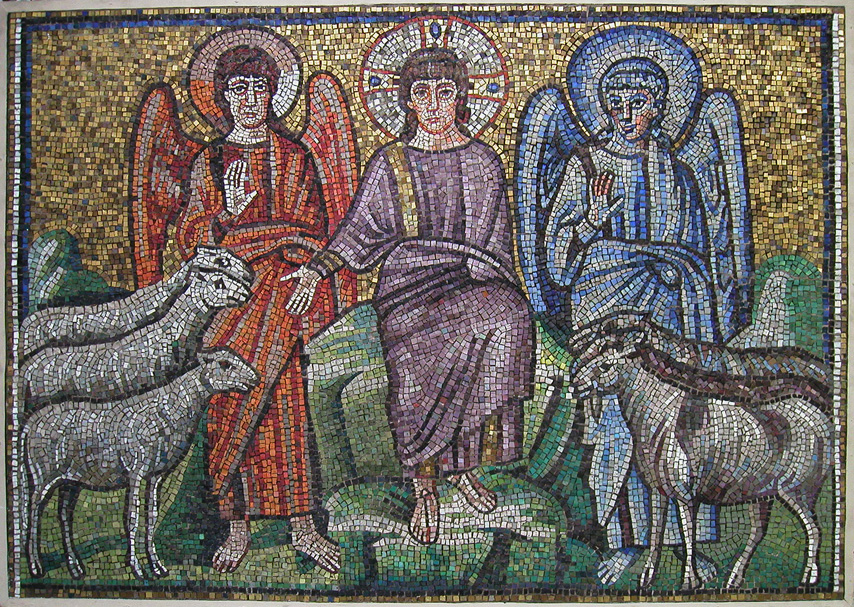
Byzantine mosaic of the Separation of Sheep and Goats. Public domain image via Wikimedia Commons.



