

As if we needed proof that the evil sort of ecumenism is very much alive, a rare public dispute happened recently between a cardinal and a bishop. To name them by the colors of their proper fascia,1 “Team Scarlet” was led by Cardinal Jean-Paul Vesco, O.P., the French Archbishop of Algiers, while Bishop Robert Barron, of the Diocese of Winona–Rochester, Minnesota, headed up “Team Violet.”
The opening volley came from Team Scarlet. As reported by Ad Vaticanum, Cardinal Vesco made some notably anti-apostolic remarks to a French-language news outlet:
In an interview with Belgian Catholic media outlet CathoBel on 23 October, the Archbishop of Algiers said: “We are the Church of this people. Not a proselytising Church, not a Church that is there to convert, but a Church that aspires to be one of the components of this people.”
Cardinal Vesco has repeatedly questioned whether evangelisation should be understood as an effort to bring people from other religions into the Catholic Church. Later in the interview, His Eminence said: “In monotheistic religions, proselytism is poison, because it implies considering the other person’s religion false.” The French-born Cardinal illustrated his objection by imagining someone who praises another person while disparaging their religious beliefs, arguing that such an approach “puts an end to dialogue”.
Team Violet returned fire when Bishop Barron contradicted His Eminence with a statement on X, which read, in part:
Well, another Cardinal has come out with a, shall we say, puzzling take on evangelization.
A few years ago, Cardinal Américo Aguiar, at the time auxiliary bishop of Lisbon, said that he and the other organizers of World Youth Day in his hometown had no interest in converting anyone to Christ.
Now Cardinal Jean-Paul Vesco of Algeria has opined that “the Church is not there to convert” and “Christians should approach other religions through fraternity rather than seeking conversions.”
Excuse me, but…what?
Last time I checked, the Founder said, “All authority in heaven and on earth has been given to me. Go therefore and make disciples of all nations, baptizing them in the name of the Father and of the Son and of the Holy Spirit, and teaching them to obey everything I have commanded you.” Sure sounds like conversion to me.
When St. Paul came to Corinth or Athens or Thessalonica, his purpose was not to listen or to form a discussion group but rather to declare an unnerving message: the euangelion (glad tidings) that Jesus Christ is risen from the dead.
Team Scarlet struck back when Cardinal Vesco doubled down and revealed his adherence to the worst aspects of the Modernist religion regarding evangelism and ecumenism.
Inasmuch as he countered the scandalous statements of Cardinal Vesco, Bishop Barron was on the side of the angels, but it is, to say the least, awkward to rely on a devotee of Hans Urs von Balthasar as one’s champion in such matters — and such is His Excellency from Winona–Rochester.
So, it was no surprise when someone cried foul from the bleachers. Ever the impolitic one, Dr. E. Michael Jones weighed in with a blistering comment leveled against Team Violet:
Why didn’t Bishop Barron say this to Ben Shapiro, when Ben asked him if he was going to hell? Why didn’t he tell Ben that baptism is necessary for salvation?
Impolitic or not, Jones is right. In a notorious interview with the famous Neo-con Zionist, Bishop Barron broke the rules2 with a very scandalous statement about Christ being the “privileged route to salvation,” but Vatican II says non-Christians can be saved, so Ben has basically nothing to fear regarding his eternal whereabouts.3 For all his disagreement with Cardinal Vesco about evangelism, it appears that Bishop Barron does not really believe that conversion to Jesus Christ and His Church are necessary for salvation.
A friend of mine, who was not Catholic at the time, once asked me in front of a group of people if I thought he was going to hell. Instead of doing “the Vatican II shuffle” like Bishop Barron, I put my arm on his shoulder and said, “Why do you think I want you to become a Catholic, Joe?” — adding some words about how I loved him and wanted what was best for him. Joe is Catholic now. I’m not saying I “converted him,” nor am I claiming great sanctity because of whatever role I did play, nor am I saying that would work with Ben Shapiro. But, when we try to convert people and they ask us what happens if they do not convert, the correct answer is not, “It doesn’t matter because … Vatican II … and Karl Rahner, who was a really smart Jesuit … and Hans Urs von Balthasar, who was a really smart ex-Jesuit … and there’s this kaleidoscopic, concentric-circle kind of ecclesiology that emerged in the Twentieth Century, and you’re probably well within its outer fringes. But Jesus is still the privileged route to salvation. So there you go!”
At that point, as far as the non-Catholic is concerned, the extent of our apostolic zeal is to move him from the cheap seats of the Beatific Vision to the front row, where the other privileged folks sit. Not very motivating — nor, more importantly, does this correspond to reality.
No, the correct answer, no matter how it is packaged,4 is that it does matter whether or not you convert; there is only one way to Heaven, and it is to be united to Jesus Christ in His Church.
The Glory of God and the Salvation of Souls,
Founded on Love of God and Neighbor
Cardinal Vesco thinks we are not “there to convert” Jews and Muslims — that we, in fact, have “better things to do”! And Bishop Barron, who takes loud exception to this in the name of Catholic orthodoxy and missionary zeal, is still willing to tell an unbelieving Jew that he can get to Heaven without Faith and Baptism.
How far all this takes us from the actual faith and mission of the Church! Kyrie Eleison!
There is a Catholic commonplace of zeal and devotion that joins two great values into one: “for the glory of God and the salvation of souls.” Saint Eugene de Mazenod used it as a motto for the Oblates of Mary Immaculate he founded. Ven. Pope Pius XII invoked it when writing about both Saint Benedict of Nursia and all Catholic priests. The great Dominican theologian, Père Reginald Garrigou-Lagrange — Cardinal Vesco’s confrere — wrote of it as a mark of “the illuminative way of the proficients.” Saint John-Henry Cardinal Newman included it as an earmark of the saints. Saint Antonio Maria Claret, founder of the Missionary Sons of the Immaculate Heart of Mary describes his ideal missionary in terms of :
For myself, I say this to you: The man who burns with the fire of divine love is a son of the Immaculate Heart of Mary, and wherever he goes, he enkindles that flame; he desires and works with all his strength to inflame all men with the fire of God’s love. Nothing deters him: he rejoices in poverty; he labors strenuously; he welcomes hardships; he laughs off false accusations; he rejoices in anguish. He thinks only of how he might follow Jesus Christ and imitate him by his prayers, his labors, his sufferings, and by caring always and only for the glory of God and the salvation of souls.
The formal joining of this pair of great Catholic values, each clearly found in Holy Scripture, most likely took place during the era of the Catholic Reformation, when such luminaries as Saint Ignatius of Loyola spoke of these concepts — as they lived them — with burning zeal.5
But what is the theological foundation of this holy duet?
It is none other than the evangelical commandments of Love of God and Love of Neighbor. Consider this schema juxtaposing Matt. 22:37–39 and the motto under consideration:
| “Thou shalt love the Lord thy God with thy whole heart, and with thy whole soul, and with thy whole mind. This is the greatest and the first commandment.” | THE GLORY OF GOD |
| “And the second is like to this: Thou shalt love thy neighbour as thyself.” | THE SALVATION OF SOULS |
Each pair has an inseparable unity within itself, a unity that is rooted in what is “second” being metaphysically dependent upon what is “first.”
What is first in each corresponds to what is first in the other, what is second to what is second: If we love God, we glorify Him; if we love our neighbor, we will pray and labor for his salvation.
Charity must enliven our divine worship by which we glorify God. Charity must also enliven our apostolate, and not only any formal apostolate in which we labor, but all of our interactions with our neighbor, no matter how seemingly banal or insignificant.
Practically speaking, how do we glorify God? Aside from direct acts of religion (our liturgical and devotional life), it is by living the Christian virtues under the command of Charity.
Practically speaking, how do we save souls? Aside from direct acts of the apostolate — which generally do not occupy most of our waking hours — it is by doing the same, that is, by living the Christian virtues under the command of Charity.
“Without faith it is impossible to please God” (Heb. 11:6). “We are saved by hope” (Rom. 8:24). “But the greatest of these is charity” (I Cor. 13:13). If we truly love God and our neighbor, it will be according to Catholic Faith, Hope, and Charity, and not according to some Modernist simulacrum of the theological virtues — that effeminate counterfeit that makes people dread the unholy accusation of “proselytism.”
Unmooring our soteriology and eschatology from the theological virtues is to separate what God has joined together. So is disuniting the theological virtues from the actual content of Divine Revelation — including explicit faith in Jesus Christ and concrete participation in the Incarnational economy of salvation He established. That entire economy disintegrates if the supernatural “faith” that is “the beginning of human salvation” is made practically interchangeable with heresy, with the unbelief of Judaism and Islam, or with sheer heathenism.
If we believe in, hope in, and love Jesus Christ, we will have no tolerance for such errors — no matter what color fascia their partisans wear.
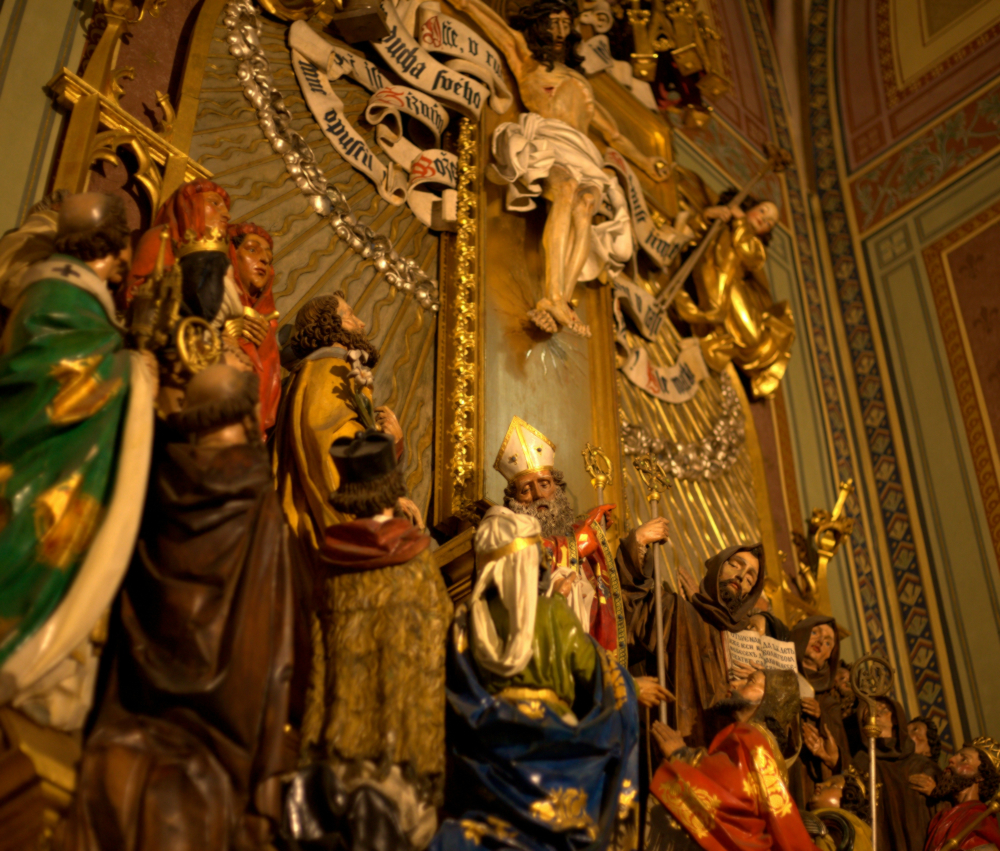
Crucifixion with saints. Photo of Saints Peter & Paul Basilica, Štulcova, Prague 2-Vyšehrad, Czechia. Photo by Andrew V on Unsplash.
— Footnotes —
2. Or, “the Rule of Faith,” as it were.
3. You do not have to take my word for it; that segment of the interview is still on YouTube.
4. And it should always be charitable, no matter what the particular circumstances of the discussion are.
5. In his “Letter of Perfection” to the scholasticate at Coimbra, Portugal, Saint Ignatius wrote, “you are to make yourselves a continual sacrifice to the glory of God and the salvation of the neighbor….”



