
Amid the vast and growing volume of commentary on the July first consecrations of four bishops for the SSPX, there a brief passage from a July 2 interview that interests us a great deal here at Catholicism.org. It is the question and answer, reproduced below, from an interview with Cardinal Kurt Koch that Rorate Caeli posted. The interview with His Eminence was broadcast on Communicatio, the podcast of the German edition of the scholarly journal, Communio.
Cardinal Kurt Koch, who is Swiss, is the Prefect of the Dicastery for Promoting Christian Unity (as well as the Bishop Emeritus of Basel); therefore, he is what you might call the Holy See’s chief ecumenical spokesman.
The following is taken verbatim from Rorate’s translation of the German-language transcript of the podcast:
Perhaps let us move on to topics that directly concern your Dicastery. The points of contention also include ecumenical openness; this is rejected by the SSPX as false indifferentism, and they still demand that all non-Catholics return to the bosom of the one true Church. Why has this demand, which connects to the dogma of the Council of Florence, extra ecclesiam nulla salus, actually become difficult today under modern conditions?
I think it is difficult even under theological conditions, because this formula, extra ecclesiam nulla salus, naturally applies to Catholics who are convinced that the Catholic Church points the way to eternal salvation. But we already have the fundamental conviction in Holy Scripture, and then also in tradition, that God wills the salvation of all people and that He then also finds other ways for people to attain salvation who have never come into alignment with the Gospel of Jesus Christ.
If the Society now essentially sends everyone to hell who is not in the Catholic Church, then I don’t know how this fundamental conviction of Holy Scripture — that God wants all people to be saved — can still be justified at all. And the danger, of course, is that the theological judgment places itself above the ultimate judicial will of God, and I consider that theologically very problematic.
Prescinding entirely from the major topic under discussion (concerning the SSPX), two points leap at us in the first paragraph of the Cardinal’s response. The first is that he applies extra ecclesiam nulla salus to “Catholics who are convinced that the Catholic Church points the way to eternal salvation.” Particularly in light of the fact that His Eminence was specifically asked about “the dogma of the Council of Florence” on extra ecclesiam nulla salus, this appears to be a highly reductionist reading of the Florentine conciliar bull, Cantate Domino — which can be read here — that excludes from salvation “not only pagans, but also Jews and heretics and schismatics” … “unless before death they are joined with Her [the most Holy Roman Church]. Cardinal Koch’s reading of the decree would logically imply that those “pagans” and “Jews” spoken of by Florence are necessarily apostates from the Catholic Church, and that the “heretics and schismatics” referred to are believing Catholics who have formally dissented from the Catholic faith (heretics) or from the unity of the Church (schismatics).
This would be a very strained reading of the text.
The second point that strikes us pertains to the text of a protocol letter from the then-CDF (Prot. N. 1732/66-55029), addressed to me, dated April 15, 2016. This letter says, concerning extra ecclesiam nulla salus, that “this doctrine must not be set against the universal and salvific will of God (cf. DI #20)….” The citation from DI (Dominus Iesus) is as follows:
Above all else, it must be firmly believed that “the Church, a pilgrim now on earth, is necessary for salvation: the one Christ is the mediator and the way of salvation; he is present to us in his body which is the Church. He himself explicitly asserted the necessity of faith and baptism (cf. Mk 16:16; Jn 3:5), and thereby affirmed at the same time the necessity of the Church which men enter through baptism as through a door”.77.1 This doctrine must not be set against the universal salvific will of God (cf. 1 Tim 2:4); “it is necessary to keep these two truths together, namely, the real possibility of salvation in Christ for all mankind and the necessity of the Church for this salvation”.78.2 (Bold emphasis mine —BAM.)
In a follow up protocol letter, dated October 20, 2016 (Prot. N. 1732/66-57466), the CDF’s Msgr. Giacomo Morandi repeated this admonition to me, along with the same citation to Dominus Iesus.
Now, it would seem that Cardinal Koch has just done what I was specifically told I may not do — and, in fact, have never done — namely, set the universal salvific will of God as expressed by Saint Paul in 1 Tim. 2:4 against extra ecclesiam nulla salus, as if one Catholic dogma could oppose another. I say this because it appears that His Eminence, Cardinal Koch, has used the universal salfivic will of God to reduce extra ecclesiam nulla salus to a “meaningless formula” (Humani Generis) by failing to keep “to keep these two truths together.”
Ultimately, it is the sacrosanct Roman Church that judges authoritatively in these matters. But, if the above translation adequately expresses His Eminence’s thoughts, it seems to me that Cardinal Koch does indeed affirm the “false indifferentism” referenced by his interlocutor, who criticized fellow Catholics for “still demand[ing] that all non-Catholics return to the bosom of the one true Church.”
At least I cannot see any other way to read his statements.
For more on the CDF protocol letters I was sent, please read, “‘Unacceptable’: Did the CDF Censure Saint Benedict Center’s Beliefs in 2016?”
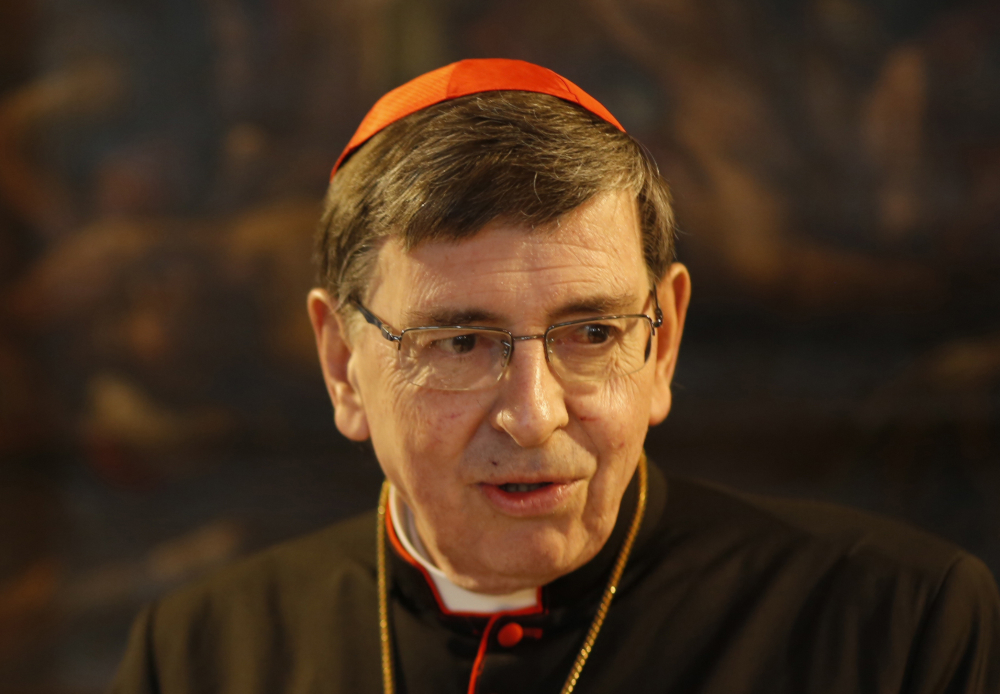
Cardinal Kurt Koch at the specialist conference of the RPP Institute on “Self-Realization & Obedience” on December 7, 2012, in the Imperial Hall of Heiligenkreuz Abbey. Photo (cropped form original) is courtesy of RPP-Institut, CC BY-SA 3.0 AT, via Wikimedia Commons.



