

Listen via YouTube. | Read summary in press release.
Watch Mike Church interview with Brother André Marie.
THERE is a false narrative circulating about Saint Benedict Center and the Slaves of the Immaculate Heart of Mary. According to this narrative, our beliefs on the dogma extra ecclesiam nulla salus (outside the Church there is no salvation) were formally censured by the Congregation for the Doctrine of the Faith1 in October of 2016. This false narrative constitutes the foundation of the unjustly imposed, oppressive decree of precepts (“decree” or “precept”) that was published against us on January 7, 2019.
In point of fact, the CDF did not publish a censure of any doctrinal position of ours. Now, I am clearly an interested party in this dispute, and it is an ecclesiastical authority in the Diocese of Manchester, New Hampshire (“Diocese”), that has circulated this narrative, in the person of the Very Rev. Georges de Laire, Judicial Vicar and, formerly, Episcopal Vicar for Canonical Affairs. Thus, the burden of proof would seem to fall on me to show his assertion to be false. It is my intention to do just that in these lines by citing not only the very protocol letters cited by Father de Laire in his relevant public statements, but also by citing the communications leading to and following from those protocol letters — communications that reveal the context of the October, 2016, CDF protocol letters. To date, most of this information has not been made public.2
Here is the most complete statement of the false narrative that has been put into the public record. It comes from the civil complaint that Father de Laire filed in his still pending lawsuit against Michael Voris and Church Militant (bold emphasis mine):
34. Doctrinally, the Saint Benedict Center interprets a particular Catholic principle, known as “extra ecclesiam nulla salus” (which means, “outside the Church there is no salvation”) in a manner that is incompatible with the official teachings of the Catholic Church.
35. In 2016, the Congregation for the Doctrine of the Faith in Rome, the ultimate voice in Catholic doctrinal interpretation, declared the Saint Benedict Center’s interpretation of this doctrinal principle “unacceptable.” See October 20, 2016 letter from Monsignor Giacomo Morandi to Brother André Marie, a true and accurate copy of which is attached hereto as Exhibit A.
36. In the October 20, 2016 letter to Brother André, that same Congregation stated, “this letter officially closes the discussion on this matter.” See Exhibit A, page 2. … [Civil Complaint, filed Feb. 5, 2021, pp. 9-10]
Note the use of the word “unacceptable” in paragraph 35. This word has been treated as if it were an official censure of specific doctrinal beliefs of Saint Benedict Center. But this is false. The word is absent from the Catholic lexicon of theological censures, which employs such terms as “heretical proposition,” “proximate to heresy,” “suspected of heresy,” “erroneous,” “false,” “rash,” “offensive to pious ears,” “ill-sounding,” etc.3 Further, its application in this instance is also plainly inaccurate for the simple reason that Msgr. Morandi did not label any actual theological or doctrinal position of the SBC as “unacceptable.” In order to prove this, I have to document the history of Monsignor Morandi’s statement and my response to it. Before that, some background is in order to set the stage.
Background: Relations Between the Diocese of Manchester
and Saint Benedict Center (SBC) from 2006 to 2013
In late 2006, I initiated a correspondence with Bishop McCormack and then-Msgr. Edward Arsenault regarding SBC’s canonical recognition in the Diocese and obtaining the services of an approved priest to offer the Holy Sacrifice of the Mass for us in the Traditional Roman Rite. After some written correspondence, there began a series of meetings with Msgr. Arsenault, starting with a lengthy meeting at the Chancery on July 18, 2007. At the same time, I was in communication with Msgr. Arthur Calkins of the Pontifical Commission Ecclesia Dei (“the Commission”).
The many subsequent correspondences and hours of in-person meetings involving officials of the Holy See, officials of the Diocese, and myself successfully culminated in our being granted the services of a resident priest in mid-October of 2010.
Father Mark Withoos, who was an official at the Commission for three and a half years (succeeding Msgr. Calkins), informed me that the Holy See had recommended that the Diocese not only grant us a priest for Holy Mass and Confession, but also “set up the chapel of the community as a public oratory,” and “erect the fledgling institute as a public association of the faithful, with a view, after a period of ad experimentum existence of being established as a Diocesan institute with the right to have members ordained as priests.” (The quotes come from a May 15, 2023, letter of Father Withoos and confirm my own recollections of these directives.)
Although the last two recommendations of the Commission never did become a reality, the status quo of our having an approved priest continued from Bishop McCormack’s tenure well into Bishop Libasci’s, which commenced on December 8, 2011. There were setbacks and challenges along the way, but there was substantial progress made toward implementing the Commission’s recommendations by the time Bishop Libasci asked us to resubmit our revised statues for approval in a letter dated March 27, 2013.
Things began to change for the worse later in 2013 when Father Georges de Laire became actively involved in our affairs at the Chancery. To narrate these difficulties in detail would go beyond the scope of the present lines. In order to chronicle the latter part of this “change for the worse” — specifically, that part of the timeline when the “unacceptable” narrative came into existence — I will take the reader on a chronological tour of the correspondences that are relevant to answering the question we have proposed for ourselves in this study.
March 21, 2016: My Letter to Cardinal Müller
Father de Laire made it very clear that our adherence to extra ecclesiam nulla salus was a problem. Because he kept pressing me on the issue, I wrote to the then-Cardinal Prefect of the CDF, Cardinal Gerhard Ludwig Müller, a German prelate, on March 21, 2016. (In this linked PDF file, the English text on page two is what I wrote; only the German text, translated by a friend who is a native speaker, was sent to the Cardinal. The letter was communicated via email to Cardinal Müller’s secretary.) My purpose in that letter is clear from its central two paragraphs:
That a Catholic in good standing may hold this interpretation [i.e., the “so-called ‘strict interpretation’ of the dogma, extra ecclesiam nulla salus”] is something we were assured of in 1988, when a Diocesan official in Worcester, Massachusetts, informed us that the Congregation for the Doctrine of the Faith told him this. We have this in writing. [Cf. Letter of May 4, 1988, from Father Lawrence A. Deery, J.C.L., to Father John B. McCormack.]
Would Your Excellency please clarify this matter, and assure us once again, and officially, that the communities tracing their origin to Father Leonard Feeney are indeed entitled to hold and to teach the “strict interpretation” of extra ecclesiam nulla salus?
The language, “strict interpretation” is not ours. It comes from the referenced letter of Father Lawrence A. Deery, then-Vicar for Canonical Affairs and Judicial Vicar for the Diocese of Worcester, Massachusetts. I employed this inadequate term merely as a convenient shorthand.
April 15, 2016: Msgr. Morandi’s Reply to My Letter to Cardinal Müller
The First CDF Protocol Letter on the Matter
My letter to Cardinal Müller, was answered by the then-Under-Secretary of the CDF, Msgr. (later Archbishop) Giacomo Morandi, an Italian cleric, in a letter dated April 15, 2016 (Prot. N. 1732/66-55029).4 This communication was a summary of recent magisterial statements on extra ecclesiam nulla salus, drawn exclusively from Dominus Iesus (DI) and the Catechism of the Catholic Church (CCC). Though he was responding to my German letter to Cardinal Müller, Monsignor Morandi’s letter was written in English.
May 26, 2016: My Reply to Msgr. Morandi
On May 26, 2016, I wrote a reply updating Msgr. Morandi on our situation with the Diocese and informing him that, because we were being threatened with draconian sanctions on this very point (by Father de Laire), I would like to meet with officials of the CDF and explain to them exactly what it is we hold in the controverted matters. Using a format recommended to me by another official of the Holy See, I wrote a brief letter of one page with a two-page addendum consisting of nine numbered “Observations.”
Critical to understanding the genesis of the label, “unacceptable,” and why it is inaccurate in this context, is point eight of my “Observations” attached to that May 26 letter:
8. Some of the passages that Your Reverence cites in your letter of April 15 from the CCC and Dominus Iesus have been given different readings that are contrary to one another. There also are theologians of both “liberal” and “conservative” inclinations who hold that these pronouncements contradict what was previously taught. But should we not here employ both the hermeneutic of continuity and the principle, obscura per clara interpretanda sunt, and conclude that there is no change to perennial doctrine?
In the interests of clarity, I have emboldened the last sentence of the paragraph, which is a rhetorical question employing the words “should we not…?” to imply an affirmative reply. (As in “should we not pray the Rosary daily in accordance with Our Lady’s request at Fatima?” — which may be contracted to the more colloquial, “shouldn’t we pray the Rosary daily…?”) Restated as a declarative sentence, my question proposes that there is no conflict between what was previously taught (the infallible formulae I explicitly cited earlier in my “Observations”) and the more recent magisterial statements Msgr. Morandi referenced. I cited Pope Benedict’s famous, “hermeneutic of continuity,” which makes it absolutely clear that I am proposing a magisterial continuity and not a rupture. The Latin expression I used may be translated as “that which is obscure ought to be interpreted by that which is clear.” (The use of this expression by a peritus of Vatican II may be found in footnote 42 the article, An Examination of Subsistit in: A Profound Theological Perspective, by Father Karl Josef Becker, S.J. In this study, published in L’Osservatore Romano, Father Becker applied the expression to the interpretation of the texts of Vatican II.)
Let me emphasize that understanding what I was saying in point eight of my “Observations” is crucial to making sense of what follows.
October 20, 2016: Msgr. Morandi’s Reply
The Second CDF Protocol Letter on the Matter
For whatever reason — possibly a language barrier — what I wrote in point eight was not clearly understood by Msgr. Morandi. In fact, it was understood to mean the very opposite of what I actually wrote. In his response, dated October 20, 2016 (Prot. N. 1732/66-57466)5, Msgr. Morandi wrote (emphasis mine),
In point eight of your observations you state that the articles from the Catechism of the Catholic Church and Dominus Iesus, which are constitutive of Catholic teaching on this subject, “have been given different readings that are contrary to one another.” You also indicate that it is permissible to hold the position that these articles “contradict what was previously taught.” In conclusion, you suggest that these articles do not need to be accepted, under the principle “Obscura Per Clara Interpretanda Sunt” and the hermeneutic of continuity. This position that you retain, even after the reception of our April 15 letter, is unacceptable and your request to meet with the officials of this Congregation cannot be granted.
In addition to the word “unacceptable” that Father de Laire later cited multiple times as a proof text, I have emboldened two passages in this paragraph which substantially misrepresent what I wrote in my letter. Regarding the first of these, I did not say “it is permissible to hold the position that these articles ‘contradict what was previously taught.’” I said, rather, that there are both liberal and conservative theologians who do, in fact, say that they contradict one another — an opinion I clearly contradicted with my “should we not… ?” rhetorical question. Concerning the second passage of Msgr. Morandi’s I put in bold, I plainly did not say that these articles (from the Catechism of the Catholic Church and Dominus Iesus) do not need to be accepted. Indeed, I said that they need to be accepted according to the “hermeneutic of continuity” in such a way that “there is no change to perennial doctrine.”
Aside from this obvious misunderstanding, another observation here is of great importance. Note that the paragraph begins with the words, “In point eight of your observation you state that…,” clearly showing that Msgr. Morandi is commenting only on that one point; indeed, point eight is the only one of my nine numbered paragraphs that Msgr. Morandi quoted or even referenced in his two-page letter. What he wrote is, therefore, restricted to the “position” he mistakenly thought I was taking in that single numbered paragraph.
When I showed the complete exchange of letters to a priest who worked at another office in the Holy See at the time, he was appalled. He concluded that Msgr. Morandi, whose first language is not English, had misunderstood me.
October 21, 2016: Abp. Di Noia’s Letter to Bp. Libasci
The Third CDF Protocol Letter on the Matter
Over two years after I received Msgr. Morandi’s October 20, 2016 protocol letter, I learned that there was another CDF protocol letter that accompanied it. This third CDF protocol letter in the matter, dated October 21, 2016, was a cover letter from Archbishop Joseph Augustine Di Noia, O.P., the Adjunct Secretary of the CDF, to Bishop Libasci. Its protocol number is redacted in the only version I have access to — the one on the Diocese’s website. In summarizing the content of Msgr. Morandi’s letter, Archbishop Di Noia wrote,
The letter [of Msgr. Morandi] makes clear to Brother André Marie that his theological position regarding the principle “Extra Ecclesiam Nullam Salus” is unacceptable. Furthermore, he is informed that his request to meet with officials from this Dicastery is not able to be granted, and that this letter officially closes the discussion on this matter.
If one read this brief two-sentence summary of Msgr. Morandi’s paragraph without reading what Msgr. Morandi actually wrote, one might assume that our complete position on the dogma extra ecclesiam nulla salus was being spoken of here. Rather, the only “position” deemed “unacceptable” was Msgr. Morandi’s misunderstanding of what I wrote in point eight of my “Observations” appended to my May 26, 2016, letter. As a respected theologian, the Dominican Archbishop certainly knows that “unacceptable” is not among the Church’s theological censures.
Had he carefully reviewed the correspondence, Archbishop Di Noia, an American, would certainly have caught the misunderstanding.
March 7, 2017: My Letter Observing the Two CDF
Protocols I Received and Pointing out the Misunderstanding
Because Msgr. Morandi’s second protocol letter clearly conveyed to me that the CDF would not meet with me and that, “this letter officially closes the discussion on this matter,” I did not reply directly to him concerning his October 20 letter. Msgr. Morandi copied Bishop Libasci on the letter, so it was evident to me that the matter was being directed to the Diocese to handle. Accordingly, on March 7, 2017, I sent a four-page letter to Father de Laire, which respectfully addressed Msgr. Morandi’s October 20 letter point-by-point, showing that we accept all the propositions in it, and giving further explanations as to how we understand those propositions to be in continuity with previous magisterial texts.
In my March 7, 2017 letter to Father de Laire, I also took the occasion to address Msgr. Morandi’s obvious misunderstanding of what I had written:
Through some misunderstanding, the Undersecretary [Msgr. Morandi] in his above-referenced letter asserts that I “indicate that it is permissible to hold the position that these articles ‘contradict what was previously taught,’” when instead, quite clearly, I stated in writing the opposite: “should we not […] conclude that there is no change to perennial doctrine?”
Contrary to Msgr. Morandi’s assertions, nowhere in my letter referenced supra did I ever write, as he mistakenly asserts, “that these articles [CCC nn. 846 ss. and DI, nn. 20-22] need not to be accepted […].” To the contrary, I emphatically profess and have always professed that the doctrine very clearly articulated in CCC, n. 846 with its source in Lumen Gentium, n. 14 is de fide divina et catholica (cf. can. 750, § 1 CIC): Extra Ecclesiam Nulla Salus.
At this point, what I wrote above — that Msgr. Morandi did not label any actual theological or doctrinal position of the SBC as “unacceptable” — should be obvious. What he labeled as “unacceptable” were two positions I specifically did not assert: (1) that one may hold that the Catechism of the Catholic Church nn. 846 ss. and Dominus Iesus, nn. 20-22 need not be accepted; and (2) that these articles contradict what was previously taught. That is the extent of what Msgr. Morandi called “unacceptable.” His statement was not a blanket judgment on the beliefs of SBC concerning extra ecclesiam nulla salus.
Yet this word, “unacceptable,” which is not a theological or canonical term of art, has been used by Father de Laire in numerous correspondences, press statements, and even a civil complaint in a federal court of law, as a single thread around which the tapestry of a false narrative has been woven. That false narrative is that the CDF authoritatively condemned a doctrinal error of SBC in October of 2016.
My letter of March 7, 2017, concluded with these words: “In submission to the above official teachings of the Church, which in no manner can ever be contradictory one to another, or to other doctrines of the Extraordinary or Ordinary and Universal Magisterium, the undersigned very respectfully requests that the Diocese of Manchester archive its doubts as to my personal fidelity to the Church’s Magisterium” (emphasis not in original).
Father de Laire never answered this letter. Then, almost two years later, in the decree of precepts issued on January 7, 2019, he falsely accused me of failing to “observe” what I had specifically affirmed to him nearly two years previously in detail. When I asked Father de Laire why he had never replied in writing to my March 7, 2017, letter, his answer was, “Nowhere in your letter of 7 March 2019 [sic] did you raise a question warranting an answer from me or from those to whom you copied the letter. Your letter affirmed a list of propositions.” (Letter of Father de Laire to Brother André Marie dated March 17, 2021).
January 7, 2019: Fr. De Laire Issues a Decree of Precepts
Based upon a False and Therefore Unjust Foundation
The unjust decree of precepts against us was issued on January 7, 2019. Under the Diocesan letterhead are the words — in very large typeface — “Let It Be Known.” There follows Father de Laire’s very important basis for the issuing of precepts against us. Upon this supposedly factual basis rests the justice or injustice of the decree:
For the following reasons:
- • That the decisions of the Congregation for the Doctrine of the Faith of April 15, 2016 (Prot. N. 1732/66-55029,) and of October 20, 2016 (Prot. N. 1732/66-57466,) have not been observed,
- • That those so corrected by the Congregation for the Doctrine of the Faith have persisted in their obstinacy (Cf. CIC 1983 canons, 750, 751),
- • That scandal in the Church continues (CCC 1997, nos. 2284-2287),
Brother André Marie Villarrubia, … and all those associated with the Saint Benedict Center, Saint Benedict Center, Inc., and the Immaculate Heart of Mary School, located in Richmond, New Hampshire, are placed under the following precepts as of 7 January 2019: …
Notice the reference, in the first bulleted point, to the two CDF protocol letters of Msgr. Morandi: these are the letters that I above labeled the “first” and “second CDF protocol letters.” Notice also the claim that these letters “have not been observed.”6 This claim is logically related to the question we have set out to answer here, viz., whether the CDF actually censured our beliefs. Father de Laire’s basis for issuing the precepts against us is that the CDF “corrected” our beliefs and that we failed to “observe” this correction and therefore caused a “scandal.” He subsequently stated in his Civil Complaint — quoted at the beginning of this study — that our interpretation of the dogma, extra ecclesiam nulla salus, “is incompatible with the official teachings of the Catholic Church.”
The January 7, 2019, decree of precepts Father de Laire issued against SBC is based on three patent falsehoods: (1) that we did not “observe” two protocol letters sent by the CDF; (2) that we are persistent in our obstinacy in not doing so (citing canons on heresy, schism, and apostasy); and (3) that therefore a scandal has ensued.
Did the CDF Condemn SBC’s Beliefs in 2016?
Now we can answer the question at the top of this small study: No, the CDF did not condemn SBC’s beliefs in 2016. Moreover, to date, the CDF (now known as the DDF) has still not done so.
After the decree of precepts was promulgated in early 2019, I published an expanded statement of “Doctrinal Beliefs,” dated April 15, 2019, on our website. In subsequent dialogue with Father de Laire, I have referenced this statement and requested that a judgment be made concerning its orthodoxy. But, as with the letter I addressed to him on March 7, 2017, Father de Laire has not replied to this request.
July 16, 2020: Msgr. Morandi’s Letter to Bp. Libasci
The Fourth CDF Protocol Letter on the Matter
On July 16, 2020, Msgr. Morandi wrote yet another protocol letter — the fourth such letter from the CDF on this matter — this time addressed to Bishop Libasci, who subsequently sent me a copy of it. Unlike the earlier protocols, this one is marked “Confidential” at the top. With this protocol letter, the CDF denied our hierarchical recourse against the decree of precepts. The reason for the denial of our recourse is worthy of note, as is a curious piece of incriminating evidence revealed in the letter.
In defense of his decree of precepts, which, as shown above, was “based on three patent falsehoods,” Father de Laire has argued7 that the CDF agreed with his findings because Msgr. Morandi’s protocol letter dated July 16, 2020, stated, “the precept and its provisions take juridical effect.” However, the CDF rejected our hierarchical recourse against the decree “in limine” (i.e. “on the threshold”), based on a mere procedural technicality and not on the merits.8 Because the CDF denied our recourse on a technicality, that dicastery has neither addressed the merits of Father de Laire’s decree of precepts nor our defenses against it.
The Diocese Reported Inaccurate and Damaging Claims
to the CDF While Our Case Was Pending There
Furthermore, Msgr. Morandi’s protocol letter dated July 16, 2020, revealed a curious claim that the Diocese made to CDF while our recourse against the decree was pending there. Citing a letter the CDF had received on May 23, 2020, from Bishop Libasci, the very same CDF letter that rejected our recourse on a procedural technicality noted the existence of “problems surrounding the [SBC] community that involve the United States Federal Bureau of Investigation.” The only such “problems” surrounding our community arose from Father de Laire’s persistent attempts in 2018 to manufacture a scandal involving the FBI by reporting “involuntary servitude/human trafficking by Slaves of the Immaculate Heart of Mary in Richmond, N.H.” (something chronicled in Anatomy of an Ecclesiastical Smear Campaign). The FBI opened and then closed an “assessment” of Father de Laire’s claims in just under two months, judging it inadvisable to open an actual “investigation.” Over a year and a half after the FBI’s assessment was closed, and while our recourse was pending at the CDF, the Diocese inaccurately reported to the CDF that there were current “problems” surrounding SBC involving the FBI. This misinformation being given to the Roman officials at the very moment they were considering our challenge to Father de Laire’s decree of precepts could only have damaged our cause.
Conclusion
Using a similar artifice to that of his false FBI narrative, Father de Laire wove a fantastic tapestry around one word — “unacceptable” — to lead Catholics to think that the CDF had officially judged our doctrinal beliefs to be, in Father de Laire’s words, “incompatible with the official teachings of the Catholic Church.”
Our best defense in this entire saga is the truth, and it is in the interest of truth that I am publishing this little study. There is more to follow.
May He who is the Way, the Truth, and the Life (cf. John 14:6) confirm us all in the truth. As He prayed to His Father on the eve of His bitter and saving Passion, “Sanctify them in truth. Thy word is truth” (John 17:17).
We are confident of our ultimate vindication, and, more importantly, of the vindication of the dogma of faith that it is our vocation to propagate and defend, for it is a dogma of faith, that is, a revealed truth that we must all believe.
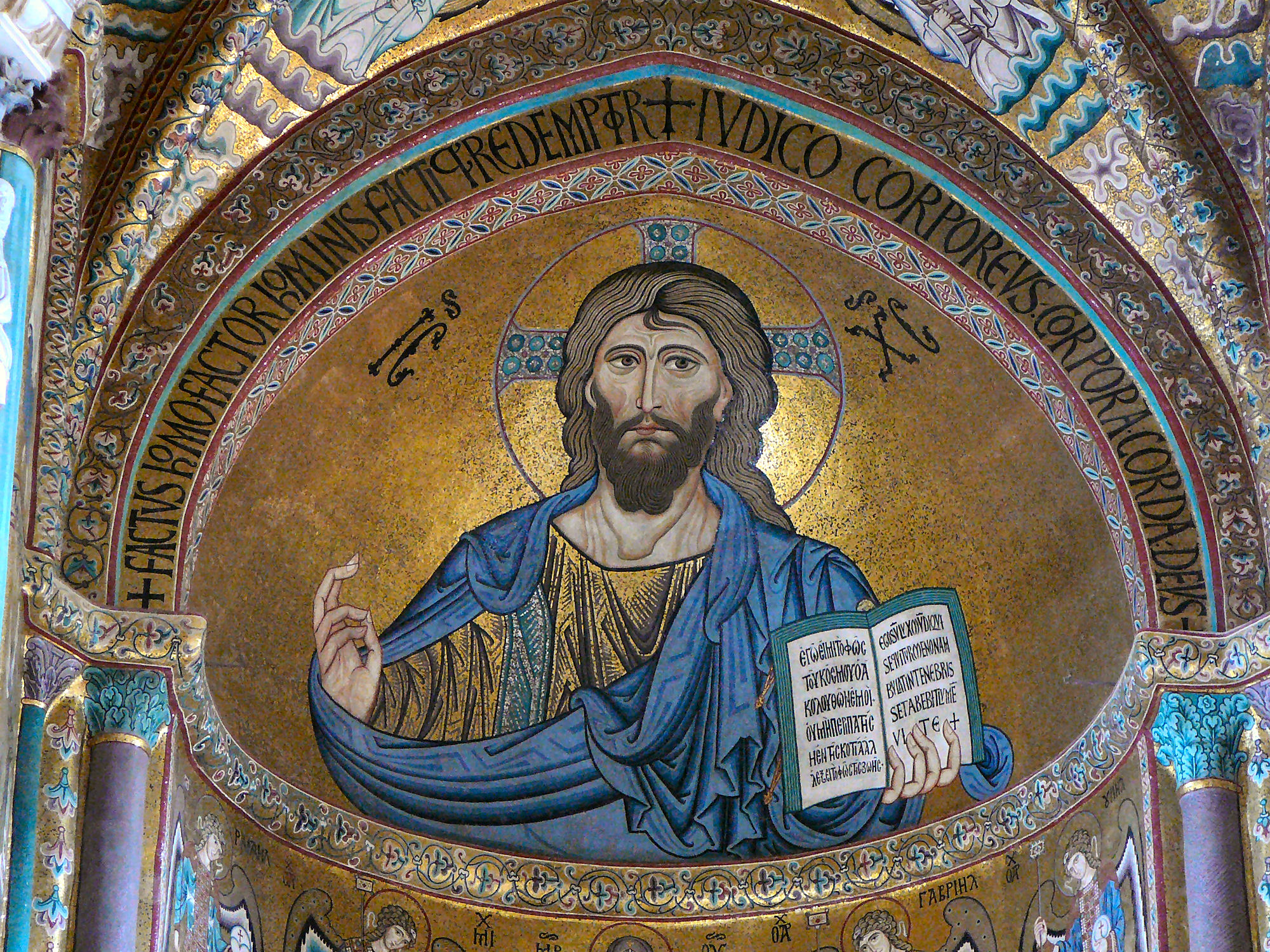
“I am the way, and the truth, and the life. No man cometh to the Father, but by me” (John 14:6). Christ Pantocrator mosaic in Byzantine style from the Cefalù Cathedral, Sicily. Photo by Gun Powder Ma, CC BY-SA 3.0, via Wikimedia Commons.
— Footnotes —
1. Pope Francis changed the name of the Congregation for the Doctrine of the Faith (CDF) to the Dicastery for the Doctrine of the Faith (DDF) in his March 19, 2022 Apostolic Constitution, Praedicate Evangelium. The changes went into effect on June 5, 2022. Because this study considers matters taking place in 2016, the older name is used throughout.
2. It may be asked why we have waited so long to publicize this information. The answer is twofold: first, that we wanted to follow Our Lord’s injunction in Matthew 18:16 sqq. regarding what do to when your brother has offended against you; second, we thought it more virtuous to avail ourselves first of the Church’s own canonical due process rather than to make a hasty appeal to the court of public opinion. Having long since made multiple attempts to make things right with Father de Laire, having filed several hierarchical recourses (“appeals”) against his decree, and having waited over seven years since the decree was published, we now deem it prudent and just to make a broader appeal to the Church at large — clerical and faithful — by publicly availing ourselves of our Natural Law right to defend our community and our cause. This is especially so because of the defamatory character of the decree. We have not given up on canonical due process, but we have been advised not to discuss the details of our currently ongoing canonical case. What we are addressing here is the historical background of what took place before the decree — truth that needs to be known.
3. Id est, propositio haeretica, heresi proxima, de haeresi suspecta, erronea, falsa, temeraria, piarum aurium offensiva, male sonans, etc.
4. It would be ideal if I could publish these letters on our website as supporting documentation; however, the Holy See’s policy on protocol letters is that they not be published without express authorization of the relevant dicastery, which I do not have. Anyone with a compelling interest in the case may contact me to arrange a viewing of our copies of the two protocol letters referenced in this study.
5. See footnote four, above.
6. To date, it is not clear what exactly Father de Larie means by “observing” these protocol letters. We were not commanded to do anything specific in the letters. The April 15, 2016 protocol notes that “The principle ‘Extra Ecclesiam Nulla Salus’ must be interpreted according to the binding doctrine of the Church….” My March 7, 2017 letter explained with clarity and in detail exactly how we do that. The October 20, 2016 protocol, which showed that Msgr. Morandi had misunderstood my reply to his earlier protocol, said that “The Congregation would like to invite you to pray for the assistance of the Holy Spirit and to seek competent theological counsel, so as to arrive at an understanding of the developed teaching of the Church, and how her teaching is not contradictory.” We acted upon this invitation. The professional academic theologian we consulted (a Professor of Dogmatic Theology with a canonical mandate to teach priests and seminarians theology) found my March 7, 2017 letter on the topic at hand to be faithful to the teaching of the Church. Yet, almost two years after receiving that four-page letter, Father de Laire wrote, with a notable lack of specificity, that we failed to “observe” the CDF protocol letters.
7. In a meeting on January 7, 2021.
8. The CDF determined that our January 2019 recourse to Bishop Libasci — which we sent before our recourse to the CDF — was filed five days late, based upon “recent jurisprudence of the Supreme Tribunal of the Apostolic Signatura.” Prior to that jurisprudence, whether a canonical act of an Episcopal Vicar carried with it a ten- or fifteen-day fatalia legis (canonical deadline) was debated by canonists. Competent canon lawyers have told me that our case established a clear precedent in the matter, a dubious distinction to be sure.



