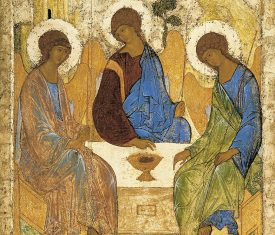
This paper summarizes Catholic teaching on the procession of the Son from the Father, and of the Holy Spirit from the Father and the Son. Given that the Son and the Holy Ghost are consubstantial with the Father, that is, … Continue reading
One of the doctrinal controversies between the schismatic, so-called Orthodox churches of the East and the Catholic Church is a dogma expressed in one word: Filioque (Fee-lee-OH-kway). But what does this word mean? Filioque is Latin for “and the Son.” … Continue reading
The following is from Blessed Columba Marmion’s masterful Christ, the Life of the Soul. In the larger context, Abbot Marmion is considering the mystery of holiness, first in God, then in men. After speaking of holiness considered as an attribute … Continue reading
This paper answers the following question: Given what Catholics believe about grace, merit and justification, why is it much more logical for Catholics to have treatises on progress in the practice of the presence of God and growth in mystical … Continue reading
A much more in depth treatment of this subject is found in our “The Three Levels of Magisterial Teaching.” The discrepancy in numbering the levels (three vs. four) is explained by the fact that some theologians, apparently following Cardinal Avery … Continue reading
Father asks: “Can an ‘implicit faith in Christ’ be sufficient for salvation?” He answers “No.”
Father asks: “Can an ‘implicit faith in Christ’ be sufficient for salvation?” He answers “No.” And he does so in over thirty pages of serious scholarship, with copious references to Fathers, Doctors, approved theologians, and magisterial pronouncements.
After the Original Sin, man was left in a condition of alienation from God. Whereas before the sin, he enjoyed infused knowledge in his intellect, loving obedience in his will, spontaneous virtue in his emotions, and no sickness or death … Continue reading
Catholic Family News has just published an informative article in the form of a book review. The review, by Paul Zarowny, Ph.D., delves into the phenomenological method of the Council Fathers, as studied by the Passionist priest, Father John F … Continue reading
There are two basic senses of Holy Scripture: the literal (or historical) and the spiritual. The spiritual sense is further divided into the allegorical, the tropological (or moral), and the anagogical. St. Thomas cites St. Gregory the Great on the … Continue reading
The importance of the Council of Trent lies in its being two things at the same time: 1) the heart and soul of the Catholic Reformation (the authentic reform of the Church); and 2) the definitive moment of the Counter … Continue reading
This is another offering from the larger work from which I earlier excerpted “The Three Levels of Magisterial Teaching.” As I said concerning that entry, this is a work in progress, being a section of a larger study on the … Continue reading
St. Maximus, the monastic mystic and eminent controversialist of orthodoxy against the Monothelites, earned his title “the Confessor” because he died in exile for his heroic confession. In his defense of the orthodox faith against an heretical emperor and supine … Continue reading
Site development: Bonaventure