

God! For so many centuries, you surrounded Poland
with the radiance of power and glory,
and with the shield of your protection protected it
from the misfortunes that were to overwhelm it.
Before your altars we offer a plea:
Save our King for us, O Lord!
— Alojzy Feliński, “National Song for the King’s Prosperity”
The Third Partition of Poland had ended the Polish-Lithuanian Commonwealth’s independence; in those areas annexed by Prussia, Poles were subject to a series of Germanisation measures aimed at assimilating them, and replacing Polish with German in their everyday lives. Both Russia and especially Austria were far less intrusive into the lives of their new subjects. But all three were deeply concerned with what was happening in France, where in the midst of the Revolution, a repeatedly victorious army leader, Napoleon Bonaparte, had taken control of the country. In 1804, he crowned himself “Emperor of the French,” and was ready to take control of the whole of Europe.
As the War of the Third Coalition against France began to peter out, the War of the Fourth Coalition began in 1806 and saw Prussia and Russia with Saxony, Sweden, and Great Britain trying to snuff out the Napoleonic flame. This gave hope to the Poles of recovering their independence and ending oppressive Prussian rule.
Napoleon, on the other hand, thought seriously about the strategic benefits of gaining control over lands on the other side of Prussia. He sent emissaries to South Prussia; these were to collect information about the situation in the province and the sympathies of its inhabitants. Their reports lead to the formation on September 20, 1806, of a new division from Polish deserters from the Prussian army. So many came that days later the Emperor decided to form a second division. The fighting in the west meant that Prussia could only maintain a small number of troops in Greater Poland — a great many of whom were Polish. Between November 1 and December 20, 3000 Polish troops deserted from the Toruń Corps.
Napoleon chose General Jan Henryk Dąbrowski, who was staying in Italy, to lead the diversion he was planning. A hero of the doomed uprising of 1794, Napoleon rightly thought that both his reputation and his competence would make him the perfect leader. On October 22, Napoleon ordered Dąbrowski to go to Poznań and organize regular Polish troops. The Polish General proposed to the French Emperor his plan of forming a Polish army of 40,000 soldiers. Dąbrowski asked for Polish officers from other Napoleonic units sent to him. Józef Wybicki was designated to become the future head of the civilian authorities. Napoleon, who was already in Berlin, told them that “the Poles have to deserve independence;” asked whether he would create a Polish State, Napoleon replied: “I will see whether the Poles are worthy of being a nation.”
Dąbrowski and Wybicki entered Poznań on November 3, 1806, as the vanguard of the French army. Their arrival became a large Polish patriotic demonstration. That day, Dąbrowski called Poles to stand on Napoleon’s side and fight Prussian occupation. Dąbrowski and Wybicki created Voivodship Commissions, whose tasks were to take administrative control. The rebellion swept over Prussian Poland; the French were able to enter Warsaw on November 27. The combined Franco-Polish maneuver cut the enemy country in half and isolated about 30,000 Prussian soldiers in Silesia. Napoleon stayed in Poznań between November 27 and December 12, 1806; arriving at Warsaw four days later, the Emperor wanted the cross the Vistula river and annihilate the Russians. This led to the bloody battle of Eylau on February 7-8,1807. The fighting was ended by the capitulation of Königsberg on June 15, 1807, the later treaties of Tilsit and the recognition of the Duchy of Warsaw by the Kingdom of Prussia.
At the treaty of Tilsit Napoleon had Prussia cede him the lands it had taken from Poland in the Second and Third Partitions; these were erected into the Duchy of Warsaw. To these were added two years later territory ceded by Austria in the Treaty of Schönbrunn. This was the first attempt to re-establish Poland as an independent country after the partitions; it covered the central and southeastern parts of present-day Poland. The newly recreated state was an independent duchy, allied and in subservience to France, in a personal union with the Kingdom of Saxony. Napoleon forced King Frederick Augustus I of Saxony to make his new realm a constitutional monarchy, with a parliament.
Following Napoleon’s failed invasion of Russia, the French abandoned the duchy; it was left to be occupied by Prussian and Russian troops until 1815, when it was formally divided between the two countries at the Congress of Vienna. Russia wanted all of the Duchy of Warsaw, plus all it had gotten from the three previous partitions, together with Białystok and the surrounding territory that it had obtained from Prussia in 1807. The other European powers united in their refusal.
In the end, Prussia did regain some of what was given to the Duchy of Warsaw in 1807. The Kulmerland and Gdańsk became part of the Province of West Prussia; the remaining territories were reconstituted into the Grand Duchy of Posen. The Grand Duchy and its populace had nominal autonomy, but, following the 1848 Greater Poland Uprising, became an integral part of Prussia as the Province of Posen.
The city of Kraków, in some sense the spiritual centre of Poland, and some surrounding territory, previously part of the Duchy of Warsaw, became the Free City of Cracow, under the joint protection of its three powerful neighbours. It would be annexed by Austria in 1846, becoming the Grand Duchy of Kraków.
Lastly, the bulk of the Duchy of Warsaw, became the “Congress Kingdom” of Poland, in personal union with the Russian Empire. This more or less corresponded to the Prussian and Austrian portions of the Third Partition (apart from the area around Białystok), plus around half of Prussia’s Second Partition conquests and a small part of Austria’s First Partition gains. It maintained its separate status only until the Polish revolt of 1831, when it was effectively annexed to the Russian Empire. Its constituent territories became the Vistula Land in 1867.
Although the Duchy of Warsaw lasted only seven years and encompassed just a part of the ethnically Polish lands, its creation had shown that the Polish people had not lost their martial fervour. Initially, the even smaller Congress Poland was taken seriously by both its inhabitants and Tsar Alexander I, who saw his title of King of Poland as a divine obligation. Thus, the “National Song for the King’s Salvation” with which we opened this article was composed as an anthem for the new Kingdom. But when Alexander died in 1825, his brother, Nicholas I, proved to be made of different stuff. He slowly chipped away at Polish autonomy, until the 1831 revolution resulted. That was the end of the Congress Kingdom of Poland. Five years later, he would suppress the Byzantine Catholic Church in his dominions. The Poles changed the chorus of the quoted song to “Return us, Oh Lord, our free Fatherland.” As noted, the Free City of Krakow was incorporated into Austria’s Kingdom of Galicia and Lodomeria. Two years later, the Grand Duchy of Poznan being fully incorporated into Prussia meant an apparent end to the last vestige of Polish independence. The rebellion in Russian Poland in 1863 saw what little was left of local autonomy stripped away. In both Prussia and Russia, Germanisation and Russification policies were levied on the Poles with relish.
In Austria, however things were rather different. Under the Habshurgs both Polish and Ruthenian culture and education were not only tolerated by encouraged — although this would cause friction between the two groups. The Ruthenian Catholics — as with all other Byzantine Catholic Churches present — received great deal of aid from the dynasty. Two prominent Poles served as Prime minister of the Austrian half of the Dual Monarchy, while another became joint foreign minister. Starting in the 1860s, a political group arose in Krakow, called the Stańczycy. Named after a famous Polish jester, they pointed out that the Habsburgs were the rightful heirs of the Jagiellons, Poland’s last pre-elective dynasty. They called for a reunited Poland under the dynasty. Among their leading members were Stanisław Tarnowski, Rector of the Jagiellonian University; Józef Szujski, historian; Stanisław Koźmian, theatre director; Michał Bobrzyński, governor of Galicia; and Walerian Kalinka, abbot of the Resurrectionist Order. Their work laid the foundation for the reestablishment of an independent Kingdom of Poland in 1915.
But all of that lay far in the future when Poland underwent its fourth partition in 1815. The patriotism of the Polish people survived, and burned so bright that Poland would resuscitate as a result of World War I, survive a fifth partition in 1939, and the horrors of occupation and Communism. Indeed, Poles would be key in the falloff the Soviet Bloc. But they had certainly had practise in resisting defeat.
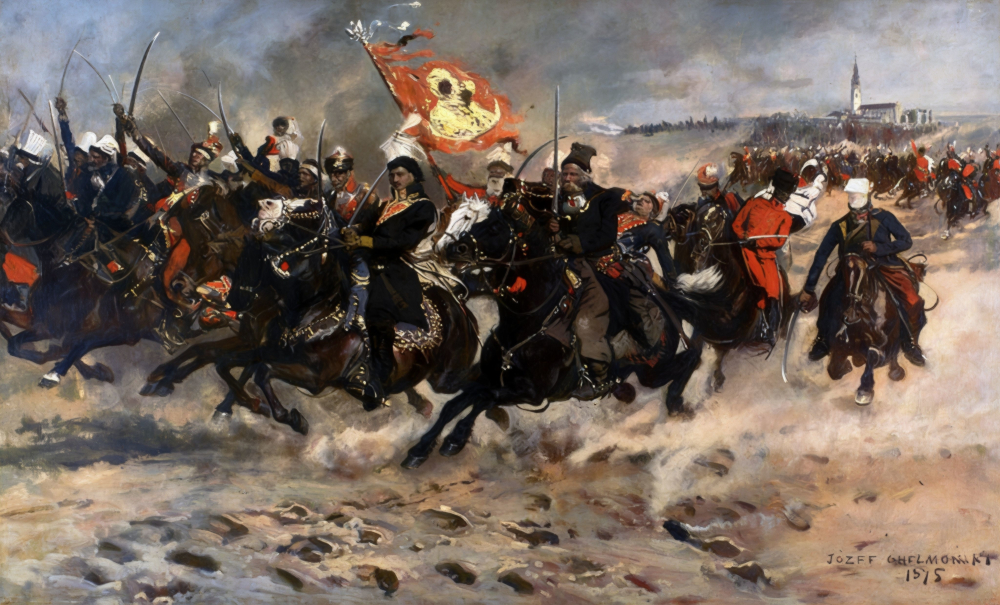
Kazimierz Pulaski near Częstochowa, by Józef Chełmoński (1849–1914). Public domain via Wikimedia Commons. Image has been digitally enhanced for Catholicism.org.



