

As we saw in the last article, in spite of Charles V’s protests, Edward’s regency council knew quite well that the French were a more principal concern for him. They pressed on to restrict Mary’s free access to Mass.
On 17 January 1551, the Council sent their demand that Mass no longer be heard in her household; it was illegal. For the protestants on the regency council, and indeed the young Edward himself, the Mass was an intolerable crime, and one they could not abide. Mary’s response was uncompromising, giving her final answer to be left in peace to follow her conscience. In peace she will not be left, and the driver in this matter was not merely Dudley, committed to the Reformation as he was, but the king. As we have seen, Edward, for whom Mary had always had a certain degree of affection, had been raised a strict Calvinist, and had no sympathy for toleration of the Mass. Over and above religious feeling, it was a matter of law. He answered her on 28 January of the same year with a stinging rebuke. If the King’s sister were to be tolerated in breaking the law, then why not some other subject? If Mary was truly a dutiful subject of his majesty, she would obey.1 This was the gist of Edward’s letters to her during this period, and they are somewhat reminiscent of her father and Ann Boleyn’s attempts to break her will in the 1530s. But she would never again break her conscience for peace, or even for life. The regret over what she had to do in 1536 still loomed large in her mind.
Since Mary still would not attend the services of the King’s prayerbook, the council got tougher. Northumberland had not forgotten Mary’s visit over Christmas, with fifty knights and eighty gentlemen in her retinue, all wearing rosaries which were meant to be seen. She did pose a serious danger, so they now took a more indirect approach. Mary’s household counselors, including her chief minister Robert Rochester, were summoned before the council. They were questioned and given instructions for the Mass to cease in her houses. Mary sent them back with a stinging missive against the council for attempting to use her servants to deliver instructions, and they were promptly arrested. When a deputation of Richard Rich, William Petre and Sir Anthony Wingfield came to remonstrate with her, they received a verbal barrage as terrifying as anything Katherine of Aragon could dole out. Particularly, she demanded the return of Rochester above all, since she had to become the governor of all accounts in his absence. She “learned how many loaves of bread be made of a bushel of wheat … my father and mother never brought me up with baking and brewing, and to be plain with you, I am weary with mine office.”2 In the spring of 1552, they were released. The pressure on her began to ease considerably, as Northumberland was focused on something else: Edward was nearing his majority. The king himself would deal with her when he came into his full powers.
Still, Mary was on alert, though nothing seemed to happen the rest of the year. In February of 1553 she came to London with a force 300 strong to see the king. We don’t know anything about this meeting, but we do know that, unknown to Mary, this was the last time she would ever see him.
After having made a summer progress3 in 1552, Edward was a model of health; he loved sports and was quite active. In 1553, shortly before Mary’s last visit, he had a chest cold, which did not appear at all to be serious. Fifteen years old, he was anticipating his majority and preparing to marry a French princess. He was actively involved in the workings of government, and his education showed through, with a brilliant legal mind. Then, rumors began to circulate in court, as well as the ambassadorial correspondence, that Edward had not shaken his February chest cold, but in fact, had become sicker still. Northumberland hoped that Edward would come around, while in the interim, he began a program of marriages to strengthen his hold on the kingdom. But, by June, it was clear to both Edward and Northumberland that Edward might not survive. Both knew that Mary would completely undo the religious changes which they had brought about, and so, Edward showed Northumberland his Device for the Succession. We must say a word about this document.
It has been sometimes thought that Northumberland instigated Edward to disinherit Mary in a grand conspiracy to put his family on the throne. But the actual evidence tells a different story: Dudley, newly made Earl of Northumberland, had indeed made political marriages to consolidate his hold on power, but changing the succession hadn’t entered into his head; rather, it was entirely Edward’s initiative. The device was originally drawn up in January, before Edward suffered his cold and when he still could expect long life. It appears to be an exercise in accord with his legal education, part of his preparation for becoming king. This partly explains the strange way it is constructed.
At first, he took a line similar to John Knox, the fiery Scottish reformer, that women were by their nature unsuited to government. So, he would alter the succession in favor of his nearest male cousin in the Grey family. The Greys descended from Henry VIII’s sister, Mary Tudor, and they were established in Henry’s will to succeed if neither Mary nor Elizabeth would have issue. Edward now decided to circumvent both Mary and Elizabeth so as to place the Greys in the succession. The motivation in this exercise is clearly due to Mary’s Catholicism, but the reason is more coldly rational. Since both are legally bastards, they should not be allowed to rule. But here he ran into another difficulty; there was no male suitable to succeed except for Henry Darnley, also related to the older Mary Tudor, but he was being raised as a Catholic. Thus he would begin with Frances Brandon and her heirs male. But who was she?
Charles Brandon, the first Duke of Suffolk, was the standard-bearer for Henry VII at the battle of Bosworth, and a regular figure at the Tudor court. He was close to the young Henry VIII, and had acquitted himself well in Henry’s wars in France. Henry had conferred upon him the title of Earl Marshal of England. Now Henry had given his own sister Mary in marriage to the French king, Louis XII. The old king delighted in his young bride—too much—and died much earlier than expected, which cleared the way for the Count of Angouleme to become François I. Mary, the queen dowager of France, returned to England, and because of the love she had previously had for Brandon, Henry permitted the marriage. Their sons did not survive, but they had daughters, the oldest of which was Frances Brandon. She would be duly wed to Charles Grey, who would inherit the title of the Duke of Suffolk. A committed protestant, Grey would become a part of the conspiracy to remove the Duke of Norfolk from the regency Council, which we addressed in the last article, and supported Dudley, later the earl of Northumberland, in his presidency of the Council. Charles and Frances also had no sons, but daughters, the oldest of which was lady Jane Grey. To cement their power, Grey agreed to marry Jane to Northumberland’s son, Guildford Dudley, whereby Northumberland would tie his family to the line of succession. But this doesn’t seem to have been Northumberland’s aim, at least not consciously, since Jane was a second choice. Nevertheless, after Frances Brandon’s mention in Edward’s Device for the Succession, follows the heirs male of Jane and her sisters. In June, Edward would revisit this schoolroom exercise, and upon showing it to Northumberland, he endeavored to make some changes to it. He adds in, “before my death,” to Frances Brandon’s section, to cut her out of the succession since she would have no male children by that time. Then, when he comes to Lady Jane, he crosses out the possessive (’s) on “Jane,” to make it “lady Jane and her heirs male,” thus setting the succession on Jane. Edward’s device for the succession, and all of these changes can be read in his own hand.4 The device, however, was also illegal, because it was never ratified by parliament.5
This did not sit well with everyone on the council, some of whom protested its illegality, while the Lord Chief Justice, Montagu, called it treasonable. Some suggested that Mary should be given the crown, but to swear an oath not to make any alteration in religion. This angered Edward, and he made it clear on 15 June that he meant to disinherit Mary from the throne, and he would accept nothing else. Nor could Elizabeth, born in adultery, be permitted. His cousin Jane, however, was virtuous and firmly Protestant. Nevertheless, on 6 July, 1553, Edward died.
Jane Grey
Jane was given a robust education in the new learning, in both classical Latin and Ancient Greek. When she was first broached about the possibility of succeeding Edward, she was found reading Plato’s republic, in Greek. She dismissed it as a joke, but on 9 July, not yet aware of the king’s death, Jane was summoned to Northumberland’s palace at Syon house. There she was informed of Edward’s death, and that according to his will she was to become queen. At first reluctant, after pressure from the nobles present and her father, she accepted, and with her husband Guidlford Dudley, made her residence in the tower, where English monarchs went prior to their coronation. The plan so far had gone off seamlessly, and the coronation of Queen Jane would soon be presented as a fait accompli. There was just one problem: the plan hinged on apprehending the Princesses Mary and Elizabeth, and this had all gone terribly wrong.
Mary had not been idle. She was well informed from sources in the court about events, and had been on a progress6 throughout her East Anglian estates. It is worth recalling here that after Henry VIII’s death, Mary became one of the richest landholders in England, only behind the king and a few nobles. She had administered her lands well, earned a great deal of support, and most decisive of all, Northumberland had brutally repressed several East Anglian counties in the Prayerbook rebellions. On 4th July, she ignored a summons to court (where she and Elizabeth were to be apprehended and placed in the tower), and secretly set out from Hunsdon, and met with Huddleston, a Catholic lord in Sawston. From there, she proceeded to her house in Hengrave, where she received positive confirmation of the King’s death. Acting while he was still alive would have been treasonable, and she had to be absolutely sure. What happens next indicates weeks of planning which were now coming into motion. Men were coming in from all over, not only from the lands of her affinity, but from other areas as well where she enjoyed large support. Disastrously for Northumberland, the most important part of the coup, having Henry VIII’s daughters in custody, went bust.
Now Mary challenged Northumberland for the throne. On 9th July, as Jane was being induced to usurp her cousin, Mary sent to the privy council a decree commanding obedience to her as queen, and that her proclamation should be announced in London. As one chronicler wrote,
The attempt should have been judged and considered one of Herculean rather than of womanly daring, since to claim and secure her hereditary right, the princess was being so bold as to tackle a powerful and well-prepared enemy, thoroughly provisioned with everything necessary to end or to prolong a war, while she was entirely unprepared for warfare and had insignificant forces.7
Charles V had sent an imperial embassy, headed by Simon Renard, to negotiate with Edward, only to find him dead. Their instructions were not to commit the Emperor to Mary’s cause, and advise her to exercise caution, as Charles did not credit her chances very highly. Unfortunately for them, events were already in motion, and when they wrote back to their master, they declared that Mary’s cause was lost, and that she didn’t have a chance. Unlike Chapuys or Van der Delft, neither Renard nor the others knew Mary well, and did not have information other than what traded in London. Soon they would discover how wrong they were.
The rapid speed which Mary had mobilized demonstrates that a good deal of planning and thought had gone into her effort. East Anglia was rising, and declaring for Mary. Men in important positions, upon seeing town after town submit to Mary, either fled or made their own submission. Not only her own estates, but Oxfordshire, Essex, and other counties were also rising for Mary. While Mary was generally popular among the populace, and even Protestants supported her because she was Henry VIII’s daughter, among the gentry, her supporters were all Catholic. A list of Catholic nobles who formed the bedrock of her support gives nearly the same names as the lists of Catholics suffering under Elizabeth’s reign. Among them, Sir Robert Southwell, the granduncle of the future Jesuit martyr of the same name.
Northumberland, as well as the privy council, was angered by Mary’s formal proclamation of the crown. Rumors began to enter London that Mary had a force of 30,000, though in actuality it was perhaps no more than 7,000 strong. In the face of a serious armed threat, Norhtumberland could not trust to inferiors. In fact, the council itself was divided, and he faced a twofold problem; how to keep them in line while also holding together his forces when there were questionable alliances. He resolved to put Suffolk, Jane Grey’s father, in charge of the Council, while he went to take command of his forces directly. He was a skilled military man, but his reception in the streets of London must have given him a sense that he had already lost. Not a man wished him Godspeed, and as yet nobody really knew what to make of “Queen Jane,” who had been proclaimed the day before Mary’s messengers were proclaiming her as queen. Nobody knew who Jane was, and since she had been conveyed directly to the tower, few had seen her. In his absence, the complicated alliances and fissures in the privy council, who were now de facto prisoners in the tower, came to bear.
On 9 July, all had gone according to Mary’s plan, she had evaded capture, and now the next phase was to bring England to rise for her. At Kenninghall, she sent out letters to the knights and gentry of Norfolk and Suffolk, and others in Middlesex and Buckinghamshire, and neighboring counties. The Thames Valley, as well as the north and west of England were answering her call. Men and Catholic gentry were ready to fight and die for their queen. On 12 July, she moved to Framlingham castle in Suffolk, where even more supporters awaited. There, news reached about more risings near London. Northumberland began to see desertions from his ranks, and he returned to Cambridge to martial his troops. There, for the first time, he was struck by indecision. Should he go and challenge Mary’s troops? Was he ready for civil war? And where were his reinforcements? Back in London, the Council had already fallen apart, and, with Cranmer one of the few holdouts, all agreed on some form of submission to Mary, declaring them always to have been obedient (in spite of accepting Queen Jane), in the hopes of saving themselves. Lord Paget, the Earl of Arundel and the Earl of Pembroke left the tower with the act of submission on the 16th.
This transpired, unknown to Mary, while on the 18th the first Protestant joined her cause, John de Vere, the earl of Oxford. With this vast contribution to her forces and the vast authority which de Vere brought, combined with the desertion of Northumberland’s forces at Cambridge, Mary was assured of success, and issued a proclamation from “Mary the quene” [sic]. The document is held in the Bedingfeld family collection, but a copy can be seen at the Lanman Museum. Her proclamation begins:
Knowe ye all goode People That the moste Excellent Pryncesse Mary eldest doughter to king henry theight and Syster to kyng Edwarde the vjth yo[ur] late Soveraigne Lorde is nowe by the grace of god Quene of Englande Frannce and Irelande Defendo[ur] of the Faithe and verie true owner of the Crowne and govern[a]nce of the Realme of Englande and Irelande and all thing[es] therto Justely belongyng and to her and to none other ye owe to be true Liege men.8
The document continues, by praising specific Catholic lords who have led the way in supporting her, and to what purpose,
To resyste the force and power of her moste False Traito[ur] and Rebell John Duke of Northumberlande and his complic[es] who upon moste false and moste shamefull ground[es] myndyng to make his owne sonne kynge by mariage of a new founde ladies title or Raither to be king hym selff hathe moste Traiteriouslie by long conteyved Treason sought and seketh the distruccion of her Royall parson.9
It is often assumed that Mary lacked the political savvy of Elizabeth, but this is often made without having examined her words. Here, rather than denouncing Jane, her cousin and a young girl, as even she was, she denounces Northumberland, and lays upon him a conspiracy to make his own son king. Now, as it turned out, Jane refused that Guildford Dudley should become king, but this detail was could not have been known to Mary at that time. Just the same, after thanking God for all who have upheld her cause, she puts a price on the Duke of Northumberland’s head.
On 20 July, she inspected her troops as Queen, for the first time. Her horse was nervous due to the presence of so many soldiers, and although she was an accomplished rider, a fall would have been disastrous for the morale of troops prepared to fight and die for her. So she inspected them on foot, and spoke to them all in such a way that, according to a contemporary account, she completely won everyone’s affections.
It was here, in the evening, that Paget, the earl of Arundel, arrived with the news that the privy council had proclaimed her Queen. Moreover, Northumberland had offered surrender at Cambridge without even drawing his sword. It might be said that Dudley had lost his nerve, but more realistically, he was not ready for civil war, and his actions ensured that not a drop of English blood would be shed to put Mary on the throne. The mass desertion of his troops and the swelling of Mary’s forces caused inaction in a man unused to anything but victory, and he determined to plea for mercy. When Arundel came to arrest him on 23 July, Arundel told him grimly, “My Lord, ye should have sought for mercy sooner.” By the 25th he was under guard in the tower.
There was universal rejoicing, even by Protestants. Bonfires were lit throughout London. Mary instructed her chaplains to give thanks to God for her victory, and On 24 July, Mary left Framlingham and made her way to London at a liesurely pace. At this point, Elizabeth appears in the picture. She had been alerted by Mary concerning the plot to lock her in the tower, and thus ignored the summons to court, but she had not come to Mary’s standard either. She carefully gave muted support but no definite action. The truth was that her cause depended on Mary’s success, and she knew it but rued it. Now that it was certain, she offered her congratulations, and made ready to join Mary in London.
Throughout England, the faithful who had hidden away vestments, chalices, missals, images and other relics of the old Church now appeared from the catacombs; Masses were said and Te Deums were sung amid the general rejoicing. There were Protestants who abandoned the new faith, seeing the hand of God behind Mary’s accession, and Stephen Gardiner, the great propagandist of Henry VIII’s Church, punished for adhering to it under Edward, was now released from the tower; he made his submission to Mary (whom he had wronged in working for the divorce of her mother), as well as the Catholic faith. For the first time in England’s history, a woman sat on the throne in her own right.
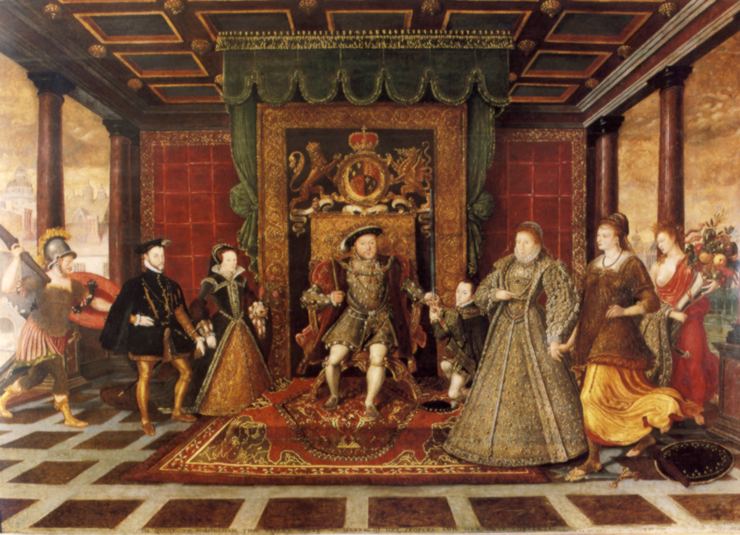
The Family of Henry VIII: An Allegory of the Tudor Succession, attributed to Lucas de Heere (1534–1584). Public domain, via Wikimedia Commons.
— Footnotes —
1. Porter, The Myth of Bloody Mary, pp. 178–179.
2. Ibid., p. 182.
3. Editor’s note: “a progress” in this sense is “an official journey or tour, as by a sovereign or dignitary” (sense nine at Dictionary.com).
4. The document is preserved at the Inner Temple Library.
5. By the same token, the Stewart accession was also illegal, by the terms of Henry VIII’s will, but by that time Elizabeth had made certain it was buried so far in archives it would not be seen again until the 19th century.
6. See footnote three, above.
7. MacCulloch, The Vita Mariae Angliae Reginae, p. 252, cited in Samson, Mary and Philip: The marriage of Tudor England and Hapsburg Spain, p. 28.
9. Ibid.



