
Till then upon Ararat’s hill
My hope shall cast her anchor still,
Until I see some peaceful dove
Bring home the branch I dearly love;
Then will I wait till the waters abate
Which now disturb my troubled brain,
Else never rejoice till I hear the voice
That the King enjoys his own again.
—Anon., 17th century
THE ill-fated history of the House of Stuart is one that should haunt or at least interest every Catholic in the Anglosphere. From the Servant of God Mary Queen of Scots, whose better right to the English throne led her cousin Elizabeth I to have her murdered; James VI and I, whose wife converted to Catholicism, and was a founding father of Virginia and Massachusetts; to Charles I, whose Catholic wife encouraged his negotiations with Rome for reunion and who was murdered by Parliament during a cruel civil war; Charles II, who managed to escape his father’s murderers in that conflict, was restored, and died Catholic; to his brother, Servant of God James VII and II, who converted to Catholicism, reformed the Royal Navy, and was driven off his throne to make way for the figurehead Monarchy of to-day; James VIII and III, whose birth caused the revolution that drove his family into exile, and tried to regain the throne unsuccessfully — most notably in 1715; Charles III, whose attempt to retake his father’s thrones in 1745-6 ended disastrously for his peoples and him — but lives on in song and story; to Henry IX, Cardinal York, who died a prelate of the Catholic Faith; it is an epic tragedy — moreover, it is our tragedy.
When Charles I raised his Standard at Nottingham in response to the impossible demands of Parliament, it was the final phase of the beginning of the Wars of the Three Kingdoms. The King set up his capital at Oxford, and for three long years the wars raged in the North and West of England, in Wales, Scotland, and Ireland. In 1645, the Battle of Naseby saw the defeat of the larger part of the Royalist Army. The following year, the King was forced to flee Oxford in disguise.
It was 380 years later, almost exactly, four friends and myself resolved to take a Cavalier/Jacobite tour through the Three Kingdoms, viewing sites associated with great dates in Stuart history. Obviously, we could not do this in chronological order, but had to see these things as we found them. We all arrived at Heathrow, and stayed in nearby Hillingdon for the next several days, at the Red Lion Hotel. Its website proudly declares: “In 1646, King Charles I cut his hair short and disguised as a servant fled from Oxford to join the Scots at Southwell. One of his companions wrote that on Monday 27th April ‘At one Mr Teasdale’s House a tavern at Hillingdon we alighted and stayed to refresh ourselves between 10 & 11 of the clock and there stayed 2 or 3 hours.’ Today, with traffic hurrying by on the main road, many people fail to realise that the Red Lion is that remote tavern which sheltered the fugitive King. In the bar you’ll find an account of his flight along with a real sense of Great British history.” In fact, they gave me the room he had stayed in as my bedroom! It was the perfect place from which to explore London sites.
In London on several days we visited the Statue of King Charles at Trafalgar Square (immortalised by Catholic poet Lionel Johnson), which is the site of an annual commemoration of his murder on January 30. I have attended this event, sponsored by the Royal Stuart Society and the Society of King Charles the Martyr several times. Nearby is the Banqueting House — the last surviving part of Charles I’s Palace of Whitehall, and decorated by him; just outside is the actual site of his murder. Returning to his bedroom at the Red Lion felt very odd.
On a happier note, we visited the Tower of London, which was much emptier of tourists than I have seen in it at other times. The Chapel Royal of St. Peter ad Vincula allowed us to pray to Ss. Thomas More and John Fisher, whose bodies are in the Crypt; their heads are in St. Dunstan’s Church in Canterbury and All Hallows by the Tower respectively — buried in the floor in each. We saw the Crown Jewels, and much else, which got us thinking about the Coronation Rite and Crown Jewels in general: they are universal marks of Catholic or Orthodox governance (Protestant Monarchies borrow them).
A friend showed us around the Temple — that enclosed space on the edge of the Square Mile that is the Original City of London, remaining to-day under its Medieval Constitution (the last of all English, Scots, or Irish municipalities to do so). Originally held by the Knights Templar, who built the Temple Church at the compound’s centre, it was given to the Knights of St. John on their suppression. Having their own headquarters and church at Clerkenwell (which I have visited previously), they let the Temple out to the lawyers. Since then, two Inns of Court, as they are called — the Middle Temple and Inner Temple) have been headquartered there: two others are nearby — Lincoln’s Inn and Gray’s Inn. The Inner Temple Garden is where Shakespeare, in Henry VI, Part 1, has Edmund Beaufort, Duke of Somerset forced by Richard Duke of York to choose between the White Rose of York and the Red Rose of Lancaster — to the ultimate ruin of the hapless Servant of God, King Henry VI.
Of course, the City and its immediate environs offer an awful lot to see; but we confined ourselves to just a few of that lot. Ye Olde Cheshire Cheese, rebuilt after the Great Fire in 1667, was the great literary hangout of Dr. Samuel Johnson and his circle. A devoted Jacobite, High Tory, and pro-Catholic, Johnson was arguably Britain’s foremost 18th century literary figure. Not far away is Ely Place, location of St. Ethelreda’s, the oldest Catholic Church in London (bought back from Welsh Anglicans in the 19th century).
There was much more to see in London, but time pressed. We headed up to the town of Stafford in the Midlands — an area of heavy contention during the Civil Wars. Our party stayed at the Vine Hotel, dating back at least to 1606. From there, we roamed to various places of interest. In Stafford itself, the Ancient High House hosted Charles I and his nephew Prince Rupert in 1642. Penkridge’s White Hart played host several times to Servant of God Mary Queen of Scots while she was being shuffled back and forth between various manors in captivity.
We sallied forth to Shrewsbury, County Town of Shropshire, and one time seat of the King’s Council for the Welsh Marches. We passed by the Old Council House as it is called now, and where Charles I stayed, while campaigning. It is a lovely town, with a Catholic Cathedral, which Mark Davies, the current Bishop, has restored to its original splendour. There we were able to venerate relics of St. Winefride; we would meet her again. One of our number being a fan of Ellis Peter’s Brother Cadfael series, we had to visit Shrewsbury Abbey, scene of that Medieval sleuth’s exploits.
One of the most dramatic events of the Civil Wars, after Charles I’s murder in 1649 was his elder son’s attempt to retake his English throne two years later. Having made a deal with the Scots Presbyterian government, the 21-year-old Charles II marched South — only to be defeated by Cromwell at the battle of Worcester. We went to Boscobel House, during the Civil Wars a Catholic home with a resident priest, Fr. John Huddleston. The fugitive King made his way to Boscobel House, where Fr. Huddleston hid him in his own priest’s hole, thus evading the Puritan soldiers who searched the house. The following day, Fr. Huddleston led him to a large oak tree — known ever since as the “Royal Oak” — where he again hid overnight, watching the Puritans as they searched the grounds. The next day he continued his journey — eventually to safety in France. But 34 years later, on his deathbed, Fr. Huddleston received the dying King into the Church, remarking afterwards, “now I have saved his soul, as once I saved his body.” Looking at the hole where priest and king had hidden together, and at the Royal Oak grown from an acorn of that which sheltered Charles II was quite-thought provoking, as was a visit to the White Ladies ruined abbey, where the King also hid.
As with Charles II, we had to move on — this time to the Principality of Wales. I had only been there once — and that was to the far south, to see the Oratory Church of St. Aban on the Moors in Cardiff (and nothing else of the Welsh capital) and Caerleon because of its connections with King Arthur and Arthur Machen — I saw the Anglican parish church and the Roman Amphitheatre which is said to be the inspiration for the Round Table. But this time, we took the train to the far north.
From Stafford, the train took us eventually to Flint. There a taxi took us to the Shrine of St. Winefride’s Well, a place in Wales where the Catholic Faith has never died out. It was here that in 1687 James II and Mary of Modena made a pilgrimage to pray for a male heir. Their pleas were heard, and James III was born the following year; but that precipitated the so-called “Glorious Revolution,” and the beginning of the whole Jacobite saga. We blessed ourselves the water, venerated more relics of St. Winifrede, and said the required prayers. The cab took us back to Flint, and the train.
We continued on to Caernarfon, a place I had wanted to see since watching the present King’s investiture as Prince of Wales back in 1969. We put up another medieval inn called the Black Boy. As it turned out, this had nothing to do with Africans. Rather, the place having been a local Cavalier gathering place, the “Black Boy” was a codename for Charles II — called so because of his dark skin and black hair. Once again, the trip’s theme was reimpressed upon us.
The next day we spent exploring the town and its castle. The latter has an impressive military museum which, of course, was one of Edward I’s means of suppressing the Welsh. But it was quite an impressive place — and something, indeed, to stand where King Charles III stood, when his mother the Queen made him Prince of Wales. The town itself was extremely charming, with the chatter of Welsh here and there. But two nights were all we could allot. We then took the train to Holyhead, simply passing through the lovely and legended Isle of Anglesey. At Holyhead, we boarded the ferry for Dublin, capital of the Kingdom of Ireland.
England and Wales were quite poignant. So much of who we are in the United States, Canada, Australia, New Zealand, South Africa, and the rest of the Anglosphere comes to us from these two little islands — and this is even truer for those of us who are Catholic. I have Irish and English blood on both sides, but Scots only on my father’s side. The next round of adventures would take us to his ancestral homeland — and to the very spot where an ancestor of mind stood with Bonnie Prince Charlie.
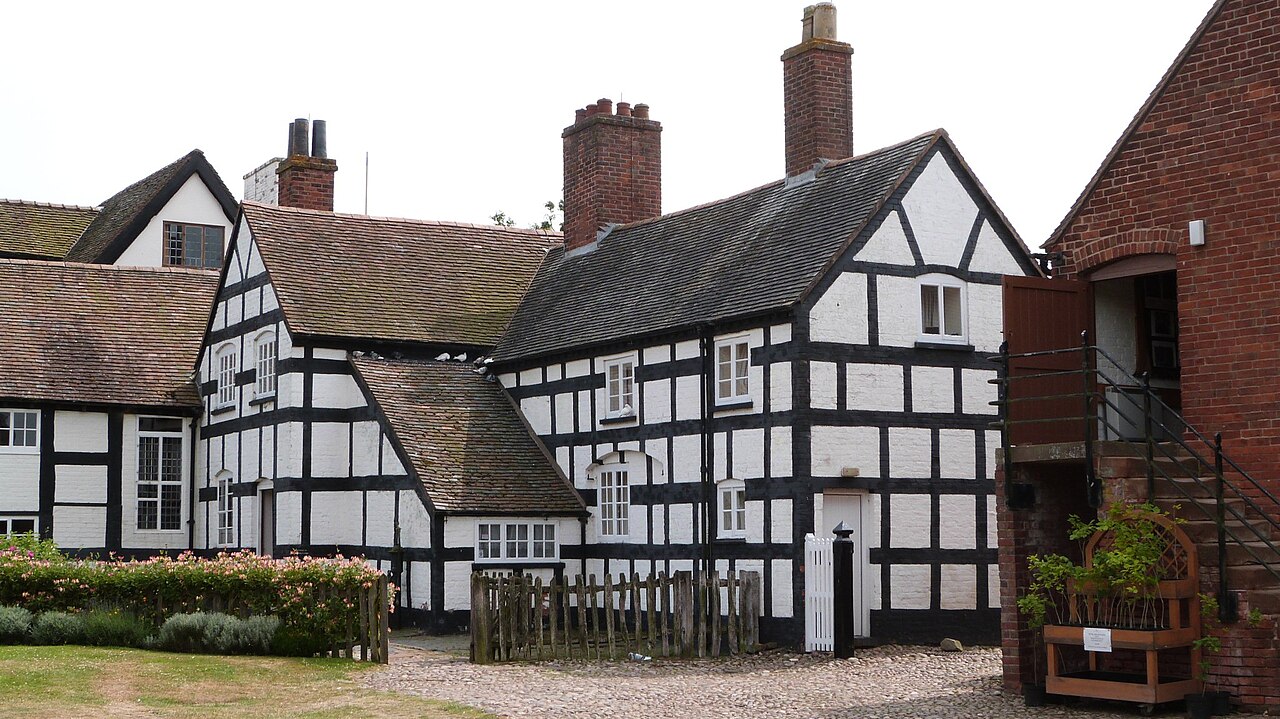
Boscobel House is a building in the parish of Boscobel in Shropshire. It was originally a farmhouse but it is most famous for its role in the escape of Charles II after the Battle of Worcester in 1651. Charles hid in a priest hole to avoid searching roundhead soldiers. Photo credits: Peter Broster, CC BY 2.0, via Wikimedia Commons.



