
The following question came in through our contact page on Catholicism.org:
Hello, among the recent mass of terms flooding my social media such as, “The Chosen People”, “Christian Zionism”, and “Replacement Theology”, I searched the Catechism to see what it had to say about this. It turns out, a lot of people use Cat. 121 to support that Jews remain Gods chosen people, since the Old Covenant was never revoked. Then I read Brother Andre Marie’s excellent article about the topic. I just am a little confused about what the Catholic Church actually teaches, as I have friends of mine asking me, and I’m not sure what to say. After reading Brother Andre Marie’s article, “Who are God’s Chosen People?”, I firmly answer that those faithful to the Church are, but where does Cat 121 come in in this conversation?
Because this is a matter of general interest, I thought I would post my reply on the site.
We faithful of the Catholic Church, by God’s grace, are the “True Israel” and the “Chosen People.” (To anticipate an objection, I note that all men, Jew and Gentile alike — men of “every nation, and tribe, and tongue, and people” (Apoc. 14:6) — are invited into Catholic unity, so this exclusive claim has nothing to do with racism of any sort, including antisemitism.)
CCC 121 says this:
The Old Testament is an indispensable part of Sacred Scripture. Its books are divinely inspired and retain a permanent value,92 for the Old Covenant has never been revoked.
As the context shows, this passage is situating the Old Testament in the full sweep of salvation history and divine revelation. Citing Dei Verbum, CCC 122 notes that the books of the Old Testament, “contain matters imperfect and provisional” and that they “declare in prophecy the coming of Christ, redeemer of all men.” CCC 123 makes it clear that the Church, “always vigorously opposed the idea of rejecting the Old Testament under the pretext that the New has rendered it void (Marcionism).” The heresy of Marcionism rejected outright the books of the Old Testament, which the Church does not do. These holy books were fulfilled in Jesus Christ.
We Catholics pray the Psalms. We read the Prophets. We accept the entire Old Testament as divine revelation. Abraham is our father.
While the Old Testament retains is permanent value and is not revoked, the Mosaic Law itself is no longer in effect, having been fulfilled in Christ and the New Law of the Gospel.
Speaking of the Church’s relationship to the Jews, another passage of the Catechism, CCC 839, cites Saint Paul’s Epistle to the Romans saying, “for the gifts and the call of God are irrevocable.” This is often misunderstood to mean that the Mosaic Law is still in effect, which it clearly is not (see the reference to the Council of Florence, below). What the passage means is that God does not repent of the gifts He gave the Jews of old, and He still calls them to believe in Christ, just as Saint Paul himself endeavored to “provoke them to emulation” (Rom. 11:14) and therefore called them into the Church. Jews have converted, and still do so, all throughout the history of the Church.
The Jews have a unique role in salvation history. Even those who have not accepted Jesus Christ have a special place as a “witness people” (Saint Augustine). In the end, the Jewish nation will be brought into the Catholic Church.
The Council of Florence taught the following:
[The Catholic Church] firmly believes, professes, and teaches that the matter pertaining to the law of the Old Testament, of the Mosaic law, which are divided into ceremonies, sacred rites, sacrifices, and sacraments, because they were established to signify something in the future, although they were suited to the divine worship at that time, after our Lord’s coming had been signified by them, ceased, and the sacraments of the New Testament began; and that whoever, even after the passion, placed hope in these matters of the law and submitted himself to them as necessary for salvation, as if faith in Christ could not save without them, sinned mortally. Yet it does not deny that after the passion of Christ up to the promulgation of the Gospel they could have been observed until they were believed to be in no way necessary for salvation; but after the promulgation of the Gospel it asserts that they cannot be observed without the loss of eternal salvation. All, therefore, who after that time observe circumcision and the Sabbath and the other requirements of the law, it declares alien to the Christian faith and not in the least fit to participate in eternal salvation, unless someday they recover from these errors. (Denz. 712)
According to the Council of Florence — following the universal tradition of Scripture, the Fathers, and the Scholastics — the Old Law “ceased” (cessasse) when the New Law of Christ was instituted. This passage from the council relies heavily on Saint Thomas Aquinas — some passages are close paraphrases — who divided the Old Law into the moral, ceremonial and judicial precepts. The moral law, which is continued in the New Testament, is nothing other than the natural law. The ceremonial and juridical precepts both ceased with the Passion of Christ (see, ST Ia IIae, Q. 103, A. 4 ad 1 for the ceremonial and Ia IIae Q 104, A. 3 for the judicial precepts). To Saint Thomas and Saint Augustine, the observance of the Old Law’s ceremonies was “neither dead nor deadly” before the Passion of Christ, “dead but not deadly” during the time in between the Passion and the promulgation of the Gospel, and finally, “dead and deadly” after the promulgation of the Gospel. For this reason, it has always been regarded as mortally sinful for Catholics to practice Jewish rites (e.g., a Passover Seder).
For further reading:
- A Slow Reading of Romans XI
- Who are God’s Chosen People?
- The Heresy of Dual-Covenant Theology
- Catholic Truth and the Salvation of Souls are at Stake
- The Jewish Mystery and the Universal Church
- Why Modern Israel is Not Biblical Israel
- Two Reconquest Episodes on Christian Zionism
- The Truth Behind Zionism in U.S. Politics: Mike Church & Brother André Marie
- The Jewish Nation will Enter the Church
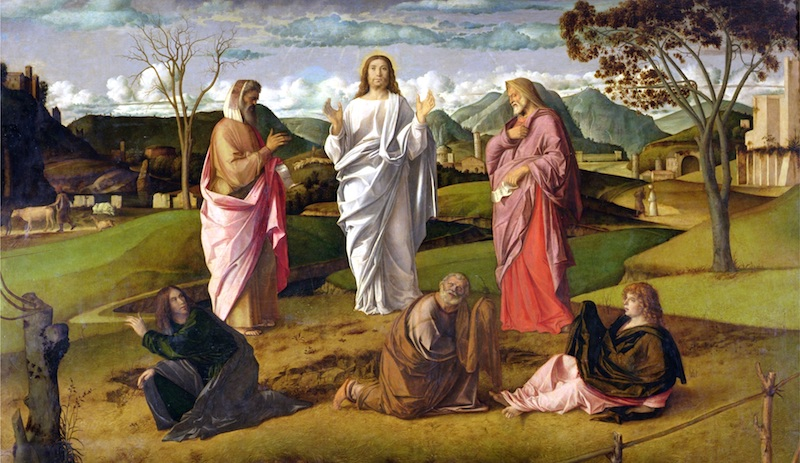
In Giovanni Bellini’s The Transfiguration (credits and details), Moses and Elias converse with Jesus, showing that the Law (Moses) and the Prophets (Elias) gave testimony of Christ.



