
His feast day was yesterday, but today is the day that he was born and died. He is perhaps the least known of the thirty-three doctors of the Church. That should not be so.
There is a stunning painting of this Capuchin saint on horseback leading the troops into battle against the Turks at Stuhlweissemburg, near Budapest, with his long beard flowing in the wind and with his right hand holding the crucifix aloft. (I couldn’t find it as I write, although I am certain that it is quite a famous work of art.) That battle was in October, 1601, with Mohammed III’s army of 80,000 troops threatening Hungary and Austria, and the pompous sultan bragging that he would use Rome’s churches as stables for his horses. Pope Clement VIII had sent Saint Lawrence to Germany to rally the imperial forces to advance against the Moslem invaders and save the empire. As chaplain to the troops, which amounted to a mere 18,000 men, the fiery preacher led the forays into the enemy lines, inspiring the soldiers to trust in God: “The victory is yours,” he assured them. And so it was, the Turks fled before the determined fury of the Christian warriors, and retreated back across the Bosphorus. The field commander, Duc de Mercoeur, who came all the way from Brittany to answer the pope’s call, testified that “the victory, which was truly miraculous, was, after God and the Blessed Virgin, due to the Capuchin Commisary.” So was the preservation of Father Lawrence from injury and death. More on that later.
He was a saint who accomplished so many different kinds of duties in his sixty years of life that there is simply no other in the same category. Leader of armies, diplomat, peacemaker, preacher, miracle-worker, exorcist, theologian, biblical scholar, linguist, confessor, mystic, and leader of the Counter-Reformation, doctor of the Church, Lawrence of Brindisi seemed ubiquitous in his time. And he followed the strict Franciscan rule (with few exceptions) of always traveling on foot, usually covering twenty or thirty miles a day on his numerous missions. He never missed offering the holy sacrifice on his ventures, no matter how tired he was, even though he knew that his Mass could go on for many hours, depending on the degree of ecstasy that regularly overwhelmed him. One of his Masses on a Christmas Day lasted sixteen hours. Of course that was exceptional; three hours was the norm.
Early Life
He was born to devout Catholic parents on July 22, 1559, in the Italian town of Brindisi, on the Adriatic side of the peninsula’s heel. His father, William de Rossi, gave him the baptismal name of Julius Caesar, little realizing that their bundle of joy (his father was wont to rave excessively about the baby boy) would also lead troops into battle and uniquely impact the history of Europe.
Julius was a precocious child who from early childhood gave evidence of a religious vocation. He was already orating at six and when only twelve he was chosen to give a Christmas address, as was the Italian custom, to the local citizens. When his father died that same year the young man went to Venice to live under the tutelage of his uncle, a priest, and study with the clerics of St. Marks. Impressed by the Capuchin friars at Verona, Julius sought entrance to their novitiate and was accepted and given the name Lorenzo, Lawrence. In preparation for the priesthood he studied philosophy at the University of Padua and returned to Venice to study theology.
While still a deacon Brother Lawrence was assigned to give the Lenten sermons at San Giovanni Nuovo in Venice and so great was the young preacher’s passion and eloquence in the pulpit that the whole city was in admiration of him. His words warmed the coldest of hearts and brought many to repentance. However, when the time came for ordination to the priesthood, he stalled at the thought of his unworthiness, and had to be ordered by his superiors to receive holy orders.
Linguist
Father Lawrence excelled in languages, not only the principal ones of Europe, of which he was fluent in five, but also in the Semitic tongues of Hebrew and Syro-Chaldaic (Aramaic), as well as Greek. It was very unusual in the sixteenth century for even the most scholarly theologian to be proficient in Hebrew, and on account of this skill Pope Clement VIII assigned him, while he was serving in Rome as the Capuchin Definitor General, to preach to the Jews of the city. In the papal states Jews over twelve years old were required to hear a weekly sermon. When their rabbis heard this long-bearded friar preach in their own tongue they were astonished. They thought that he must be a Jewish Christian. Many converts were won among the Jews in Rome and elsewhere when Padre Lawrence, with his ready familiarity of the Old Testament, demonstrated for them how perfectly Christ fulfilled the types and figures of the Old Covenant and the Mosaic Law. Not only were the rabbis impressed with the friar’s knowledge of the Hebrew scriptures and the Greek Septuagint, but they were even more amazed with his knowledge of the Aramaic Biblical Targumim and later commentaries. Some of them actually began calling him “the living Bible.” This was no exaggeration. When a friend once asked him what would happen if the Protestants, who were producing the vast majority of printing presses, somehow managed to bury the authentic scriptures beneath a mountain of corrupted translations? The saint answered that he could re-write the whole Bible from memory.
Superior and Diplomat
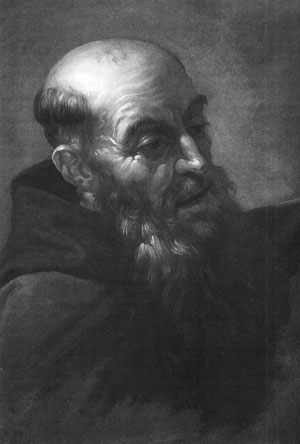
Saint Lawrence of Brindisi
Father Lawrence served in practically every office of his order, from teacher to seminary rector to Provincial Superior to Definitor General, Commissary General, and finally Vicar General. In this capacity he healed many wounds of division, reformed lax monasteries, and, consequently, made both friends and enemies, but far more of the former. As Vicar he established many new religious houses for the Capuchins in Bavaria, Bohemia, and Germany, while making his dutiful visitation of other houses of the order. These visitations gave him the opportunity to preach to the Lutherans and other heretics. The clarity of his arguments, his gifted oratorical skills, in fact his very demeanor, which could inspire both trust and reverential fear, won thousands back to the true Faith.
In addition to these responsibilities he was often called upon by the pope or the emperor to go on diplomatic missions to settle disputes between rulers and nobles, forge alliances, and effectively build up a more united Christendom among the Catholic sovereigns. Whether it was to negotiate a treaty between France and Spain, or reconcile the Archduke of Naples with his Hapsburg sovereign in Spain, or to convince Philip III to join the Catholic League in raising an army to fight the Turks, the Capuchin preacher was man for the job. Although not always successful, what he was able to accomplish on the diplomatic level at least gave the empire enough stability wherein the great saints and reformers of the counter-reformation could achieve most of their goals without too much persecution.
Sanctity and Miracles
It would be hard to question the holiness of a man who worked miracles and expelled demons as frequently as this humble Capuchin and who would regularly be taken up into an ecstasy during his Mass. While he was Provincial Superior he cured a blind man in front of many witnesses. At the court of Philip III of Spain he cured a woman who was paralyzed. Once while stopping with some companions at an inn a rowdy customer began to ridicule the friars. Getting no reaction he resorted to blasphemy and even mocked the crucifix that the saint was wearing. “To vindicate the honor of this cross which you have blasphemed, may God punish you!” Immediately the man dropped dead to the floor before the stunned diners. Finally, at Milan, there was a young boy covered with sores and so deformed that he could not remove his head from his left shoulder while his right arm was held fast to his chest. After receiving a blessing from Father Lawrence the boy’s wounds dried up and his head and limbs were set free in the sight of family and neighbors.
On some of his missionary tours into heavily Protestant regions Father Lawrence had to be accompanied by a military escort of twenty-five soldiers. Once they were ambushed by about seven hundred militant Protestants. That large a number of armed fanatics made the escort pause momentarily as to what recourse they might have, whether to make a run for it, and maybe survive, or surrender and die. The holy priest made the choice for them: “Charge them,” he shouted, as he raced ahead to confront the enemy. The rout was a miracle. Twenty-five soldiers gave chase to seven hundred would-be murderers.
Francis Visconti, a colonel who headed one of these escorts, went to confession to Father Lawrence and received a rather unusual penance. He was required to serve his confessor’s Mass and kneel on his bare knees. After some time the pain became too much for the officer and he made as if to rise and rest. The saint waved a finger at him indicating that he should remain. Several hours passed and the officer’s exhaustion was about to topple him over, when, to his amazement, he saw the priest rise off the ground suspended three feet from the floor. The Mass lasted ten hours and the colonel persevered to the end.
There were two favorite expressions of Lawrence of Brindisi. One was the exclamation “Ah simplicita,” which he would utter whenever a temptation or a challenging crisis would pass. It was his way of instilling in others a filial trust in the providence of God. Another, which was his customary greeting with other religious, was the Latin prayer: Nos cum Prole pia benedicat Virgo Maria. (May the Virgin Mary bless us with her holy Child.) Father Thomas Feeney, the brother of Father Leonard, used to salute all the religious, even lay people who knew the response, with this prayer. He would say the first part and the recipient would reply, benedicat Virgo Maria. It is still the customary greeting among the Slaves of the Immaculate Heart of Mary.
Theologian
Father Lawrence was thoroughly loyal to the Franciscan school of theology. He believed, as did Saint Bonaventure and other Franciscan theologians, that the Son of God would have become man even if Adam had not fallen. “God is love,” he reasoned, “and all his operations proceed from love. Once he wills to manifest that goodness by sharing his love outside himself, then the Incarnation becomes the supreme manifestation of his goodness and love and glory. So, Christ was intended before all other creatures and for his own sake. For him all things were created and to him all things must be subject, and God loves all creatures in and because of Christ. Christ is the first-born of every creature, and the whole of humanity as well as the created world finds its foundation and meaning in him. Moreover, this would have been the case even if Adam had not sinned.”
The Battle of Stuhlweissemburg
Imagine if you were a commander facing a well-armed enemy of 80,000 foot and calvary and your troops were outnumbered four to one. You’ve had several skirmishes with the foe, but the big battle would be in a day or two. This gives you time to evaluate the situation, make a strategic retreat, negotiate terms, or do battle. You have a chaplain reputed to be a saint and he works miracles. You know the man and you believe that his reputation is well deserved. When you ask his advice he tells you to prepare for battle and trust God and His holy mother.
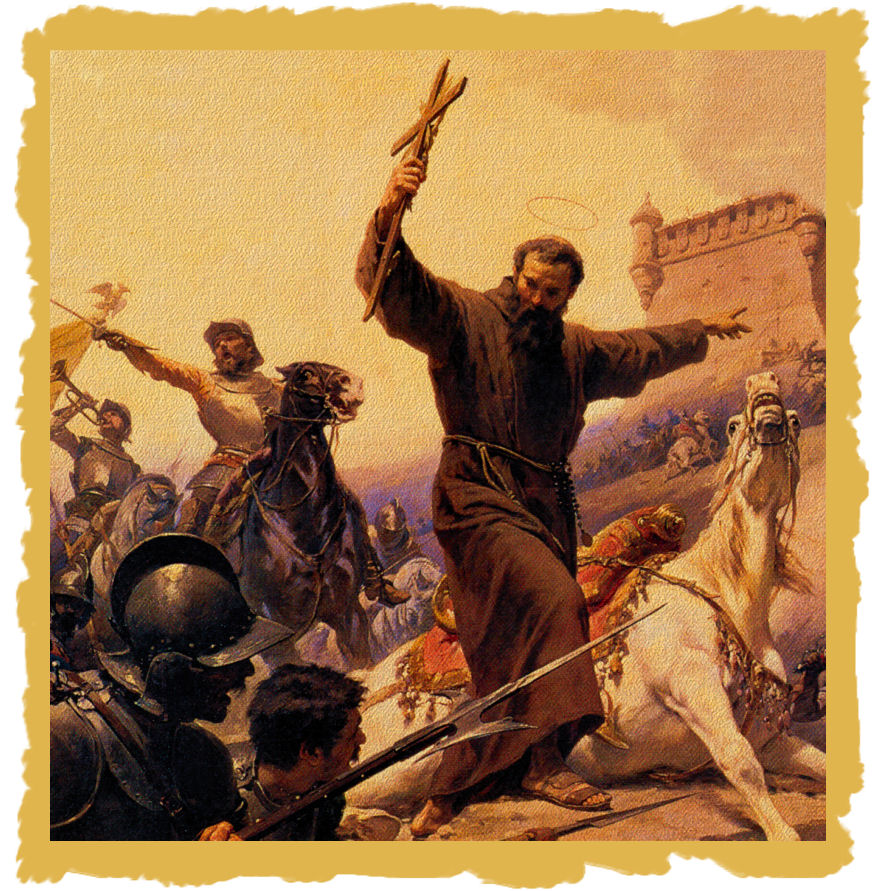
This is what happened that October day in 1601 in Hungary, just twenty-three years after the Moslems were defeated in the Mediterranean Sea in the Battle of Lepanto. The saint rallied the troops and led the charge into the enemy lines. Bullets, arrows, and canon balls flew all around him as he held the crucifix on high. One of the bullets miraculously got lodged in his hair. Scimitars were being swung at him from every direction but never did a blade even graze his flesh. Five horses fell wounded beneath him as he galloped back and forth urging the brave warriors to fight on for the victory would be theirs. It was far from an easy victory, but at the end of the day the Turks were routed; they would be back again, and defeated again, eighty years later, at the gates of Vienna. Among those who fought for the empire and Christendom in this battle were bands of German Lutherans. Many of these converted after witnessing the heroism of Father Lawrence and the divine protection so visibly allotted to him. The Moslems were convinced that they were defeated by a “Christian magician.”
His Written Works
Most of the thousands of written sermons of Saint Lawrence have been lost, but there are about eight hundred extant. These are all in Latin except for nine in Italian. Usually the saint did not write out his sermons, although he would spend hours preparing them, and he always preached in the vernacular. When Pope Clement sent him in 1605 to preach to the Protestants in Germany, he spoke with such a command of the language, and with such a mellifluous voice, that even in those areas where dialects often varied considerably the people could understand him perfectly. He was the most effective preacher of his day winning many back to the true Faith and back to the sacraments. It was not only his eloquence and great learning that wrought conversions, but the miracles that followed him everywhere. The great theologian, Cardinal Cajetan, a contemporary, said that Padre Lorenzo was “an incarnation of the old apostles, who, speaking to all nations, were understood by all. He is a living Pentecost.”
The saint’s Complete Works, Opera Omnia, were not published until 1964. They consist of ten quarto volumes. The reason it took so long to publish the works of this prolific doctor was due to the difficulty in reading the manuscripts. He often used shorthand, and that was of his own making.
The first volume of the saint’s writing to appear was the Mariale, in 1928. It consisted of eighty-four sermons on Our Lady, eleven of which were dedicated to the Immaculate Conception. His one apologetical work was the Lutheranismi Hypotyposis (the Image of Luther), which grew out of his disputes with the Lutheran preacher, Polycarp Laiser. Part II of this opus is a masterful defense of the necessity of faith and good works and refutation of the sola scriptura error of the heretics. Part I is a historical study of Luther and the rise of Protestanism. Part III, actually titled Hypotyposis of Polycarp Laiser, is a study of the effects of Protestant doctrine in practice, morally and socially. There are also five sermons on Saint Joseph, whom the holy doctor connects with the Incarnation as an indispensable instrument in the work of redemption.
What is inexcusable, however, at least since 1969, is that so few of this great doctor’s works are translated into English. I could find only one sermon on Our Lady, although there are undoubtedly more. Even Pope John XXIII’s declaring him Doctor of the Church in 1959 did nothing to spur on English translations of his works.
Death
Lawrence of Brindisi died while on a diplomatic mission on behalf of the leading citizens of Naples who were suffering under the injustices of their Viceroy. It was 1619, and he had hoped to retire on account of the huge toll his labors had taken on his health. To achieve this he would have to travel to Portugal to request the interference of the King of Spain, who also ruled Portugal at that time. Before departing from Genoa he informed certain companions that he would not return. After successfully gaining the support of Philip III, his feeble body broke down. Three days of intense suffering followed. Finally, in Lisbon, on his sixtieth birthday, July 22, 1619, Lawrence of Brindisi, the Doctor Apostolicus (Apostolic Doctor) died.



