

Initial Catholic Reactions to the Establishment of the State of Israel
At midnight, on May 14, 1948, the British Mandate for the Administration of Palestine — first assigned by the Supreme Allied Council in 1920, and confirmed by the League of Nations in 1922 — expired.
Eight hours earlier, shortly after 4 pm on May 13, 1948, the Jewish People’s Council in Tel Aviv, declared “the establishment of a Jewish State in Eretz-Israel, to be known as the State of Israel.”
Eleven minutes after midnight, on May 14, 1948, U.S. President Harry Truman personally signed a public statement recognizing the Provisional Government of Israel as “the de facto authority of the new state.”
On May 17th, three days after Israel’s conditional recognition by the United States, the U.S.S.R., under the leadership of Marshal Joseph Stalin, became the first government to extend formal, de jure recognition to the Jewish State. The Soviet Union would go on to become Israel’s principal arms supplier — via Czechoslovakia — in the first Arab-Israeli war.
The reaction in the Catholic world to the creation of Israel was not celebratory.
The only Catholic majority countries to recognize Israel in 1948 were Soviet bloc satellite regimes, or a handful of Latin American republics which were client states of the U.S.
Diplomats in Catholic Ireland were skeptical of the right of the United Nations to partition small countries and hoped for a unitary Palestinian state with guarantees for the Jewish minority.
One of the original belligerents against Israel in the first Arab-Israeli war of 1948-1949, was the Republic of Lebanon, a Christian nation with a Catholic president.
Most Catholic states in Western Europe and Latin America did not extend diplomatic recognition to Israel until the armistice, pausing hostilities between Israel and its Arab neighbors, in 1949.
Portugal and Spain were exceptions, only establishing diplomatic relations with the Jewish State in 1977 and 1986, respectively.
The Holy See, committed to the internationalization of Jerusalem, concerned over the custody of the Holy Places, and supportive of the rights of Palestinians, both Christian and Muslim, declined to recognize the Jewish State.
Pope Pius XII, who had appointed an Apostolic Delegate to Jerusalem and Palestine in February of 1948, issued no less than three encyclicals in 1948 and 1949, calling for a just peace in Palestine and guaranteed access to the Holy Places.
In his second encyclical on Palestine, In Multiplicibus Curis, issued in October of 1948, the Pope decried “the destruction and damage of sacred buildings and charitable places” — desecrated and looted by Israeli soldiers — and expressed sympathy for those suffering “the fear of the terrorized,” and for “thousands of refugees, homeless and driven…from their fatherland in search of shelter and food.”
In his third encyclical on Palestine, Redemptoris Nostri Cruciatus, issued in April of 1949, after the cessation of hostilities, Pius XII again recalled the plight of the Palestinians, and the targeting of Christian institutions, stating:
“We are still receiving complaints from those who have every right to deplore the profanation of sacred buildings, images, charitable institutions, as well as the destruction of peaceful homes of religious communities. Piteous appeals still reach Us from numerous refugees, of every age and condition, who have been forced by the disastrous war to emigrate and even live in exile in concentration camps, the prey to destitution, contagious disease and perils of every sort.”
The Pope was referring to the Nakba, or catastrophe, where more than half of the population of Palestine was permanently displaced in 1948 and 1949.
While some Israeli historians place the number of Palestinian refugees at no more than 500,000, and claim that they were encouraged to leave by Arab leaders, Palestinian sources, international institutions and so-called Israeli “new historians” record the number at between 700,000 and 750,000, and describe the flight as an expulsion caused by massacres, bombardments, forced displacement and psychological warfare.
In the language of the 21st century, this campaign of state sponsored terror would be characterized as ethnic cleansing.
In the end, a 32%, partly alien minority, dispossessed a 68%, wholly native majority of 77% of their country.
As Christians comprised eleven percent of the Arab population of Mandate Palestine in 1948, it is likely that the Israelis expelled approximately 80,000 Christians, more than two-fifths of them Catholics, from their homes and villages.
Catholics in America Come to Support Israel
In the decades that followed, Catholics in the Anglosphere, particularly in the United States, developed a more benign attitude towards the Jewish State.
The lack of Palestinian voices in the media, the academy and the American Church; strong support for Israel in the American press; Jewish voters and campaign donors as an integral component of the New Deal coalition; the increasing effectiveness of the Israel lobby; and the growing identification of the Arab cause with the East Bloc, neutralism and the emerging Third World, all caused the American public, including Catholics, to view Israel as a reliable ally in the Cold War and as a plucky underdog in the conflicts of the Middle East.
Prior to the George McGovern presidential candidacy in 1972, most American Catholics supported the Democratic Party.
It was a popular Democratic President, Harry S Truman, who recognized the Jewish State, and it was the first Catholic President, Democrat John F. Kennedy, who, in 1962, lifted the U.S. arms embargo against Israel, which had been imposed by the Truman Administration in 1948, and was continued under the Presidency of Dwight Eisenhower.
Just as Catholics began migrating to the Republican Party in the 1970’s, that party started to promote a more vigorous defense of Israeli interests.
The rise of neo-conservatism, and the awakening of the Christian right, with its dispensationalist, Christian Zionist theology, all served to make the GOP, not the Democratic Party, the principal advocate for the Israeli cause in American politics.
It was Republican President Ronald Reagan who formalized strategic cooperation between the U.S. and Israel in 1981, and who designated Israel a Major Non-NATO Ally (MNNA) in 1987.
By the 1980’s, virtually all Catholic members of Congress, both Democrat and Republican, were supporters of the State of Israel.
When President Donald J. Trump recognized the Israeli annexation of the Golan Heights, removed sanctions on illegal Israeli settlers in the West Bank, and moved the U.S. Embassy to Jerusalem, objections from American Catholics were negligible.
The Fever of Ecumenism
Support for the Jewish State among American Catholics was solidified after the Second Vatican Council.
Nostra Aetate condemned anti-Semitism and absolved the Jews of modern times of any responsibility for Deicide.
Muslims, who could hardly be found in America in the 1960’s, were not the objects of ecumenical enthusiasm. That affection was reserved for mainline Protestants and for the Jewish community.
In one of America’s largest archdioceses, Boston, the ecumenical fever was acute.
Catholic-Jewish Seders were common. In one of the city’s most prominent parishes, the Israeli flag was displayed at church events, alongside Old Glory and the Papal standard.
The Archbishop of Boston was represented by a Delegate at fundraising dinners for the Anti-Defamation League of the B’nai B’rith, despite that organization’s advocacy of abortion and sodomy.
In the midst of all of this came the Six Day War, where support for Israel was so uniform and normative among Catholics, that Irish comedians, visiting Boston for Saint Patrick’s Day, would, as part of their stand-up routine, regale the audience with jokes about Arab soldiers being killed by Israelis.
By the 1980’s, aspiring religious education teachers, in the Confraternity of Christian Doctrine, were required to meet with an official of the ADL, who would warn them about the dangers of anti-Semitism in presenting Catholic dogma.
When the cause of Queen Isabella of Spain was introduced in Rome, America’s oldest Catholic newspaper, The Pilot, published an op-ed piece by the regional director of the ADL, condemning the saintly Queen.
When this writer questioned the Editor of the paper about that unprecedented commentary, she replied “I had no choice. I was ordered to do so.” (Her immediate superior was the Vicar-General.)
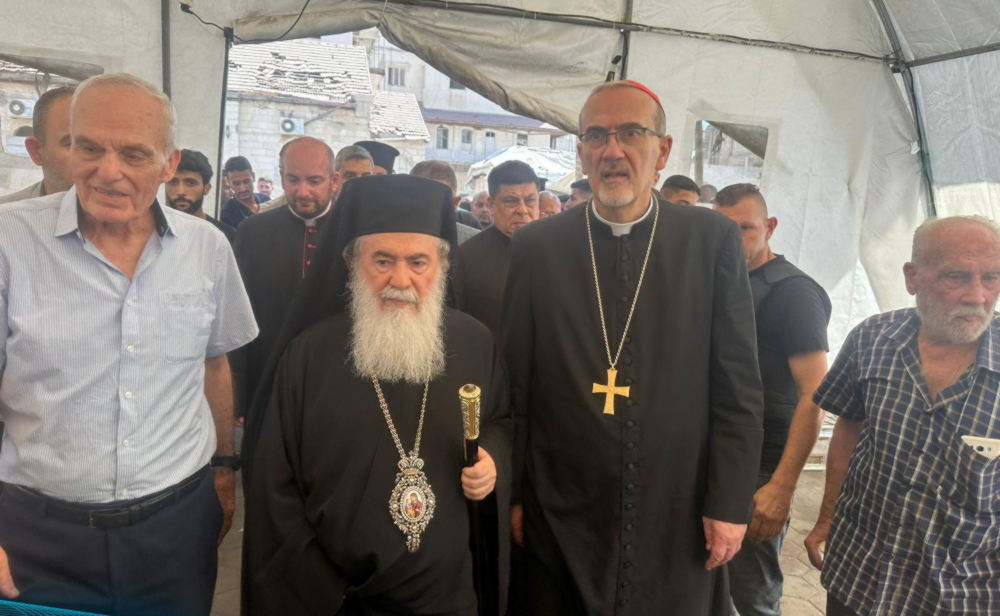
His Beatitude, Pierbattista Cardinal Pizzaballa, Latin Rite Patriarch of Jerusalem (front right), with Theophilus III, the Greek Orthodox Patriarch of Jerusalem, inspecting Gaza. Image, courtesy of the Latin Patriarchate of Jerusalem.
The War in Gaza
Despite repeated incursions by Israel into once Christian Lebanon, the flight of Christians from Israeli occupied territories, and the implosion of the Christian population of Iraq, following the Israeli backed U.S. invasion of that country, Catholic support in the United States for Israel remained high into the third decade of the 21st century.
Catholic attitudes towards the Jewish state began to change following the surprise terrorist attack by Hamas against Israel on October 7, 2023.
Hamas killed more than 1,200 Israelis — half of them civilians — and kidnapped, as hostages, 251 Israeli citizens.
It was the Israeli response which shocked the consciences of Catholics.
It was evident from the beginning of the Israeli Defense Forces (IDF) campaign, which emphasized aerial bombing, that Israel regarded the entire territory of the Gaza Strip as a combat zone, that civilians might be afforded a few pro-forma warnings, but no real protection, and that the IDF would not comply with the prohibitions contained in the Geneva Convention and in International Humanitarian Law.
From the commencement of hostilities, civilian deaths and injuries, whether as a matter of deliberate targeting or of depraved indifference to disproportionate collateral casualties, outnumbered, substantially, the losses inflicted upon Hamas militants.
Claiming that Hamas was using the civilian population of Gaza as human shields — in effect, that Hamas was everywhere — the IDF began the systematic destruction of the housing stock and civilian infrastructure of the Gaza Strip.
A January, 2025 report from Doctors Without Borders, stated that 92% of the housing units of the Strip, along with 70% of all structures, have been damaged or destroyed. A May 19th, 2025 statement from the United Nations Relief and Works Agency (UNRWA) confirmed that figure, which comes to 436,000 residential units.
Earlier in 2025, the IDF claimed to have killed 20,000 Hamas militants since the beginning of the war. A July statement from the Israeli Chief of Staff said another 1,300 Hamas militants had been killed in recent fighting.
If that is so, then the IDF has damaged or destroyed more than twenty Palestinian homes for every Hamas fighter killed.
In May, the Times of Israel reported that the destruction of Palestinian homes was a deliberate prelude to ethnic cleansing.
According to the Times, Israeli Prime Minister Benjamin Netanyahu told the Knesset’s Foreign Affairs and Defense Committee that Israel is “destroying more and more houses [in Gaza and Palestinians accordingly] have nowhere to return.”
Netanyahu went on to say that “The only obvious result will be Gazans choosing to emigrate outside of the Strip, but our main problem is finding countries to take them in.”
The forced displacement of Gaza’s civilian population — which would, under International Law, be a war crime and a crime against humanity — was first broached on February 4th, at a joint press conference by President Trump and Prime Minister Netanyahu, where President Trump called for the permanent relocation of Gaza’s population.
By then, it was evident that the Israeli Defense Forces campaign in Gaza was never simply about defeating Hamas, but was intended to reduce Gaza to rubble and ruin, providing the pretext and circumstance for the removal of all Palestinians from the Strip.
According to a June 27, 2025 statement by UNRWA, 1.9 million Palestinians in Gaza — more than 90% of the population — have been displaced, some on multiple occasions.
Housing was not the only Israeli target, however. According to a May 22nd statement by the UN’s World Health Organization (WHO), 94% of Gaza’s hospitals and medical facilities have been damaged or destroyed, leaving only 2,000 hospital beds available for a population of more than two million.
A 2024 statement by Save the Children claimed that nearly 88% of educational facilities in Gaza had been damaged or destroyed.
New figures just released by Human Rights Watch indicate that more than 500 schools and university buildings — many of them used as shelters — have been struck, totaling more than 97% of the educational infrastructure of the Strip.
An August 6, 2025 statement by OCHA (the United Nations Office for the Coordination of Humanitarian Affairs) revealed that, as of July 31st, 61,158 Palestinians had been killed since October 7th of 2023.
Of these fatalities, 4,429 were senior citizens, 9,735 were women, and 18,430 were children. Another 151,442 were injured or wounded.
That means that reported Palestinian casualties amount to 212,600, or nearly ten percent of the Strip’s pre-war population of 2,226,544.
That would be the proportionate equivalent of 35 million American casualties.
Accepting the IDF figure of 21,300 Hamas fatalities, means that more than 65% of all Palestinian fatalities have been civilians, a ratio of civilian to combatant deaths of nearly two to one.
In the Second World War, despite the deliberate targeting of the civilian, urban populations of Germany and Japan by strategic bombing, carried out by the United States and the United Kingdom, the ratio was the reverse.
Civilians accounted for only 37% of German casualties and only 31% of Japanese casualties in the greatest war in history.
Official casualty figures however, do not tell the whole story.
An estimated 14,000 Palestinians are missing and likely buried under the rubble.
Civilian deaths due to secondary causes such as malnutrition, starvation, and unhygienic conditions; lack of access to clean water, medicine and routine health care; the inability of emergency services to reach, locate or transport victims of military strikes; and interruptions in electricity and lack of generator fuel to power incubators, respirators, resuscitation equipment and dialysis machines all compound the reported fatality totals.
According to a January, 2025 study by the British medical journal, Lancet, civilian fatalities in Gaza may be 40% higher than previously reported.
Repeated Israeli blockades and interdictions of food, fuel, and medical supplies bound for Gaza, the mismanagement, by Americans and Israelis, of food distribution centers, and attacks by the IDF on Palestinians seeking food, has left Gaza on the “brink of famine,” according to UN General Secretary Antonio Guterres, who said “Palestinians in Gaza are enduring a humanitarian catastrophe of epic proportions.”
The World Health Organization reported that 63 Gazans, including 25 children, died of starvation in July, while 11,500 children were treated for malnutrition in May and June.
According to the UN affiliated World Food Programme, 500,000 people — nearly a quarter of Gaza’s population — are enduring famine-like conditions, while the remaining population is facing emergency levels of hunger, with 320,000 children at risk for acute malnutrition.
Meanwhile, the IDF is forcing the remaining Palestinian population of the Gaza Strip further south into an enclave — a so-called “Humanitarian City” — comprising only 11% of the Strip’s territory, which former Israeli Prime Minister Ehud Olmert described as a “concentration camp” which will be used for ethnic cleansing.
In May, Olmert wrote an op-ed for the Israeli newspaper Haaretz, titled “Enough Is Enough. Israel Is Committing War Crimes.”
He went on to say “What we are doing in Gaza now is a war of devastation: indiscriminate, limitless, cruel and criminal [in the] killing of civilians. We’re not doing this due to loss of control in any specific sector, not due to some disproportionate outburst by some soldiers in some unit. Rather, it’s the result of government policy — knowingly, evilly, maliciously, irresponsibly dictated. Yes, Israel is committing war crimes.”
Olmert, who called Netanyahu’s government a “criminal gang,” warned that the world was turning against Israel, and his perception of reality was lucid.
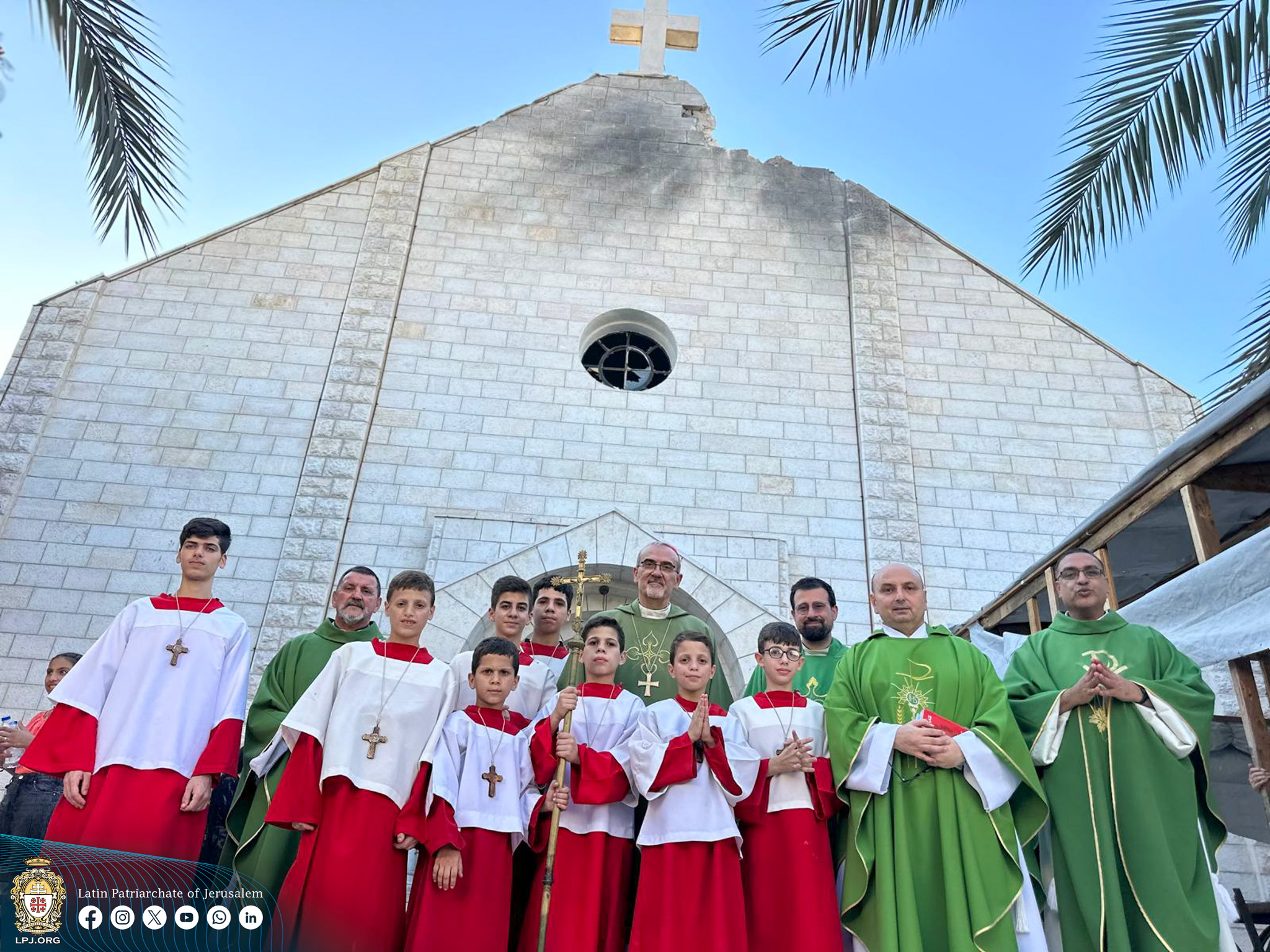
His Beatitude, Pierbattista Cardinal Pizzaballa, Latin Rite Patriarch of Jerusalem (center), with Father Gabriel Romanelli (pastor of Holy Family Church, Gaza, second from right), and other clergy and altar boys in front of the damaged Holy Family Church in Gaza. Image, courtesy of the Latin Patriarchate of Jerusalem.
Attacks on Christians
The indiscriminate killing described by Prime Minister Olmert did not exclude Christian Palestinians, houses of worship, or religious institutions.
On October 19, 2023, less than two weeks into the Gaza War, the Israeli Air Force bombed the Greek Orthodox Church of Saint Porphyrios — one of the oldest churches in the world — located in Gaza City.
Eighteen Palestinian civilians were killed and more were injured. The church was damaged and an adjoining building collapsed. More than 400 Palestinian refugees had sought shelter in the complex.
The IDF claimed it was an accident, with the munitions intended for a nearby Hamas command center.
The Greek Orthodox Patriarchate of Jerusalem called it a war crime.
Eleven days later, on October 30th, the Arab Orthodox Cultural Center in Gaza City, which had been sheltering 3,000 displaced people, was destroyed by the Israeli Air Force. The unexplained attack on the Greek Orthodox institution was deliberate. On October 28th, the IDF ordered the Center’s evacuation. There was a complete property loss, but no casualties.
The Saint Porphyrios compound was attacked a second time on July 29, 2024. The monastery was struck by three 155 millimeter artillery rounds, (one of which failed to detonate) destroying the refectory and causing two walls to collapse, injuring three civilians, two of them seriously.
On June 5th, 2025, Al-Ahli Arab Baptist Hospital — the only Christian hospital in Gaza and the Strip’s only cancer treatment facility — was the target of an Israeli drone strike which killed five civilians and wounded thirty others. It was the eighth time the hospital was attacked since 2023.
Its emergency ward was destroyed in a previous Israeli bombing in April of 2025.
Despite its name, reflecting a brief Baptist ownership, the hospital was founded by Anglican missionaries in 1882, and is affiliated with the Episcopal Diocese of Jerusalem.
Voices throughout the Anglican Communion condemned the attack, with the Church of England calling it “yet another callous, reckless attack…part of a relentless and outrageous pattern of attacks on hospitals and healthcare facilities in Gaza.”
The Episcopal Diocese called upon the international community to “enforce the combatants adherence” to the Fourth Geneva Convention.
The first loss, suffered by Catholics in Gaza, at the hands of the Israeli military, came in November of 2023, when the evacuated Rosary Sisters School, a private Catholic academy in Gaza City, was bombed, burned and bulldozed by the IDF. More than 80% of the campus, including the library, was destroyed.
The center of the Catholic community, Holy Family Parish in Gaza City, first came under Israeli fire in December of 2023.
At noon on December 16th, an elderly Catholic woman was murdered by an Israeli sniper as she walked from the church to the Missionaries of Charity convent. When her middle aged daughter came to her mother’s side, she was shot and killed.
According to a statement by the Latin Patriarchate of Jerusalem, “Seven more people were shot and wounded as they tried to protect others inside the church compound. No warning was given, no notification was provided. They were shot in cold blood inside the premises of the Parish, where there are no belligerents.”
The statement continued: “Earlier in the morning, a rocket fired from an IDF tank targeted the Convent of the Sisters of Mother Theresa. The Convent is home to over 54 disabled persons and is part of the church compound, which was signaled as a place of worship since the beginning of the war. The building’s generator (the only source of electricity) and the fuel resources were destroyed. The house was damaged by the resulting explosion and massive fire. Two more rockets, fired by an IDF tank, targeted the same Convent and rendered the home uninhabitable. The 54 disabled persons are currently displaced and without access to the respirators that some of them need to survive.”
“In addition, as a result of the heavy bombing in the area, three people were wounded inside the church compound last night. Furthermore, solar panels and water tanks, which are indispensable for the survival of the community, were destroyed.”
The Israelis claimed, implausibly, that the Catholic parish housed a rocket launcher.
The second fatal attack on Holy Family Parish — one which drew the attention of the world — came at 10:20 am on the morning of Thursday, July 17, 2025.
The gunner on an Israeli tank fired a shell — apparently at the Cross atop the church — which chipped the facade next to the Cross and then landed on the roof, spreading shrapnel, which killed three civilians in the courtyard and wounded nine others, including the Parish Priest, Father Gabriel Romanelli.
The cannon on a tank is a gun, not a howitzer, or a long range piece of naval artillery. It is a line of sight weapon. The gunner, like a sniper, can see what he is firing at.
Catholics Finally React
With the second attack on Holy Family Parish in Gaza, the proverbial dam burst. All of the Catholic reticence about criticizing Israel, from reasons relating to papal diplomacy, ecumenical relations, loss of philanthropic support, or fear of charges of anti-Semitism, was swept away in a torrent of outrage.
The Holy See responded immediately. A telegram from the Secretary of State, Cardinal Pietro Parolin, assured the Catholics of Gaza of the Holy Father’s “spiritual closeness” to them, and reiterated his call for an immediate ceasefire.
The Latin Patriarch of Jerusalem, Cardinal Pierbattista Pizzaballa, who had offered himself as a hostage to Hamas in exchange for Israeli children, decried the attack as the “targeting of innocent civilians and of a sacred place,” adding “this tragedy is not greater or more terrible than the many others that have befallen Gaza. Many other innocent civilians have also been harmed, displaced and killed. Death, suffering and destruction are everywhere.”
He went on to call the war “humanly and morally, unjustified.”
In a forceful message, the Franciscan Custody of the Holy Land condemned “an attack from the Israeli army, which targeted the parish of the Holy Family.”
The message from the Custody went on to “strongly denounce the unacceptable and cynical reality in which defenseless civilians, places of worship, and humanitarian structures become targets of violence and destruction.”
A July 18th statement by the Patriarchs and Heads of the Churches in Jerusalem referred to the “heinous attack by the Israeli army,” and said “we strongly denounce this crime.” The statement called for an immediate ceasefire.
On July 18th, the day after the attack, Cardinal Pizzaballa, together with Theophilus III, the Greek Orthodox Patriarch of Jerusalem, entered Gaza to express solidarity with the Christian community and all of the suffering residents of Gaza, and to bring food and medical supplies to the beleaguered population.
Upon returning to Jerusalem, Cardinal Pizzaballa, addressed the worsening humanitarian crisis in Gaza, stating:
“Humanitarian aid is not only necessary — it is a matter of life and death. Refusing it is not a delay, but a sentence. Every hour without food, water, medicine and shelter causes deep harm.
We have seen it: Men holding out in the sun for hours in the hope of a simple meal. This is a humiliation that is hard to bear when you see it with your own eyes. It is morally unacceptable and unjustifiable.”
The Cardinal went on to say “There can be no future based on captivity, displacement of Palestinians or revenge.”
The language of Catholic aid organizations was even more direct.
The Catholic Near East Welfare Association and its Pontifical Mission condemned “the unconscionable military attack” on Holy Family Parish, calling the incident “totally unjustified.”
Caritas, another Pontifical agency, stated “History will not forgive this barbarism…”
In a devastating and comprehensive indictment of Israeli war crimes, Caritas said “The whole Gaza Strip is being bombed and razed to the ground to clear the strip and make it uninhabitable. Hundreds of thousands of Palestinians are being slaughtered: the official numbers are only those who have been certified dead at health facilities and we know many, many more have been killed.”
“People are being starved to the point of famine. Children are bombed while waiting for therapeutic nutrition and vaccines. People are shot by the dozens daily while queuing for water and food. Food, water and other basic necessities are systematically blocked and withheld at anything other than tokenistic levels.”
“Medical facilities are destroyed and overwhelmed, killing patients and medical staff. Hundreds of aid workers and journalists have been killed in the line of duty. The Israeli Government is planning to forcibly evict the entire population of almost 2 million people of Gaza to a non-existent camp in Rafah…”
Even Pope Leo’s position seemed to harden. In his telegram of July 17th, he called for a ceasefire and spoke of the need for reconciliation.
The tone, content, and emphasis of his Angelus address on July 20th were quite different. Referring to “last Thursday’s attack by the Israeli army on the Catholic Parish of the Holy Family,” the Pontiff declaimed “I again call for an immediate halt to the barbarism of the war and for a peaceful resolution of the conflict.”
Then, in a pointed instruction on the core tenets of both international law and Catholic just war doctrine — aimed at the government of Israel — Pope Leo said “I renew my appeal to the international community to observe humanitarian law and to respect the obligation to protect civilians, as well as the prohibition of collective punishment, the indiscriminate use of force and the forced displacement of the population.”
The three prohibitions cited by the Pope were a direct and undisguised criticism of Israeli practices.
Two days before the Holy Father’s Angelus Message, Cardinal Parolin called the Israeli campaign in Gaza “a war without limits,” and questioned whether the attack on Holy Family Church was deliberate, a doubt also expressed by Cardinal Pizzaballa.
The most explicit denunciation of Israel by a high ranking Catholic prelate came from Cardinal Augusto Lojudice, the Archbishop of Siena, who, in an interview with the Italian newspaper, La Stampa, said Netanyahu is “not stopping because he is a tyrant pursuing a dark and bloodthirsty plan for power.”
Lojudice accused Israel of “evil without logic” in Gaza.
After a telephone call from President Donald Trump, Prime Minister Netanyahu called Pope Leo on July18th.
The day before, the Prime Minister’s office released a statement which read “Israel deeply regrets that a stray ammunition hit Gaza’s Holy Family Church. Every innocent life lost is a tragedy. We share the grief of the families and the faithful.”
The West Bank
Israeli attacks on Christians have not been limited to Gaza. Since June, there have been four attacks by Israeli settlers upon the last entirely Christian village in the West Bank, Taybeh.
On June 26th, approximately 100 armed Israeli settlers entered Taybeh, attacking homes, setting fires and burning vehicles.
According to Father Bashar Fawadleh, parish priest of the Latin Rite Church of Christ the Redeemer in Taybeh, “Settlers are grazing their cows on a hill planted with olive and barley fields right next to people’s homes. Locals see this as part of a systematic effort to strangle them economically and push them out.”
“These days we are living under fire, barbarism, and brutality of the settlers,” Father Fawadleh said, noting that they are conducting their attacks under the direct protection of the Israeli army.
The second attack on the Christian village occurred on July 7th, when settlers ignited fires next to both the local Christian cemetery and the ancient Church of Saint George. The site includes both the ruins of a fifth century church and a modern Greek Orthodox parish.
The three parish priests of Taybeh — Latin Rite, Melkite and Greek Orthodox — issued a joint statement on July 8th, where they warned that the fire could have had catastrophic results for one of the oldest Christian landmarks in Palestine.
They also condemned repeated incursions by Israeli settlers against Christian farms, where cattle are brought, unlawfully, to graze on agricultural lands, trampling crops and endangering the olive trees upon which Christian farmers depend for their livelihoods.
A third arson attack was perpetrated on July 11th, when fires were set near Christian homes, and Saint George was, once again, imperiled.
These three arson attacks prompted a forceful, public response from the Council of Patriarchs and Heads of Churches in Jerusalem, who traveled to Taybeh on July 14th.
In a statement released that day from the West Bank town, the Christian religious leaders said the settler attacks were “a direct and intentional threat to our local community first and foremost, but also to the historic and religious heritage of our ancestors and holy sites.”
The Patriarchs and prelates not only condemned the arson attacks and land seizures, but denounced the billboard erected by the settlers, which told Christians “there is no future for you here.”
They also demanded an investigation into “why the Israeli police did not respond to emergency calls from the local community and why these abhorrent actions continue to go unpunished.”
In a stunning development, five days after the visit to Taybeh by the Christian spiritual leaders of the Holy Land, the Mayor of Taybeh received the United States Ambassador to Israel, His Excellency, Mike Huckabee.
Huckabee, an ordained Baptist minister and former Arkansas governor, has long been known for his Christian Zionist beliefs.
Surprising the world and astonishing the Israeli public, Huckabee issued a statement which said “To commit an act of sacrilege by desecrating a place that is supposed to be a place of worship, it is an act of terror, and it is a crime. There should be consequences, and it should be harsh consequences…”
Huckabee went on to describe the attack on Saint George as “an absolute travesty,” whose perpetrators need to be “found and prosecuted.”
In what was perhaps the first time in eight decades that the U.S. Government expressed solicitude for Palestinian Christians, Huckabee continued:
“We come to express solidarity with the people who just want to live their lives in peace, be able to go to their own land, be able to go to their place of worship. This is a Christian community…and it’s one that deserves respect and deserves to be treated with dignity. Nothing short of that.”
Despite the visit by the Patriarchs and the public rebuke from the U.S. Ambassador, settler thugs struck Taybeh again in the early morning hours of Sunday, July 27th.
Houses were stoned, three vehicles were torched, there was an arson attack on a home, and threatening messages were scrawled on walls.
In a July 29th statement, the Patriarchs and Heads of Churches condemned not only the attack but the “climate of impunity” which enabled it, complaining that “Israeli police…reduced the matter solely to property damage, omitting the broader context of systematic intimidation and abuse.”
The prelates also revealed that “Only days ago, settlers forcibly entered Taybeh, herding livestock into the heart of the town. Masked individuals — some armed, others on horseback — roamed the streets, spreading terror and threatening the sanctity of daily life.”
The attacks on Taybeh are part of a wider campaign of settler violence. According to a July 15 press release from the United Nations Office of the High Commissioner for Human Rights, “During the first half of 2025, there have been 757 settler attacks that resulted in Palestinian casualties or property damage…”
The Armenian Quarter
No examination of current Israeli hostility towards Christians would be complete without some understanding of the combination of extremist violence and municipal extortion afflicting the inhabitants of the Armenian Quarter of the Old City of Jerusalem.
The Armenian presence in Jerusalem dates back to the fourth century, shortly after Armenia became the world’s first Christian nation.
A July report from the Religious Freedom Data Center, on Israeli anti-Christian incidents, in the second quarter of 2025, revealed that half of all hate crimes in Jerusalem occurred in the Armenian Quarter.
Incidents included spitting, verbal abuse, vandalism, trespassing and desecration or disrespect of holy sites.
These episodes are against a backdrop of Israeli real estate speculators, fronting for settler groups, attempting to acquire land in the Armenian Quarter.
When the fraudulent land deal fell through, the Jerusalem Municipality began applying financial pressure to the Armenian Patriarchate, claiming that it owed the municipal government $5.7 million in back property taxes, known as the Arnona tax.
The Municipality threatened to foreclose on the Patriarchate and auction off its real estate holdings, which the Armenian Patriarchate maintained were traditionally tax exempt under the so-called Status Quo, governing Christian holy sites in the Old City.
In a February, 2025 statement, the Patriarchs and Heads of Churches called the planned foreclosure “unjust,” the Arnona debt “unverified and exorbitant,” and the whole proceeding “legally dubious and morally unacceptable.”
Efforts at foreclosure are currently paused, but the threat still hangs over the Armenian Patriarchate.
An Inflection Point
On July 30, 2025, for the first time in American history, a majority of the Democratic Caucus in the United States Senate voted to oppose an arms transfer to the State of Israel.
Two days earlier, U.S. Representative Marjorie Taylor Greene (R-GA) became the first Republican Member of Congress to use the word genocide to describe Israel’s conduct of the war in Gaza.
A poll, released by the Gallup Organization on July 29th, revealed only 32% of Americans support Israel’s campaign in Gaza, while 60% disapprove. The same survey revealed that Prime Minister Benjamin Netanyahu has a 52% unfavorable rating among Americans, with his approval rating standing at only 29%.
A June, 2025 Quinnipiac University poll found that American support for Israel had reached an all time low of 37%, while U.S. support for Palestinians had reached an all time high of 32%. For the first time in the history of polling, those numbers are now competitive.
An April, 2025 survey by the Pew Research Center found that 53% of U.S. Catholics (along with 50% of mainline Protestants) held an unfavorable view of Israel.
Support for Israel was strong only among U.S. Evangelicals, the religiously unaffiliated, and in the Jewish community.
Whether appalled by the death and human suffering inflicted upon Gaza, or suspicious of Israeli efforts to entangle the United States in a conflict with Iran, an increasing number of American conservatives have spoken out in criticism of the government and policies of Israel.
In addition to Congresswoman Greene, those critics include former Trump strategist Steve Bannon, former Fox News host Tucker Carlson, former Congressman Matt Gaetz, Congressman Thomas Massie (R-KY), Washington Times columnist Michael McKenna, Judge Andrew Napolitano and political commentator Candace Owens.
Bannon, McKenna, Napolitano, and Owens are Catholics.
Whether it can be characterized as a sea change, a paradigm shift, or an inflection point, the once broad, enduring and unquestioned consensus, of reflexive support for the State of Israel, among Americans, and among American Catholics, has dissolved.
Support or opposition to Zionism is now conditioned by partisan, generational, ethnic, and sectarian considerations.
Demographic and generational trends suggest support for Israel will continue to decline, with or without the accelerant of Benjamin Netanyahu slaughtering Palestinian civilians.
Lessons to Learn
What can Catholics learn from the tragedy and the crime that is the Gaza War?
First, the Church must make a more effective effort at catechizing the faithful about Catholic just war doctrine.
That might end the moral schizophrenia of pious Catholics vehemently opposing the killing of innocent children with vacuum suction machines, while passionately supporting the killing of innocent children with 2,000 pound bombs.
Abortion fanatics defame the pro-life movement by claiming it is not really pro-life, only anti-abortion. When it comes to the war in Gaza, that criticism, in some cases, is not entirely unwarranted.
Secondly, Catholics must never again make the mistake, so common since the 1960’s, of placing amicable inter-faith relations with a non-Catholic group over a robust solidarity with their fellow Catholics.
That was an imprudence, an abandonment, and a betrayal.
The Catholics of Palestine, Lebanon, Syria, and Iraq deserve the unfailing support of the Catholics of America, whose affluence, resources, and political influence, properly deployed, might have prevented the near extinction level losses, those Catholic communities, outside of Lebanon, are experiencing today.
Finally, there is a growing confluence between Catholic just war teaching, international humanitarian law and the desire by most Americans to abstain from the neo-conservative enterprise of wars for regime change.
That might be the basis for a political alliance to restore the United States as a constitutional republic, which, in the words of our First President, would “steer clear of permanent alliances,” avoiding “overgrown military establishments,” and excluding “inveterate antipathies against particular Nations and passionate attachments for others.”
Our Lady of Palestine, pray for us!
C. Joseph Doyle is the Executive Director of the Catholic Action League of Massachusetts



